
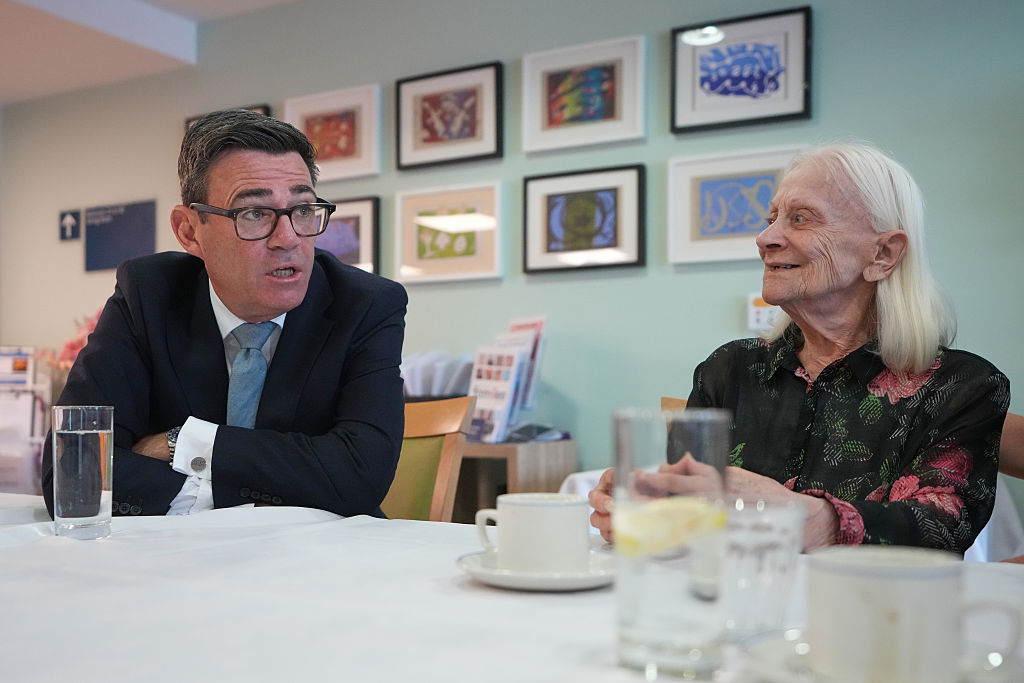
“Grasp the nettle”, “rip the plaster off” – whatever metaphorical cliché you choose, Andy Burnham is serious about fixing social care. The Prime Minister used his big pre-conference interview with the BBC’s Laura Kuenssberg to set out his vision for an NHS-style system for universal social care, free at the point of use and paid for by “everybody”.
This issue, the PM stressed, was too important to ignore, to put in the “too difficult” basket and kick down the road as countless past politicians have done. That’s why he was going to prioritise it. How? By coming up with a plan and putting it front and centre Labour’s next manifesto.
This means, of course, that there is little chance of seeing any change until after the next election – not due until summer 2029. That’s nearly three years away.
On the one hand, this is probably the amount of time it takes to come up with a detailed, workable, fully-costed plan that can be put to the electorate, especially given Burnham has said he is waiting for Baroness Casey to advise on how to fund it, and Casey’s report isn’t due until summer 2027.

On the other, it’s not all that different from what Keir Starmer promised. The recently departed prime minister was not as explicit about the kind of social care model he favoured, but the promise of the “National Care Service” was in the 2024 manifesto. It was Starmer who commissioned Casey to do her review, which was originally due in 2028 – presumably with the aim that the recommendations would be Labour’s offering in the next election. Burnham as brought the deadline forward a little, but the overall plan – promise progress, wait for Casey, go to the country – seems very similar.
What is different is the emphasis: the decision by Burnham to make social care his conference centrepiece and make the case for why it’s necessary (even if it means finding a way to pay for it) in blunt and explicit terms. Starmer, a prime minister who seemed allergic to making a strong moral argument for what he wanted to do, has been replaced by one for who sees making the moral argument an integral part of the job.
But still, we are left with questions, namely: how is this going to be paid for? The price tag estimated by the Health Foundation is £18.5bn by 2035/36. Burnham has dismissively suggested it wouldn’t be that high, but Andrew Dilnot – the expert who led a social care reform commission 15 years ago depressingly similar to the one Casey is undertaking now – thinks that figure is actually an underestimate for the type of universal model the Prime Minister seems to want. Dilnot’s own commission recommended a lifetime cap on care costs of £35,000, with individuals paying a contribution towards their care before the state stepped in. The Health Foundation has modelled a scenario where that cap is raised to £86,000 over a lifetime, at a cost to the taxpayer of £4bn a year by 2035/36. But that isn’t the direction Burnham has indicated.
Instead, we are getting rumours that officials are looking at scrapping the triple lock – the mechanism that ensures the state pension rises each year in line with earnings, inflation or by 2.5 per cent, whichever is higher.
There are several good reasons to review the triple lock. When it was implemented in 2011, it was intended as a temporary measure to address pensioner poverty and enable pensions to catch up with wage growth. A decade and a half later, it has become a cornerstone of British welfare policy, to the extent that even pointing out that it has achieved its stated goal provokes a furious backlash. Today, pensioners are significantly less likely to be living in poverty than working-age adults and half as likely as children and pensioners on average have more disposable income than non-pensioners. All this against backdrop of stagnating wages: according to the Institute for Fiscal Studies, if the state pensions had risen in line with average earnings since 2010, it would be worth 12 per cent less – a drop of approximately £1,500 per year.
The policy is also forecast to cost £15.5bn a year by 2030, making it an attractive target for politicians looking for large amounts of cash, even if diverting money away from pensioners have proved politically toxic (just ask Rachel Reeves about the winter fuel allowance). Perhaps the thinking within government is that the outcry would be less damning if savings from reforming the triple lock were going towards more spending on the same demographic in eliminating their care costs. If that moral argument could be made – and remember, Burnham likes making moral arguments – it would be a welcome change to the usual Westminster mindset that the costs of an ageing population must fall on a shrinking pool of struggling younger workers.
But there are some big caveats. For a start, any savings from reforming the triple lock accrue gradually, year by year, and are impossible to predict as we don’t know what inflation and wage growth figures will be. It’s a relatively modest annual saving that adds up, not a designated pot of money that could be reassigned for a huge new social care model.
It would also potentially mean taking money away from some of the poorest pensioners – those with no assets whose only income is the state pension – to fund the care of the richest whose assets, which could be worth millions (more than one in five over-65s live in households worth over £1m), would remain untouched.
One can argue that this wealth has been earned and taxed over a lifetime, and it’s not fair to expect it to go towards the care of those who hold it, anymore than it would be to deny them NHS healthcare. That’s a valid argument – indeed, it’s the argument Labour made in 2017 when Theresa May proposed a social care solution that would have required those with assets to contribute to their own care. May’s proposal, lest not forget, lost her a majority.
But the alternative is taking the money from people who may have no assets at all – be they pensioners (via reforming the triple lock) or workers for whom stagnating wages and the rise in property prices mean it is looking highly unlikely they will ever get to acquire any (via general taxation). That doesn’t seem to fit with the Burnham vision of “fairness”, and even if it did, it’s a bold policy to put in a manifesto for an election that, right now, already looks pretty dicey.
There is a reason why reviews on social care, both those commissioned by the government and research done by think tanks, have shied away from an NHS-style model, instead recommending caps and social insurance schemes that would require a certain level of individual contribution. And even then, the cost has proved too high for successive governments, which have balked at the idea of telling the electorate some of the money is going to have to come out of their pockets. It’s been three decades since Tony Blair launched a royal commission on the topic, and the result of those years of delay and failure is an expensive, heartbreaking mess. Burnham is right to view tackling it as a moral imperative.
But what we have seen so far isn’t grasping any nettles or ripping off any plasters. It’s a vague and currently unrealistic promise, years on the horizon. Now where have we seen that before?
[Further reading: Wes Streeting’s Blue Labour turn]
Content from our partners



Related
Join the debate
Subscribe here to comment