
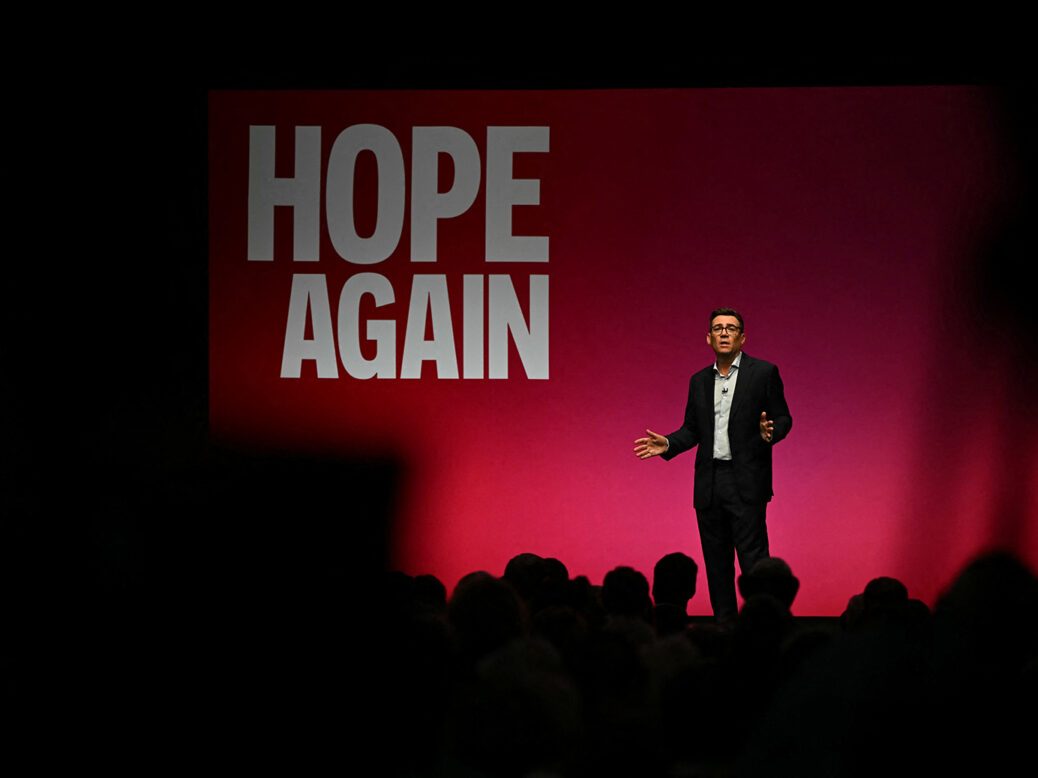
Sunshine and rain greeted Labour’s delegates in Liverpool for this year’s conference, literally and metaphorically. While the weather couldn’t make up its mind, the Labour Party finally did after a decade in which it has swung from the left to the right. It has settled on the soft-left tradition slap bang in the middle of the party: Andy Burnham’s most fervent supporters would call this the “heart” of Labour. Those who dare to dissent even at this moment, the peak of his honeymoon period, suggest it is simply the party’s comfort zone. “Today, we draw a line on a decade of division,” Burnham told the Labour Party Conference in his first speech as leader on 29 September. He meant the country, with its seven prime ministers in the last ten and a bit years, but the PM might just as well have been talking about the Labour Party.
Those headline announcements in full: the end of the pension triple-lock, from 2030, with the savings used to pay for a new national care service that provides social care free at the point of use, on the NHS model. A new help-to-buy scheme offering ultra-low deposit thresholds for first-time home-buyers. An end to the bar on public ownership of water companies, first brought in by Margaret Thatcher. A new relationship with Europe (whether that’s a customs union or something more radical remains to be seen). A new Great British Grid to challenge private energy providers. And, perhaps most consequentially for British politics, a Labour Party that is committed to ending the first-past-the-post electoral system.
As he began, Burnham promised a “real speech”, heavy on substance as well as rhetoric. It amounted to a full-scale programme for government – one he envisages taking ten years to implement. Having identified one of Keir Starmer’s core problems – that he promised a future of “change” but one so light on detail the public could not imagine it – Burnham decided to paint in primary colours.
The PM’s broad aim was to set the terms of political debate after two years in which Labour, many felt, was on the back foot, too reactive to political headwinds it had not shaped. In that, he has succeeded. The creation of the national care service, which will affect the lives – at some point – of everyone in the country, could be one of the great political decisions of our time.

The night before, as Burnham was putting the finishing touches on the speech he had waited so long to give, was the 50-year anniversary of a historic event in Labour’s history, one most of the party faithful would prefer to forget. On 28 September 1976, a Labour chancellor also named Healey, Denis, went cap-in-hand to the International Monetary Fund to ask for a £2.3bn bailout.
Now, Chancellor John Healey must strive to avoid the same troubles as his namesake. He does so with the economy stagnating, during a geopolitical shock caused by the Iran war and a surge in public borrowing, up to £18.3bn in August, an increase of £2.9bn on the previous year. Fiscal headroom is down from £24bn to around £12bn, and the effective interest rate on ten-year bonds is at 5.4 per cent.
Healey insists he will stick to the fiscal rules. With Labour’s manifesto ruling out rises in income tax, VAT and National Insurance contributions, quite how he can negotiate these stormy waters confounds the experts and worries the markets.
So there are rainy times ahead. But for a moment on the banks of the Mersey, the PM’s talk of working-class aspiration and a self-confident Britain cast a spell on the Labour faithful. Like his predecessor of half a century ago, “Sunny Jim” Callaghan, Burnham seemed briefly to defy economic and political reality. Hope again, indeed.
He put fire into the bellies of MPs and activists. They will relish making the case for the health service’s contributory principle to be extended to the realm of social care. Electoral reform too – which he would implement in the next parliament after including it as a pledge in the Labour manifesto – would transform British politics. Burnham believes it will make the country’s democracy fairer and prevent “divisive” governments from coming to power on low popular-vote shares. By this he meant Reform, though Labour achieved its huge 2024 majority on barely 34 per cent, such are the vagaries of first past the post in a multi-party system.
One key aspect that distinguished this leader’s speech from those of Keir Starmer – apart from its emotional engagement with the audience, including tears which came when talking about his late father, Roy – was the absence of any mention of the opposition parties. Both Reform and the Conservatives were not mentioned, and neither Kemi Badenoch nor Nigel Farage were name-checked. What a contrast with Starmer’s final conference speech, during which he made a full-frontal attack on Reform and accused it of racism.
The only non-Labour politician Burnham mentioned by name was the late Margaret Thatcher: is she perhaps the real leader of the opposition in Burnham’s mind, the politician whose legacy he wants comprehensively to undo?
Like her, he wants a decade in power and, like her, he wants to remake the political and economic settlement for generations. If he succeeds, this speech will be remembered as the true beginning. In 1979, the tired Labour government crashed and burned against the rise of Thatcherism. Fifty years later, both the British left and the British right will prepare for a rematch. This time, Labour thinks it can get a different result.
[Further reading: Labour doesn’t know who it’s fighting anymore]
Content from our partners


Related
This article appears in the 01 Oct 2026 issue of the New Statesman, Sunshine and Rain
Join the debate
Subscribe here to commentGreat vibes, and, yes, I agree we can be probably be more optimistic with Burnham as PM, but I think he will regret not canning the triple lock as from next April.
That he has not had the courage to tell the UK public the full extent of what we absolutely have to spend on (most essentially, but not only) defence and what we can currently afford, and that it is thus necessary to abandon manifesto pledges on tax now, and not as part of the next election pitch, is a very great pity.
In the absence of a say 2p increase in income tax (pretty much across the board with some extra protection for basic rate tax payers), I fear we will get a whole range of ineffective and incoherent fudges from Healey, which will probably introduce various tax rises we know do not produce sustainable increased tax take, such as CGT (this has already been hugely frontloaded by investors cashing in anticipation of increases, and will be reduced in future by behavioural modifications).