
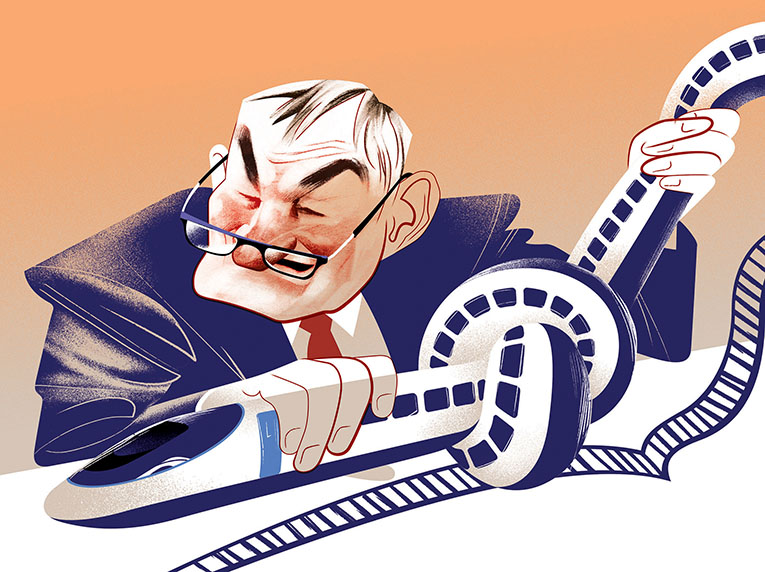
Have you heard the one about the Christmas tree in Burton Green? Like some latter-day Wenceslas keeping his serfs’ spirits up, HS2 Ltd buys the Warwickshire village a community tree every December in acknowledgement of the disruption its new train line has caused. Or the one from 2016, when HS2 published a surprising new route that chopped through a housing estate in Mexborough, plans that were drawn up using maps from before the estate existed? It is not recorded how much this error cost. Or there’s the one about Whittington Heath Golf Club? HS2 wanted to buy £400,000 of land from the club, and so, as a sweetener, built it a new clubhouse, part of a £7m development. Britain must be the only country that bribes itself into accepting infrastructure projects – rather like the fool who celebrates renewing his gym membership with a McFlurry.
The great antagonist of British public optimism for approaching two decades now, HS2 has had one implacable challenger throughout its knackered life: the fearsome Public Accounts Committee of the House of Commons, a Gladstonian initiative that scrutinises public spending with all the stern and unbending temper of the tight-fisted old Liberal. It has had some very stern things to say about HS2: 2017, “shocking waste”; 2020, “badly off course”; 2021, “no clear end in sight”; 2024, “very poor value for money”; 2025, “a casebook example of how not to run a major project”.
When the Liberal Democrat MP Sarah Olney opened the committee’s latest pasting of the project on 14 September, an oral evidence session on “Rising Costs of HS2 and Euston Construction”, she called HS2 “a perennial, I would say, for this committee”, with a wicked grin. Before her were three civil servants, looking every inch three schoolchildren summoned to explain their version of “these incidents yesterday break-time”. As well as Olney’s not-angry-just-disappointed headmistress, they had to face down the maddest bursar in Britain: Rupert Lowe, the leader of Restore Britain and Elon Musk’s man in Great Yarmouth.
Since his election to Public Accounts (achieved with the curious support of Conservative Party MPs last October), Lowe has become a rare social media crossover event for the committee. “Rupert Lowe DISSECTS civil servant over FAILED plans to drive economic growth”; “Rupert Lowe CONFRONTS ‘WOKE’ NHS boss for hiring ‘foreign doctors’”; “Rupert Lowe UNLEASHES on ‘UNFIT’ civil servant: ‘I WANT YOU FIRED!’” – these are just three of the highest-viewed YouTube adaptations from the otherwise humdrum activities of the committee, once only observed by hare-eyed clerks and Hansard reporters. Lowe’s exploitation of the committee’s camera set-up is a useful reminder of just how right-wing parts of the English public are – loathing state overreach, civil servants and public waste with a fervour you’d normally expect to find in rural New Hampshire.

It’s not hard to spot how Lowe – eyebrows permanently arched and eyes gimleted behind reading glasses – works the room. The other MPs sit in their committee-room horseshoe looking glum in the flat, grey, WC lighting. They and their assistants stare down stonily at laptops, giving the unfortunate impression of a discreet power-nap. Lowe, by contrast, is a mania of activity. Listening to the other contributions, he cycles through an acting school of faces, like a handcuffed man fighting an itch. He grins, and gurns, and sniggers at his notebook, and opens his eyes wide when he hears something especially incredible, mock-shocked.
He has much to be shocked about. HS2 is expected to cost more than £100bn and will not be finished until the 2040s. Parts of it no longer make any sense, such as the fact that the high-speed trains will travel to Manchester from Birmingham not on new tracks at high speeds, but on normal tracks at normal speeds.
There will be a long and sad history to be written of this project one day, and the findings of this committee will populate its footnotes. They asked how HS2 was proceeding after its latest combination of up-budgeting and delay, and received cogent accounts of “design immaturity” and “optimism bias”, issues the panel were hoping to “de-risk”. They haggled over the reduction in HS2’s speed from 360km/h to 320km/h (apparently even the “Chinese struggle to get from 350km/h to 360km/h”). They back-and-forthed on the difference between a “megaproject” (a real designation in UK government bureaucracy, not a sub-brand of Lego) and “critical national infrastructure”. They debated whether the development at Euston Station should be designated as its own separate “megaproject”. And they didn’t laugh once at the name of the witness Dean Creamer, director general of major rail projects in the Department for Transport, even if they did rather gingerly approach his name: “Dean, um, Creamer.”
Whereas when Lowe addressed Creamer, he said, “I think this one’s for you – oh joy!” as he turned on him, like a smiling falcon. Lowe’s pose is that of the can-do guy, the ex-business pro, kicking the tyres of government with the boot of private sector know-how. He spoke on behalf of the “beleaguered taxpayer, very much out of pocket”. He made irreverent drive-bys about HS2’s viability: “Most of the civil service works from home now.” He reminisced: “Being a contractor myself…” and “When I was on the board of the FA…” He used boardroom phrases, speaking of “duff contracts” and “pig deals”, of how a jilted contractor will still have you “by the short and curlies”, while all those parasitic lawyers will still have “new wheels on their Bentleys”. He made room, of course, for a broader political attack on this “centrally planned statist failure”.
Between scenes Lowe scrolled and tapped on his phone. Presumably he was on X, perhaps composing a fresh tweet about grooming gangs or halal slaughter. The phone and the sharp, smarting questions are part of the new rhetorical culture in parliament. Even interventions in the House are calculated for vertical-video delivery; watching a parliamentary debate now is to watch each MP deliver roughly two minutes of passion before retiring to X. In one sense, parliamentary speeches have never had a bigger audience.
“Westminster Hall debates” are the least prestigious of parliament’s debating chambers. They are non-legislative, little-attended and generally provide a forum for MPs to make favourable remarks about their constituencies to be recycled in the local newspapers. But they are filmed. It was at one Westminster Hall debate on the ECHR that Lowe first used his slogan “I don’t care”, which he now encourages his supporters to use whenever they encounter any wimpishness over mass deportations.
A 50-second clip from 14 September’s proceedings was uploaded to Lowe’s X feed within 27 minutes of the committee’s adjournment, ready for his 893,000 followers. What will Lowe’s supporters think when they see footage of him “destroying” HS2, encouraging its cancellation and slandering its conception? It allows him, Janus-faced, to present himself as the common-garden Tory champion of fat-trimmers and Quango bonfire-pilers, even as he or whoever controls his social media accounts rallies anonymous racists via ethno-nationalism and phobic innuendo. At least someone is winning out of HS2.
[Further reading: Farage’s fan club doesn’t care about scandal]
Content from our partners



Related

This article appears in the 16 Sep 2026 issue of the New Statesman, Will AI kill us all?
Join the debate
Subscribe here to commentI sympathise with the people who believed in HS2. I wanted to build an OO scale replica of Luton Midland Road Station circa 1965 in my garage and I started without getting planning permission from my wife! I managed to get the OK in retrospect but it was a close run thing. The problem now is that I need to expand the lines but it is impossbile to fit this uprade into the garage without getting rid of the original garage contents! Needless to stay it has been a very expensive exercise. A relocation to the attic greenfield site is on the cards!
“I wanted to build an OO scale replica of Luton Midland Road Station circa 1965 in my garage”
This would only happen in England :-).
Yes and OO scale is inaccurate – the track is the same as HO scale which is accurate but the rolling stock are 12% too high! Still we muddle along!
In the 1970s oil crisis the French government realised that they had no oil and had to do something. So they planned a fleet of nuclear powerstations and high speed electric trains and .. um.. just went ahead and did it!
The French government probably still employs their own engineers.
The British government is like a naive householder enthralled by a Del Trotter kitchen fitter. “Gold speckled marble, that’s all the rage now, and the thing is – it don’t cost you more than chipboard now! I can get you a deal on it, Look at this sample nice eh!”
No engineers, no way of evaluating the claims made.
these projects need PR persuasion in order to succeed….in Germany, we now have an ICE Frankfurt><Cologne line which is quicker than any short-haul flight and is incredibly well-accepted