
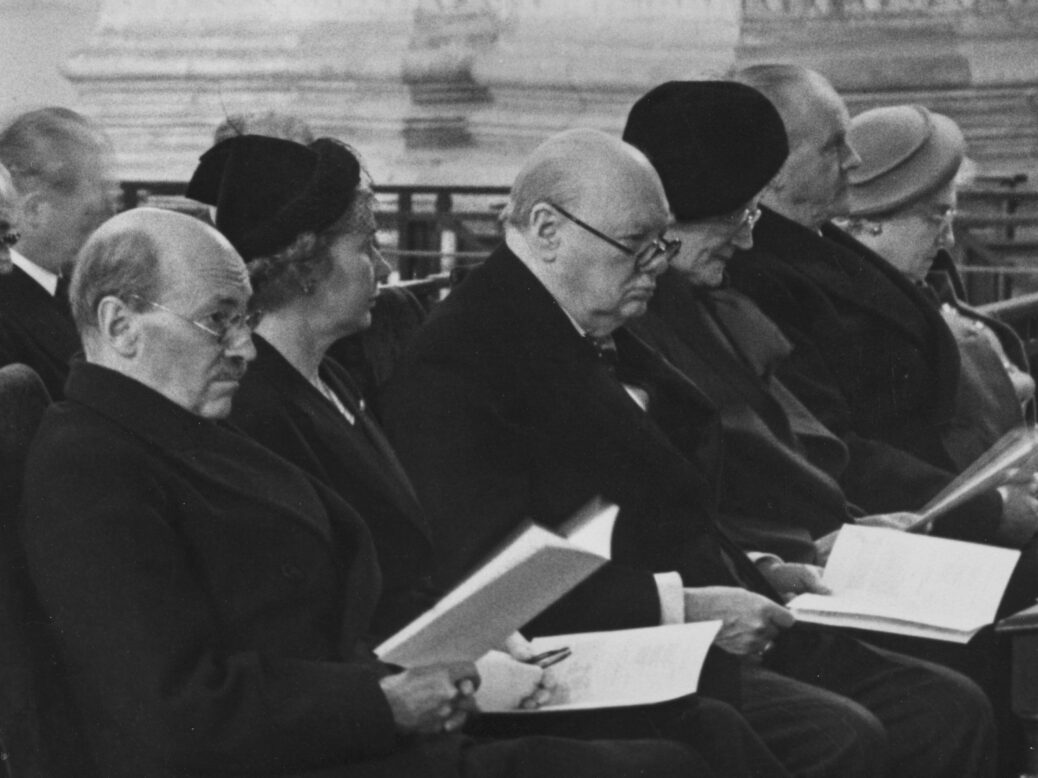
The reading habits of politicians, like their sexual proclivities, are largely hidden from public view until we are offered brief, revealing glimpses of their inner lives and sometimes unexpected private pleasures. In both cases, an intensely personal habit can acquire a profoundly public significance, and prove embarrassing if a journalist discovers the details. With reading, the ideas, arguments and topics politicians encounter on the page inevitably shape, to some degree, how they understand the world and then govern it.
The reading lives of our leaders are back in the news. Recently, former prime minister Sir Keir Starmer, from all that has ever been published, donated a biography of himself to Downing Street’s library, perhaps as a case study of what not to do in power. Rachel Reeves, Nick Thomas-Symonds and Lisa Nandy all donated items they had written themselves, in a further act of literary self-regard.
To be fair, MPs have always enjoyed reading about MPs. Clement Attlee, Stanley Baldwin, Ramsay MacDonald, Arthur Balfour and Ted Heath all put their own works on the No 10 shelves. Kenneth Baker went one better, contributing an “anthology of satirical and abusive verse” selected by Baker himself. Presumably, he felt future premiers would require help in the vital arts of satirising and abusing, beyond what they had already learnt in the Commons. Former Labour minister Chris Mullin lists his own diaries, his political novel A Very British Coup, Rory Stewart’s memoir Politics on the Edge, Sasha Swire’s diary of being an MP’s wife, Alastair Campbell’s diaries, Alan Johnson’s memoir This Boy and Denis Healey’s autobiography as some of the most thumbed tomes in Westminster.
As bookworms go extinct in the wider population, are they also doing so in politics? Historically, leaders have often been distinguished by bibliophilic voracity. Harry Truman observed that “not all readers become leaders, but all leaders must be readers”, claiming to have read all 2,000 books in his local library by the age of 14. Theodore Roosevelt was a book-a-day president, moving deftly between genres and languages, including German, French, Italian and Latin. He would reach for a volume when someone was boring him – although the Commons tearoom would end up a library if that became established etiquette – while George W Bush, not renowned for his grasp of the English language, held reading competitions with a policy adviser. On this side of the pond, William Gladstone translated Horace. As a young army officer, Winston Churchill immersed himself in Gibbon, Macaulay, Plato, Aristotle, Malthus and Darwin among others. In 1943, gripped by fever, he sought out Pride and Prejudice for solace. Contrast with Starmer listing football comic Roy of the Rovers as his favourite “book”.

But as Russia goes on the offensive and China rises, do we want our politicians’ thoughts taken up by the latest Booker Prize winner? There is a notion that fiction makes us more compassionate. Ex-Green Party leader and MP Caroline Lucas completed a PhD on female readers in Elizabethan literature. “Make space for fiction and poetry,” she advises MPs. “It’s a vital way of expanding your imagination, putting yourself in the shoes of others and developing empathy. I’d want to make sure that a copy of Warsan Shire’s poem ‘Home’ is on the desk of the Home Secretary and everyone around her (‘No-one leaves home unless home is the mouth of a shark/You only run for the border when you see the whole city running as well’)”.
A large library is not always a guarantee of equally sizable reserves of empathy or wisdom, however. As Times columnist and author of The New Dark Ages: The End of Reading and the Dawn of a Post-Literate Society James Marriott points out, some of history’s worst dictators were also its greatest readers. Joseph Stalin and Adolf Hitler both did so widely, the former writing sensitive nature poetry and the latter murderous turgid bilge with a prose style as ugly as the politics it conveyed.
That said, being an ardent bookworm brings other benefits to the political culture, sharpening both minds and arguments. Marriott tells me: “If you look at the shallowness of parliament at the moment, that does seem to be symptomatic of a political class that has no intellectual grounding in anything deeper than whatever happened five minutes ago on Twitter. A lot of our leaders don’t seem particularly at home with complex thought, sophisticated ideas or detailed argument. They don’t seem to have much of a sense of history”.
In their defence, the culture of consuming politics is less text-based than it once was. “Parliamentary speeches were analysed in newspapers and taken apart almost as literary criticism”, Marriott explains. “You were making something that had to stand up in print. That holds people to more rigorous standards of argument because it’s harder to just assert things and ramble on in print than spoken conversation. Now people are speaking for social media; all they want is 10-30 seconds of getting their funny or outraged line out. The average length of a Parliamentary speech was about 1,000 words from the 19th century until the 1970s and then began to decline. In around 2014, it fell off a cliff and that appears to be related to the arrival of short form video. MPs spend more time than most people scrolling on Twitter and TikTok.”
But modern politics is not wholly devoid of bibliophiles. Former Conservative minister Michael Gove read a volume of Robert Caro’s epic biography of Lyndon B Johnson as his wife was giving birth. As Justice Secretary, he relaxed restrictions on sending books to prisoners. “I tried to read a book which was not directly related to my work for at least half an hour every day,” he tells me. “I sometimes spent some of my lunchtime out of the office reading biographies.”
What should politicians read? There are the history and political theory necessary for debate. There is the patriotic business of immersing oneself in the intellectual and cultural life of the country, not to mention the practical necessity of understanding the internal workings of our nation’s adversaries (the Russians, the Chinese, the French). “The Bible is the only must,” advises Gove. “The best memoir by any living UK politician is Tony Blair’s. The best recent political biography of a UK politician is Andrew Roberts’ Churchill. I would also recommend Maurice Cowling’s Mill and Liberalism, Michael Oakeshott’s essay on Rationalism in Politics, Demons by Fyodor Dostoevsky and Revolt of the Elites by Christopher Lasch.”
Perhaps none inspires such feverish devotion among politicos as Caro’s colossal biography of LBJ, now four thick instalments in, with a fifth to come. Any single woman hoping to meet a Westminster man need only sit in St James’ Park clutching a volume and wait to be swarmed. Gove refutes any suggestion that the passion is rooted in politicians’ own hopes of a multi-volume epic being composed in their honour.
“Caro is a superb writer who uses a reporter’s eye for telling detail to illuminate personality and motivation”, he enthuses. “Johnson himself is an endlessly fascinating character – deeply flawed, indeed immoral, and yet an instrument of social justice and reform. The interplay between personality, the mechanics of decision-making, issues of conscience and the price of power make these works compelling. I don’t think any contemporary UK politician could prove quite as rich a subject and I don’t imagine any would want to be.” George Osborne was reportedly so inspired by the bold moves recounted by Caro that he made his own, promising to abandon inheritance tax for properties below £1m and so spooking Gordon Brown into abandoning an early election. Gove tells me that he himself sought out historical parallels in office, basing decisions on Just in Time by John Hoskyns, Bernard Donoghue’s diaries and Edmund Morris’ books on Teddy Roosevelt.
Those in politics can find themselves instinctively drawn to subjects that they feel reflect their own era. Attlee conceived of Britain’s own loss of imperial might by reaching for Gibbon’s multi-volume narration of Rome’s fall. As Israel’s war in Gaza unfolded, Benjamin Netanyahu consumed Barry Strauss’ history of Jewish revolts against the Roman Empire, telling a journalist: “We lost that one, I think we have to win the next one.” Former Foreign Office special adviser Ben Judah found that the texts he had originally selected to understand the White House, including an account of Nato’s origins, offered little insight into the Trump administration. Instead, he “found sense in Roman history or novels”, turning to Suetonius’ The Twelve Caesars and Robert Graves’ I, Claudius.
Historian Andrew Roberts agrees with Judah’s choice. For Trump, “you’ve got to go back to Rome”, he says. “It’s Nero, Caligula, Tiberius. I’d go straight to Plutarch – he and Sallust are probably the only people that can help anyone attempting to deal with the court intrigues of Donald Trump.” However, he cautions against drawing direct parallels between past and present. There is a danger of stripping events of context, confirmation bias or taking a one-size-fits-all approach to problem-solving. “With the Suez crisis, Anthony Eden convinced himself this was a re-run of the appeasement issue in 1938 whereas it was the beginning of decolonisation and rise of Arab nationalism which was entirely different. The response which he initiated on military action, which was probably the right one for 1938, was the wrong one for 1956”.
For politicians eager to reach the top, there can be a particular interest in the “great men” of history as figures to emulate. “One of the people Churchill read about most was Napoleon, he was fascinated by him,” Roberts tells me. “Churchill recognised that Napoleon was trying to establish hegemony over Europe but at the same time admired Napoleon and called him the greatest man of action since Julius Caesar. Napoleon admired Caesar and all three admired Alexander the Great.” But one should not study only the victors. Lessons of history are as much about the errors of those who failed as the wisdom of those who prevailed and leaders are always more inclined to think they are the next Churchill rather than Chamberlain.
But after a long day, even the most hardened parliamentarian welcomes some light relief. Stanley Baldwin enjoyed detective fiction. Margaret Thatcher would have had more than four hours of sleep had she not stayed up reading Frederick Forsyth’s spy novels. Given that she was ultimately in charge of the security service, this does seem less like escapism than taking the office home with her – although that’s technically unavoidable in Downing Street. Writer Stephen Vizinczey once asserted that “reading helped Harold Macmillan to understand far more how life works than position papers.” In an age of TikTok and Twitter, let’s celebrate the politicians still eagerly brandishing their library card – and having a Prime Minister who has forever silenced every relative’s impertinent question about what job you can get with a degree in English. MPs feeling the strain after returning to parliament should look to Macmillan, who often said he enjoyed nothing more than going to bed early with a Trollope.
[Further reading: Our island stories]
Content from our partners



Related

Join the debate
Subscribe here to comment