
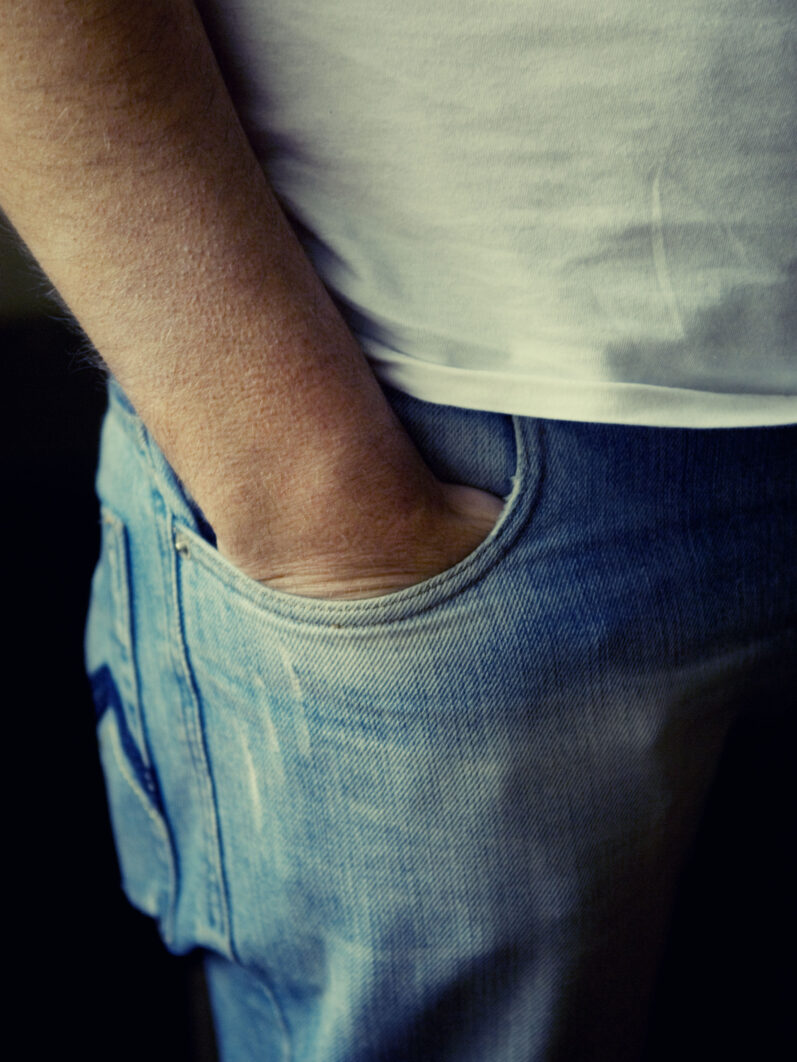
“There is an earth-shattering moment in every white boy’s life when he discovers UNIQLO,” tweeted the prolific shitposter Donald Boat in April 2022. When I read it, I retweeted it unhesitatingly, because it was profound and true – not just for white boys, but for us all, though particularly for white boys. We must now acknowledge another earth-shattering moment. There is BU, before Uniqlo; AU, after Uniqlo; and AJWAXU, after JW Anderson X Uniqlo.
We are now in the year 9AJWAXU, because – if you for some reason adhere to a different lord and saviour to Jonathan William Anderson – it was in 2017AD that the Northern Irish fashion designer launched his collaboration with Uniqlo, the Japanese Godzilla which makes unbranded clothes just expensive enough, and just high-quality enough, to escape the stain of “fast fashion”. You’re probably wearing Uniqlo socks, or Uniqlo pants, or a Uniqlo T-shirt, right now. The brand is fashion’s Coca-Cola or Mini, beloved by both people who care a lot and people who don’t care at all about how they dress. To the latter, it offers simplicity and function; to the former, mortar for holding together the weird, expensive parts of their outfits.
Uniqlo keeps the fashion-y side of its customer base interested via collaborations with designers who usually make clothes about ten times the price, like Jill Sander and Christophe Lemaire, the former creative director of Hermès who (until last month) oversaw the elevated Uniqlo U line, which makes very good white t-shirts. But the JW Anderson range is especially popular: a company like Uniqlo doesn’t give you two collections a year, every year, just because the clothes look nice.
I have been bought multiple pairs of the socks – thick; colourful; “JWA” embroidered at the top – for multiple Christmases. I am writing this sentence while wearing a mint green polo shirt from this year’s JW Anderson X Uniqlo spring/summer collection. I spent a lot of this summer in this polo shirt. It has a pleasing pastel shade, and a small embroidered flag with “JWA” inside it that sits just above my left nipple.

Preppiness, with a bit (but not too much) personality worked in, is what Anderson has always been going for here: his first 2017 collection included Fair Isle jumpers and a colourful striped scarf; last year’s autumn/winter collection included some very Barbour-coded jackets; the releases have names like “Modern Preppy” and “Prep Meets Play”. It’s an accessible aesthetic with a trace of formality; it works for corporate white-collar workers wearing it guilelessly, and for creative white-collar workers wearing it knowingly, to spurn slobby, tech-bro-y casual wear. If there’s a fashion equivalent to the “AirSpace” interiors of cafes, hotels and co-working spaces, as coined by the American critic Kyle Chayka, this is it.
Anderson has conquered many other worlds too, having quintupled the annual revenues of Spanish luxury brand Loewe (“lo-WEH-vay”) before becoming creative director of Dior (both womenswear and menswear) last year, which has involved designing Taylor Swift’s wedding dress among much else. Dior, plus Uniqlo, plus his own brand means producing 18 collections a year. Most interviews with Anderson remark on how much coffee he drinks.
The 41-year-old’s high perch in hyper-globalised high fashion is a long way from the street-level sectarianism where he grew up: the Northern Irish town of Magherafelt, for which there is a standalone Wikipedia page titled “The Troubles in Magherafelt”. He’s talked about seeing the aftermath of explosions as a child. In 1998, his mum Heather was driving away from Omagh after returning some shoes, when the car bomb that killed 29 people went off in town.
His family are non-religious Protestants; his dad, Willie, captained the island of Ireland’s rugby team, and his brother Thomas – or “TJ”, as per apparent family tradition – is another former rugby player who is now operations director at JW Anderson. You can see this in Anderson’s own stubborn lack of personal glamour: he wears a lot of Uniqlo, rather than the wacky stuff he usually designs. (He’s released handbags in the shapes of pigeons, frogs and cushions – and, after a heirloom tomato with the caption “this tomato is so Loewe I can’t explain it” went viral in 2024, a heirloom tomato.)
Maybe that means that his muted Uniqlo collections are actually more personal – more rooted in a time and place – than his mad work in luxury. The preppiness that guides them has more layers than a winter wardrobe. On the American east coast, guys and girls at posh prep schools would dress in the sporty and slightly tweedy garments of an off-duty English aristocrat. In the 1950s, this was known as Ivy, after Ivy League; by the 1980s, it was prep.
American preppiness really went big in Japan, which ended up producing button-down shirts of such wondrous quality that Tokyo basically became prep’s new Rome. (See W David Marx’s Ametora: How Japan Saved American Style.) Uniqlo’s clean, semi-formal product is a product of this – and with a British designer designing the brand’s most fashion-y collection, the trail of influence completes a full lap of the globe.
So – the JW Anderson X Uniqlo collections haven’t just become popular because they’re made by a huge multinational, but because they’re powered by the cultural might of two and a half current-or-former superpowers. They also illustrate the ambiguous status of Britain’s present-day clout. One of the most important designers in world fashion is British, but one of his most important projects is designing a version of Britishness shaped by outside forces. Which is a lot to think about when you’re wearing your nice green polo shirt. But as everyone knows, fashion is probably the least frivolous industry there is.
[Further reading: Sadie Sink doesn’t care about your politics]
Content from our partners


Related

Join the debate
Subscribe here to comment