
Snuggled among blankets of commercial brassica eight miles west of Canterbury lies Preston-next-Wingham – a village with a name almost like something a rugby coach might bark at a squad of public-school boys. This is a place where crime means hare-coursing, and where 10mph speed limits are set by the British Horse Society. The parish church door remains closed, not in anticipation of antisocial behaviour or rough sleepers, but to “keep wildlife out”. The most popular pint at its only pub is Master Brew, a rusty Kentish ale favoured by the old boys who shuffled in by midday. It is an English every-village, with all the awkward architectural add-ons a post-feudal economy requires for a 924-strong population. Perfectly preserved oast houses alongside soggy Sixties bungalows; newbuild closes of faux-Georgian frontage overlooking the odd remaining low-thatched cottage.
But modern England is here, too. A Highway Maintenance van rattles past me over a stretch of potholes, as if to prove its own futility. Southern Water keeps shutting the roads down because of burst water mains; residents blame this on the Grange, a newbuild estate that the village infrastructure can’t handle. And after 8pm on Friday 4 September, as autumn’s early acorns crunched underfoot, hundreds of men turned up and parked all along the main road: in private driveways, including the local butcher, at the village hall carpark, outside the primary school, and on the rec, which hadn’t yet been fenced off after the village fete.
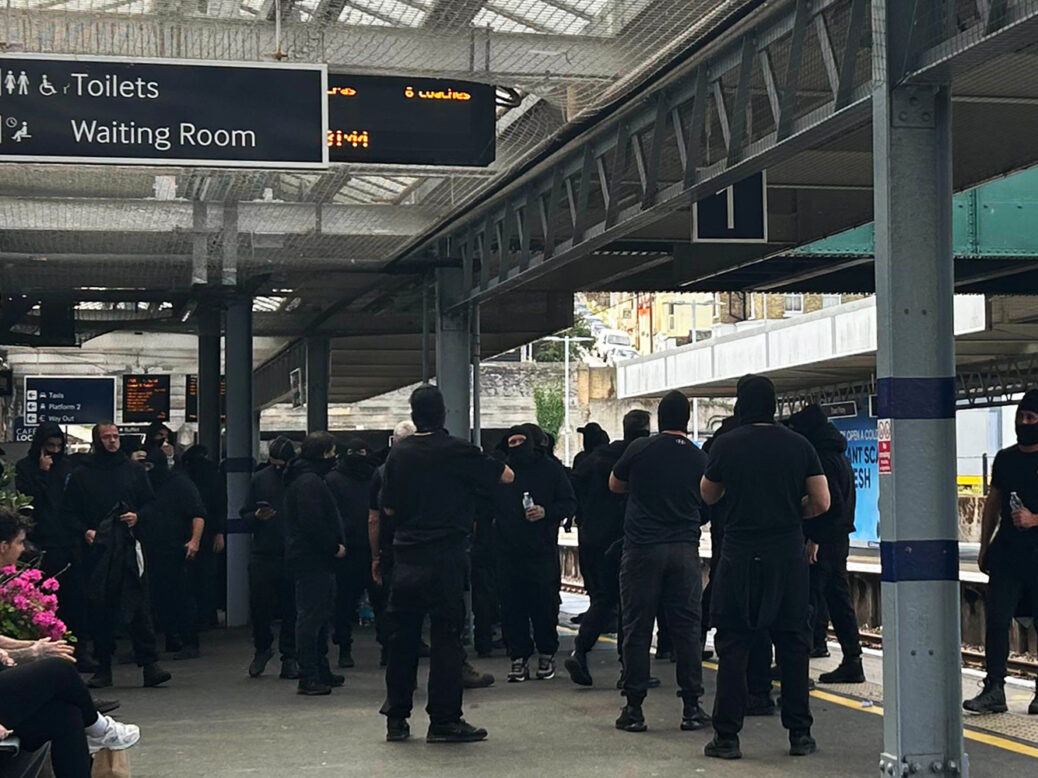
Villagers watched as they walked in groups up the main road. Some were seen wearing black tracksuits and balaclavas, others just in normal clothes. The local Tory MP, Roger Gale, described it as a “bloody nightmare”. They “seemed like a lot of tradesmen”, said Stephen Atherton, a 53-year-old butcher in a blue-and-white striped apron who had worked at Preston Family Butchers for 18 years. He watched the guys parking up their vans and jeeps without permission on the driveway via the shop’s security cameras.
For such a small village, it was “a shock” said Atherton from behind his counter of venison and wild boar burgers. “It was a lot of upheaval… We went looking for the owners of the cars on Saturday morning, because Saturday morning’s our busiest day and if they’d asked we would’ve said no.” There were complaints on the local village Facebook group, I’m told, and even to Kent Police (who did not confirm the nature of these complaints to me).

It became clear as locals chatted to the men what they were here for. They were planning a protest down in Dover the next day. The following morning, villagers woke up to scenes of masked black-clad men blocking the port, causing disruption and chanting “stop the boats”. “We knew what they were going to do,” one mum picking up her six-year-old son at the school gates told me. “They called themselves the Patriots.” Another woman, a 23-year-old stay-at-home mum waiting at the bus stop under dripping hanging baskets, told me the same: “There are a lot of old people here and they were worried about seeing groups of men hanging around, but then they explained that they’d be going down to Dover for a protest.”
The villagers knew in advance about a plan that took police, port authorities and the council by surprise. Direct action was organised in secret by Daniel Thomas, “Danny Tommo”, an associate and former bodyguard of the far-right agitator Tommy Robinson. Anti-migrant demos are usually publicised well in advance; there’s a Britain First march in Tamworth this weekend, for example. But the Dover one had been mobilised secretly via Thomas’s network of angry men, Patriot Platform: an organised group of England’s growing collection of wannabe vigilantes. Thomas led the same group on a protest in Portsmouth last Sunday (6 September).
Still, Kent Police were warned about fragments of the plan picked up by villagers the night before they arrived. A spokesperson admitted to me that “this information was not fully assessed”. Nick Lowles, head of the anti-fascist campaign group Hope Not Hate has reported that counter-terrorism police were also contacted. They hadn’t replied to my questions about this at the time of writing. But beyond police incompetence is a deeper concern for Britain’s battered institutions. Something is changing in the gamey heart of old England. Not even gangs of strange men in tracksuits and illegal parking – a twin horror that could not have been better designed in a lab to niggle at the nerves of rural villagers – took away from support for those men.
They were described to me as “polite”, “lovely”, “really friendly”. There was “no animosity”, “nothing threatening”, even if they were “a bit naughty” not to ask permission to park. “I’ve never felt safer,” said one of the school-gate mums. “I suppose it’s a good thing, if it works,” said another. “No one else is doing anything about it.” They could see how the balaclavas could be “intimidating”, but “it was for protection, wasn’t it?” Their kids ran through the playground, reaching for scooters, snacks.
“I get why they’re doing it, I understand the cause. I wouldn’t go and do it myself, and they’re doing it to the wrong people; they should’ve gone to parliament or something. But we’ve been ignored for too long,” said the butcher, who is relaxed about immigration if “they come over and do it properly”. For him, the issue is “the little business is ignored – they’re building so many houses the roads keep closing, which affects our trade. The roads are a state. We can’t afford to keep paying for these people.”
There is a kind of folklore I hear from most villagers out on this rainy afternoon. Tales of nursing homes in nearby towns given over to asylum seekers. What a friend of a relative working at the Manston processing centre – just a 15-minute drive away – says that they see in there (“free phones and trainers!”). Houses and schools in Dover “full of migrants”, girls feeling unsafe and being “nicknamed chicken nuggets” (cheap white meat). A quick Facebook search will throw up the lurid, vicious “sources” of such rumours.
Thomas and his ilk are of a loud fringe of fundamentalists: nativists, ex-cons, deniers of democracy and evangelical Christians preaching fear of the Other. Most Britons still recoil at such rude and cruel Americanised ways – such as the screams of “traitor” and “scum” at the RNLI. But in what the national psyche deems respectable England, where the Barbour trumps the balaclava, there is a faint echo of those screams. Both Reform and Labour plan to house refugees in smarter postcodes. But there is an almost oral tradition, amplified by algorithm, whispering in such places too. The residents of the 400-strong Oxfordshire village of Piddington, for example, who voted for “independence from the UK” in a referendum held amid Home Office plans to house more than 1,000 asylum seekers nearby.
I dry off by the open log fire in the Half Moon and Seven Stars. The landlord, Ben Edwards, used to work in an East End fruit market, from the age of nine, before he moved from east London to Kent. He worked with Muslim stallholders and remembers the Muslim-run caffs on the market that would nevertheless serve bacon to keep the old cockneys coming in for a fry-up. “You just have to ask questions, be open with people, and have a conversation to find out about different cultures,” he told me, serving me a cup of tea. What did his regulars say about the men trooping past the pub that Friday night?
“People who agree with them don’t want to say anything, and people who disagree don’t want to say anything, because they don’t know where the person standing next to them stands,” he told me. “I’m a publican so I don’t stand anywhere. I stand in the middle.” But quietly, the silence is being filled.
[Further reading: The violence in Portsmouth and the rise of vigilante Britain]
Content from our partners



Related

Join the debate
Subscribe here to commentAs a long-term resident of Preston until about 15 years ago, you have brought back a host of memories. ‘Twas (is) a lovely little non-posh place surrounded by fruit farms, with the concern even then being the new estate built on a former one, without the roads to cope with it or the nearby mega-trucker business. But small as it was, it boasted a local league cricket team. Very ‘darling buds of May’. Bless!