
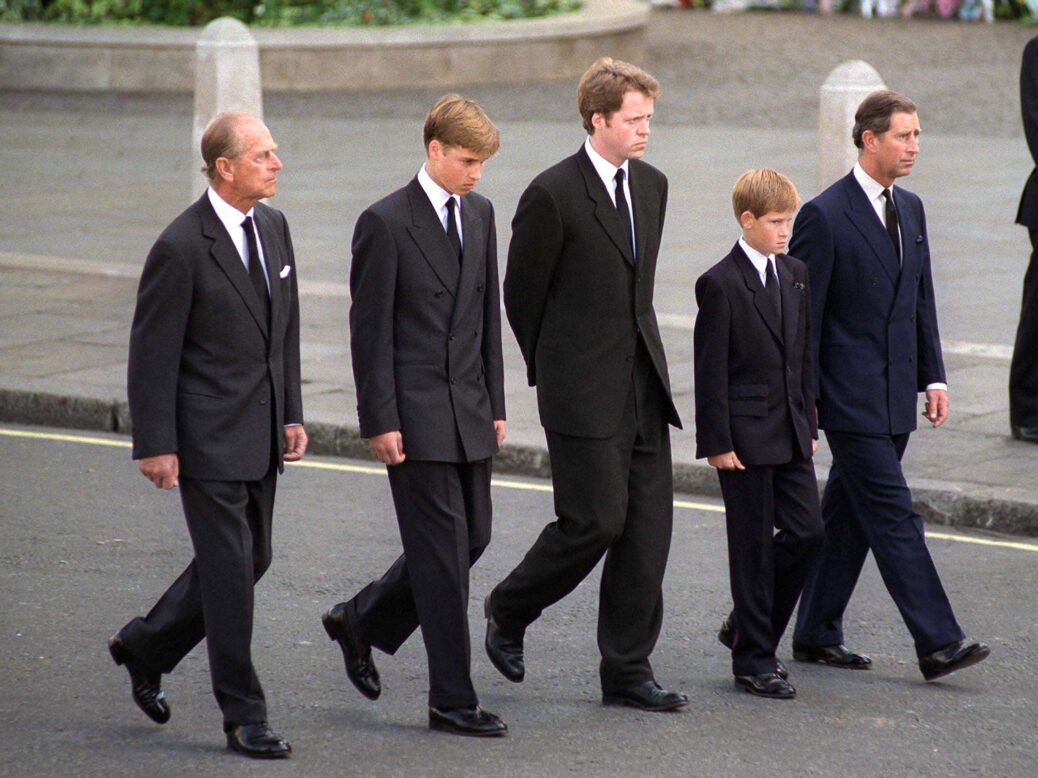
Royal courtiers still call it “the revolution”. And, admittedly, when most celebrities die in accidental car crashes – such as James Dean, or Marc Bolan – the public does not march on a royal palace, shoulder homemade placards, or denounce its head of state (“SHOW US YOU CARE” ordered one banner). The demands were slight – this is England after all – relating to the flying of flags and the broadcasting of public statements. But the revolution occurred when the demands were met. Democracy had overthrown deference. The royal family took its orders from crowds.
If the events around the death of Princess Diana were “the revolution”, perhaps courtiers will come to call recent days “the duel”. Like the revolution, it has been bloodless. First came the tabloid briefings. (“HIS WORDS WERE MONSTROUS” screamed the Daily Mail on 19 September, which reported the King had said of his ex-wife, “We’ll forget her soon enough.”) Then came the BBC sit-down on 20 September: Charles Spencer, quarter-zipped and looking suspiciously like Tim Nice-but-Dim, repeating allegations that the then Prince Charles was “giddily elated” by Diana’s death and “went nuts” over her funeral arrangements. From 22 September, the hardback Swan Song: Diana, My Sister, cluttered the shelves of TG Jones. And the book takes an axe to the forgotten and even fallen branches of the family tree. Do we care that Sarah Ferguson’s father was “asked to leave Eton on academic grounds at a time when that was a very rare call indeed”? (Piers Morgan has since announced plans to take legal action against Spencer because of other allegations in the book, factual errors for which Spencer has apologised.)
But Charles Spencer has found his mark. The Palace has said, “His Majesty is mindful that the pain of fraternal grief can cloud reason, affect judgement and colour memory in ways others do not recognise.” Tempers fly high at times of revolution, and any kind of fury could have been indulged in the week after Diana’s death. It’s less conceivable that Spencer would have kept this stick of dynamite in the back pocket for 29 years, waiting conveniently for the popularity of the monarchy to reach a new low before striking the match. But whatever the truth of his claims, they are further punishment for a staggering institution that looks weaker every year. And when you see brother-in-law fighting brother-in-law, it wounds because it makes the irrationality of hereditary rule – occasionally flaunted as some mystical asset – bleakly plain. You’re reminded of the most obvious fact: the Royal Family is a family.
When expanding that family, the Hanoverians avoided this sort of intra-aristocratic nightmare by sourcing its consorts from overseas. Diana was the first English woman to marry the heir to the throne in more than 300 years. Before then, we imported the daughters of Mecklenburg, Brunswick or Copenhagen. Phil the Greek was born on Corfu, and while the Queen Mother was a Scottish descendant, her husband was never meant to be king. But by Prince Charles’s majority in the late Sixties, a time when the deficit in the balance of payments was keenly felt, this method must have looked insufficiently national-minded.

Therefore, Charles only briefly followed the cosmopolitan pattern, allegedly losing his virginity to the daughter of the Chilean ambassador at university (historians have claimed this was “arranged” by his college master, the former Conservative home secretary Rab Butler). His early twenties were passed happily truffling in the pages of Tatler. Davina Sheffield, Jane Wellesley and Sarah Spencer – all of whom were very English, and looked smashing by the polo pitch in a pair of Dubarrys. And all of them understood the rules of engagement, and the order of precedence. Throughout their relationship, Lady Jane apparently never called Charles anything but “sir”.
But when Lady Sarah introduced Charles to her sister Diana, their marriage brought the Windsors into union with one of the most powerful and tempestuous families in the British aristocracy. The failure of that marriage has since been overshadowed by the graver sins of Andrew Mountbatten-Windsor. But it made naked the human frailties of the King – his weakness, his adultery, his phone sex.
For what it’s worth, Charles Spencer speaks from no pedestal. If we are pulling up receipts from 1997, we can declare it a revolutionary year for him too, if only in the root sense of a “rolling over”. In December of that year, he divorced his first wife, who alleged he had cheated on her with ten women in the five months she spent in an anorexia clinic. He denied this – but even so, his priapism appears to have been a family legend: his daughter once presented him with a collage of Halle Berry images in lieu of a birthday card. Since then, he has tumbled through marriage and divorce at a rate almost to match his ancestor Henry VIII.
But the difference between Spencer and the King (and Henry VIII) is that the indiscretions of the former belong to him alone. They do not involve the national crest. In his BBC interview, Charles Spencer said of aristocratic titles, “Titles are – I know I’ve got one, but I don’t really use it – so titles are not very important to me.” And he added, on the royal family’s statement, “‘His Majesty says’ – I just don’t think it’s healthy for a human being to be seen in such archaic, servile terms.” That may be the truest part of his claims, and the disjuncture between human and holy that monarchy demands will be its undoing. When better historians than Charles Spencer look back at 1997, they will declare it a moment in a longer, deeper revolution.
[Further reading: Prince George starts at Eton and enters the belly of the beast]
Content from our partners



Related


This article appears in the 24 Sep 2026 issue of the New Statesman, A Sense of Power
Join the debate
Subscribe here to comment