
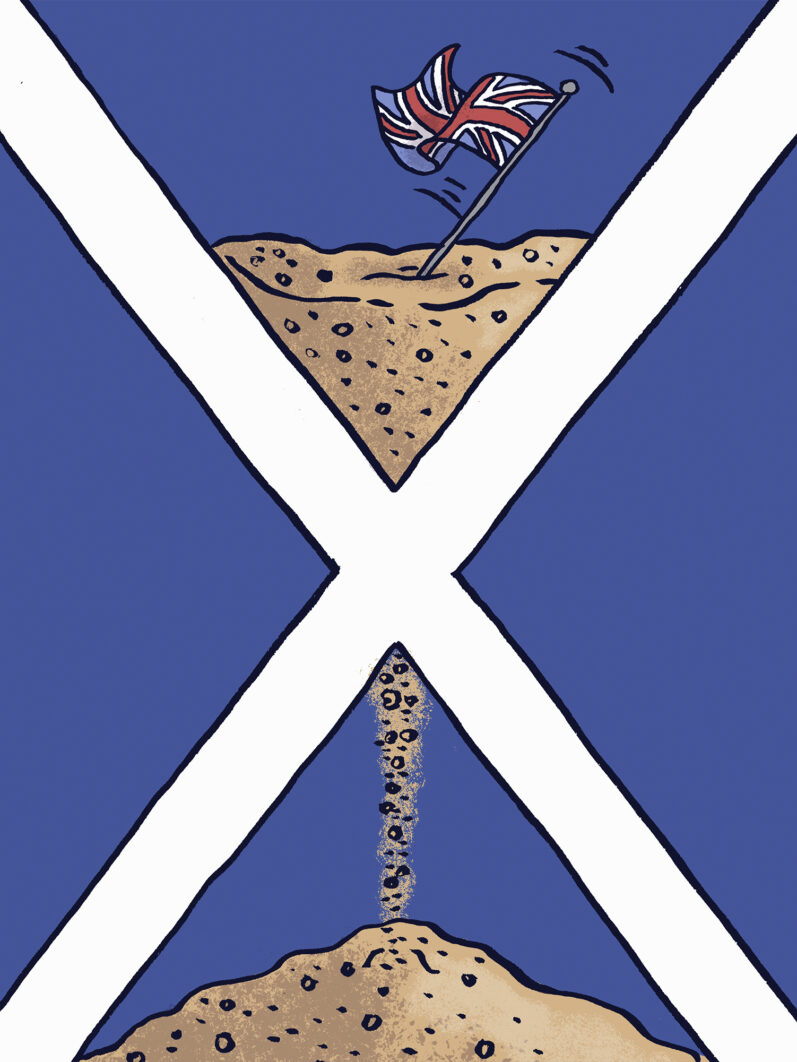
“Imagine a rambling stately home. It has a rickety old electricity system which means that the power is only on in some rooms,” wrote Andy Burnham in his book Head North, “upstairs, directly above the living room, is the main bedroom. There, the lights flicker but they do work. Let’s call that room Scotland.”
This is the dim view of the crumbling British state, and Scotland’s nearly three-decade experience of devolution, that Burnham took as he came to power. In his analogy, Wales and Northern Ireland were smaller rooms, the northern cities ones with even dimmer lights. Now he is setting out on his renovation project, and a visit to Motherwell last week to deliver a speech on Scotland’s future was the first step.
In some senses Burnham’s political vision for Britain is a Scottish one. He has said he wants a Basic Law to redistribute wealth across all parts of the country and while the idea takes its name from a German concept, he has often described it as a kind of Barnett Formula for the whole UK. But Scotland has also been held up as the antithetical case when he extols the virtues of devolution in his beloved Manchester. On paper, Scotland should be one of the most civically engaged and well-run countries in the world – a highly educated people with a large measure of control over their domestic affairs who cannot move for opportunities to vote for representatives at the national, devolved and local level. Yet Scotland is a country where political apathy reigns (turnout in the 2026 elections was a paltry 53 per cent) and policy outcomes are poor (life expectancy remains lower than England and Wales).
Burnham knows this. It’s why he sees Scotland as a room where the lights are flickering. But while the SNP says that Scotland can switch the lights back on by moving house entirely, the PM is a self-professed “fan of unions”, whether they be trade unions, the European Union or the Acts of Union. As he said at Labour conference, he is “utterly determined” to avoid the role First Minister John Swinney has attempted to cast for him: the last Prime Minister of the United Kingdom.

When he went to Scotland last week to crash the SNP’s annual conference and announce that he would never provide the necessary authorisation for a second Scottish independence referendum, Burnham had to square a circle. He came to power promising to be the most pro-devolution, pro-democracy, pro-cross-party-cooperation Prime Minister ever. Yet he is already running into the problems that practical reality throws up.
Senior figures in the SNP are seeking to paint Burnham as a hypocrite, with his ban on a second Scotland referendum coming in the same month when he floated the overturning of the Brexit referendum. Alongside a fight with the SNP, he is also in the process of dismantling Labour’s power-sharing relationship with the Green party in councils across England as a response to their “Zionism is Racism” position. Meanwhile he is facing the beginning of a backlash in his own party to his commitment to electoral reform, which could collapse under the weight of opposition from turkeys who don’t wish to vote for Christmas.
Even at this early stage of his premiership, Burnham is attempting to make concrete progress on the most radical and difficult parts of his programme for government: the wholesale reform of the British state and UK party politics, with an expansion of democracy, cross-party pluralism and decentralised power. At the same time, he must deal with the hard realities of being a Prime Minister who must keep his country and party together. Some of the more radical leftists who originally supported Burnham’s bid for office are already doubting his ability to do this as the constraints imposed by high office and the instinctive caution of the Parliamentary Labour Party become clearer.
To square the circle in Scotland, he has presented a plan for greater devolution within Scotland. The PM will now press ahead with a plan for the biggest shake-up to the way the country is run since devolution, with new and much enlarged regional authorities to cut through petty bureaucracy and, potentially, new elected roles like a Glasgow metro mayor that could end up breaking the SNP’s political dominance.
While some joke that in his effort to avoid the constitutional question, Burnham has ended up siding with the fledgling Shetland Independence movement in an attempt to sideline mainstream Scottish nationalism, the PM’s earnest view is that Scotland is too centralised. And the bilateral relationship between Holyrood and Westminster, which he described in his book as “inevitably tense and political”, has now reached a nadir in which little gets done other than arguing. By changing the way Scotland is run, he hopes to break the stalemate.
Burnham’s first Scottish visit as PM could be remembered as the first in a wider story of UK-wide political reform. But will it have a happy ending?
[Further reading: Inside Scottish Labour’s civil war]
Content from our partners



Related
Join the debate
Subscribe here to comment