
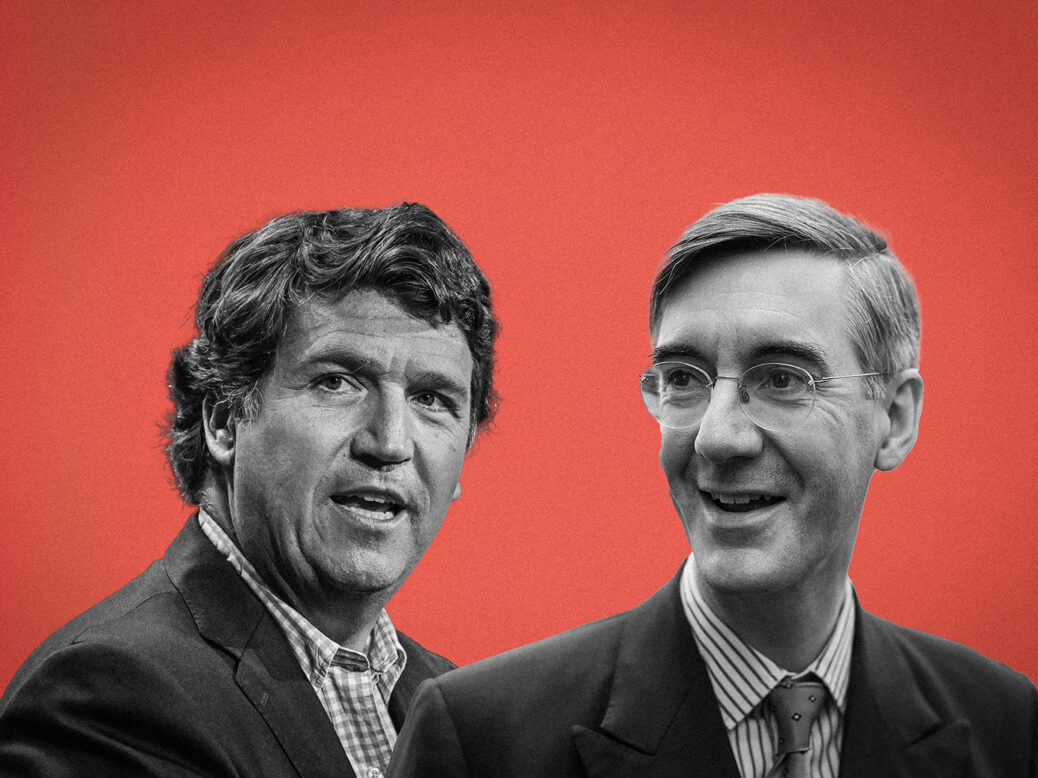
It’s the kind of video you couldn’t imagine just a few short years ago but that today seems to make perfect sense: Jacob Rees-Mogg calmly and patiently trying to convince a suspicious American that Hitler was actually bad.
This episode of the Tucker Carlson Show has amassed more than 1.5 million YouTube views in three days. It is headlined “‘Prepare for War’ – Tucker Confronts Britain’s Most Pro-War Advocate”.
In an interview conducted in the home of Britain’s supposedly most pro-war advocate, in front of an unlit fireplace against a backdrop of pink flocked wallpaper and reproduction busts, the mild-mannered if proudly right-wing Conservative politician who became a household name in Britain during the Tories’ Brexit breakdown is recast as an indiscriminate warmonger for suggesting the UK should prepare itself against the threat of Russia. “What is this war and why do you have to fight it?” Carlson wants to know, unmoved by the litany of examples Rees-Mogg gives of Russian hostility towards the UK over the past decade, from the Salisbury poisonings to Russian submarines in British waters.
So far, basic Russia apologia. But then Carlson broadens the discussion out to why the UK has historically bothered fighting other wars. The Second World War, for example. The fact that the Nazis would have invaded Britain does not convince him. For a start, he naively takes Hitler’s assurances that he had no intentions on the UK at face value. But even if Germany had invaded, what’s the big deal? “We’d all be speaking German,” Rees-Mogg points out, to which Carlson responds: “Who cares?” He also defends Hitler’s decision to invade Poland and seems to suggest Brits today would be better off had the country just allowed a Nazi invasion to happen.

“The defence of Putin didn’t surprise me, the defence of Hitler really did,” Rees-Mogg tells me. He’s in Birmingham for the Conservative Party Conference and has managed to spare some time between events to reflect on the somewhat surreal interview with the Fox-journalist-turned-alt-right-agitator. “Why would anyone try to defend Hitler? An effort to have a revisionist history of the Second World War seems to me to be bizarre. It was clearly the right thing to do.”
Rees-Mogg’s discomfort is evident in the video itself, where he expresses surprise that Carlson is “verging on defending Hitler” and gently cautions, “I think this is not really what you want to be doing.” Carlson for his part jokes about being or not being “a secret Nazi”, to which Rees-Mogg responds that he is “reassured”.
Since losing his seat in 2024, Rees-Mogg has remained an active figure on the British right, and still presents a show on GB News. Earlier this year he launched a think tank dedicated to “strengthening the civilisational partnership between the United Kingdom and the United States” and defending “our shared Judaeo-Christian civilisation”, with reports that the Trump administration intended to allocate it a grant of $7m.
But how did he end up inviting Carlson into his home to debate the merits of standing up to Putin and Hitler? “I put something up on YouTube which he disagreed with and my office got a message saying he was in London, could he interview me. So I thought, well, why not.” And he had some inkling of where the conversation might go given Carlson’s podcast, in which he regularly rails against US military involvement both historic and contemporary, and repeats Russian talking points. He just didn’t expect what sounded a lot like Nazi sympathising.
“There’s always been a strong isolationist tendency in American politics, which is why of course they took so long to come into the Second World War,” Rees-Mogg continues. “So I’m not surprised that this is part of American politics because it has been for a very long time. What I’m surprised at is this defeatism that seems to think that America’s prior involvements weren’t beneficial because clearly in the Second World War they were.”
What would the world without US intervention in the Second World War look like? “You’d have complete Nazi domination of Europe and Japanese domination of the Far East. America would have been effectively surrounded. It would be a very risky and difficult situation for America to be in.”
All this might seem blindingly obvious. While one is hardly short of examples in which US interventionism has gone badly wrong – from Vietnam to Iraq to Donald Trump’s recent Iran escapades – America has also benefited hugely from its military endeavours. Without them, the US would never have achieved the superpower status it has enjoyed for so long and now seems to take as both inevitable and immutable. Rees-Mogg’s original point was not that war is good but that by preparing for war countries can actually avoid it. Case in point: the Cold War, which is “proof that if you are strong and you express strength, you can actually avoid war, which is the ideal situation”.
Yet the view that America should shut its eyes to what’s happening in the rest of the world, once the preserve of the pacifist left, has since the early days of Maga cemented itself as a cause célèbre on the right. Carlson, once a passionate Trump champion, has, since leaving Fox News, turned vitriolic isolationism into a brand. And he has found an audience for it: his is one of the most popular podcasts in America.
Does it worry Rees-Mogg that this school of thought is going mainstream? “I’m not sure how mainstream Tucker Carlson is any more,” he says drily – a devastatingly English put-down. “I do wonder if he does all this for clickbait, because it does make him a lot of money.”
At the same time, he admits “American politics is very fractious at the moment. Both the left and the right in America are going more extreme than either has tended to be.” And whether Carlson believes that Hitler had a point, or that there is greater freedom of speech in Russia than the UK (the look on Rees-Mogg’s face as he tries to explain that Russian dissidents are thrown out of windows rather than arrested is something to behold) is irrelevant if his millions of followers do.
Rees-Mogg doesn’t think he was able to change Carlson’s opinions, that it’s difficult to do if those opinions aren’t sincerely held. But he hopes he might have had some impact on his audience. Of the over 30,000 comments on the YouTube video, there’s a healthy mixture of condemnation (often in colourful language) of both contributors.
There is no doubt that by agreeing to chat to Carlson, let alone inviting him into his home, Rees-Mogg has not only presented himself as a target of the alt-right but also made his interlocutor money, providing viral content to be monetised. Yet at the same time, the only other option is a vacuum in which an alternative reality is free to flourish unchallenged – one in which the world if Britain hadn’t fought against Hitler would have been just fine and Russia can be trusted not to cause trouble if it is just left alone.
All in all, is he pleased he did the interview? “I tend to think you should always debate with people, because you don’t win arguments by hiding away.”
[Further reading: Former Green leader: I am “deeply upset” by Zionism vote]
Content from our partners


Related
Join the debate
Subscribe here to commentYou know what would be really interesting? A debate between Tucker Carlson and Zak Polanski! My bet? They’d agree on more than they’d disagree on.