
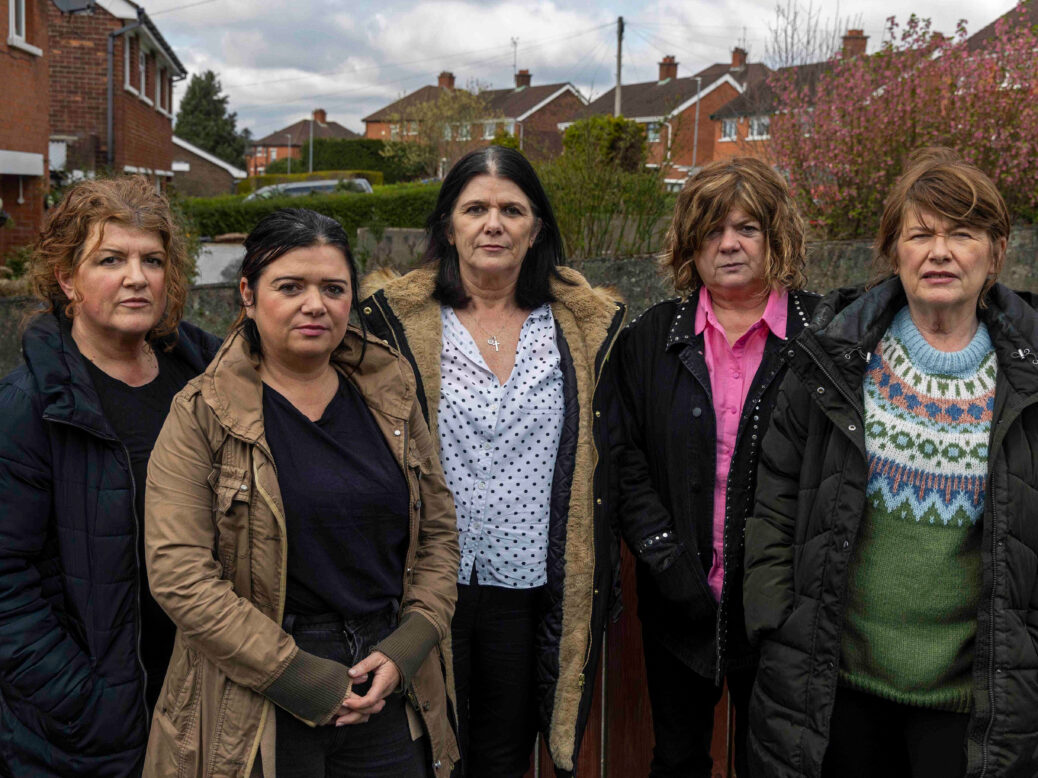
There were no guns, no balaclavas, no air of menace. Catherine, one of five McCartney sisters, says plain Hobnobs were on the table when they met two IRA men. She recalls “the disappointment they weren’t chocolate, because I think by that stage we were all very hungry”.
It was February 2005. Three weeks earlier, the sisters’ brother, Robert, had been stabbed to death outside a pub close to Belfast city centre. Over more than five hours, the men delivered the findings of an IRA inquiry into the murder from a ‘’fairly scrappy’’ piece of A4 fished out from a jeans pocket. “Their investigation produced more details of that night than the police did,” said Catherine.
The McCartneys were told IRA members were “involved” in the killing after all. It was a surprising reversal – just 11 days before, a shorter statement from the IRA had denied any involvement.
The meeting, the statement, the admission illustrated what Catherine and her sisters – Gemma, Paula, Donna and Claire – had accomplished after they refused to accept the first accounts of their brother’s death. They made the IRA think again – and contributors to a new BBC documentary series argue their brave campaign marked a pivotal moment in Northern Ireland’s peace process.

In Murder in Belfast: Sisters Seeking Justice, the filmmaker John O’Kane interviews the key players in this affair that has street crime meeting high politics. While the normally sure-footed republican movement struggled to deal with sisters who refused to be afraid, an American diplomat identified the McCartneys as the face of the issues preventing the completion of the peace process.
The IRA wasn’t quite the same afterwards. The irony is that the sisters ended up accomplishing something they never set out to.
On one level, the death of Robert, a 33-year-old father of two, was familiar. A pub argument turns violent, spills into the street where a knife is produced, and two men end up bleeding on the pavement. It has happened many times in many places without becoming political.
Rioters interfered with police trying to conduct searches. As many as 70 people were in the bar, but apart from one of Robert’s friends, no one could recall seeing the flashpoint that led to his death. The bar had been cleaned with bleach and its CCTV tape taken. The murder weapon had disappeared. “It wasn’t their first rodeo,” one detective says. “It’s not the Boys’ Brigade you’re looking at. It’s the Provisional IRA.” The funeral was to be held in the Short Strand, the nationalist enclave where the seven McCartney siblings had been raised (another brother, Gerard, died by suicide four years before Robert). The Short Strand is typical of Belfast working-class neighbourhoods. It’s often described as tight-knit and has well-defined boundaries: waste ground leading down to the river on one side, Protestant districts on every other, one of the main reasons the community’s knitted-ness is considered so tight.
Because the police investigation delayed the release of Robert’s body, it was a week until the funeral. That’s a lifetime in Belfast, so the sisters had time to hear what friends were piecing together. Catherine says: “The house never stopped. All the talk about who done it, who was involved, the police getting nowhere. It never stopped. You didn’t get a space to grieve. I think we actually still haven’t really grieved. Because it was done for years, that constantly searching for the truth. You don’t have time to grieve, so you don’t.”
Most witnesses were thought to be too afraid or too loyal to the IRA to speak to police, but the stories that reached the McCartneys revolved around one figure: Gerard “Jock” Davison, who police said was the most senior IRA figure in the area. He is dead now, shot in 2015 in an unrelated attack said to have been carried out by a former IRA comrade, who was killed by two gunmen in return.
Robert’s friend Brendan Devine, who was also stabbed but survived, gives his account of Davison’s role for the first time. Devine, a thick-set former boxer, says that when an argument began in the bar, he stepped in. A friend grabbed him and said, “Whatever you do, don’t be lifting your hand. That’s Jock Davison.”
The altercation turned violent, glass was smashed and dragged across Devine’s throat. He credits Robert with getting him out of the bar and into the street, where Devine made a fateful mistake. “I says: ‘Who’s Jock Davison? Did he do this to my throat?’” explains Devine. “And as soon as I said that name, four or five guys were in front of me, and they started shouting: ‘You’re getting it! You’re getting it! You’re getting it!’”
Devine claims he saw Davison draw his finger across his throat. Minutes later, he and Robert were crawling away, bleeding. According to the few accounts of that night, Robert hadn’t thrown so much as a punch.
More than 1,000 people attended Robert’s funeral mass. It was held in the Short Strand’s Catholic church, which 35 years before had been the scene of one of the Provisional IRA’s foundational moments. A gunfight with loyalists known as the Battle of St Matthew’s helped the IRA forge its reputation in the Catholic community as its defender.
Robert’s murder was endangering that reputation among the very people supposed to sustain it. He was, according to his sisters, a Sinn Féin voter and should have been one of the people the IRA was supposedly protecting. But between the clean-up at the bar and the riots aimed at disrupting the police investigation, the IRA was keeping the killers from justice. “The fact was that they could just murder you for no reason other than having an argument with you and that was going to be fine,” says Catherine.
The funeral was a turning point. “It was after he was buried you were able then to start to focus on why there was nobody being arrested,” says Catherine. “That was when I sort of woke up, in a sense, that something had to be done about the cover-up.”
And so began the family’s high-profile campaign for answers. The sisters, with Robert’s fiancée Bridgeen, were adept at capturing the media’s attention. Eamonn McCann, the Northern Ireland civil rights campaigner, spoke at a rally they held in the Short Strand. “What made the McCartney sisters so dangerous to the republican movement… is that they couldn’t be dismissed,” he says. “It was the integrity, the strength, the authenticity of the McCartney sisters which was most striking.”
There was also the timing. A month before Robert was killed, the Northern Bank in Belfast had been robbed of £26.5m. The IRA denied it, but many people, including their supporters, believed the robbery was to demonstrate to the British that the IRA hadn’t gone soft after years on ceasefire.
Along with robbery, the murder raised questions about the ongoing purpose of the IRA. More than a decade had passed since its first ceasefire, and the Good Friday Agreement had been in place for seven years. Policing had been reformed. Sinn Féin had become the largest nationalist party. Politics and the peace process was achieving what the armed struggled hadn’t. What was the IRA for?
About six weeks after Robert’s murder, Paula found herself approaching passport control in Washington DC and looking at the part of the landing card that asked for the purpose of the visit. “I had been reading the card and I was saying I hope no one says ‘the president’ here, because they’ll think we’re mad.” But Bridgeen, ahead of her in the queue, did say they had come to see the president. “So the big custom officers, I mean, they’re huge, and they’re intimidating, and he asked her: ‘President, hey… president of what?’ And she said: ‘Your country.’ So then the next thing was, we were all put in to the holding centre.”
It is testament to the amount of attention the McCartneys had that their detention was short. Paula says the late senator Ted Kennedy’s office confirmed the purpose of their visit: they really were on their way to the White House.
The McCartneys had been brought to Washington through Mitchell Reiss, who was then president George W Bush’s special envoy to Northern Ireland. He tells the BBC documentary the Americans saw Robert’s murder as emblematic of the problem the IRA posed for the peace process. “The thread between the Northern Bank robbery and the McCartney murder was really one of criminality,” he says. “Our feeling was that if the McCartney family was willing, and it didn’t seem exploitative, that they would be a very attractive poster for the criminality, the vigilantism, the injustice, the rough justice that was taking place across republican communities by the IRA.”
In the whirlwind of the McCartneys’ visit to Washington, that message seemed to work. Kennedy was one of a number of politicians who, having previously encouraged republican involvement in the peace process, started to talk about a decisive break with the IRA. Standing in front of the sisters, he called the IRA “an albatross” around the neck of Sinn Féin and the peace process.
Sinn Féin says British concessions on policing and justice led to rapid advances. But four months after the McCartneys’ trip to Washington, the IRA ordered its members to dump arms and pursue a purely political path. Two months later, the IRA announced it had put those arms “beyond use”. Reiss sees those steps as “a direct consequence” of the family’s trip.
Looking back over 20 years, Catherine sees the Washington visit as a turning point, but not one that helped deliver the family’s goal of bringing Robert’s killers to justice. “I’m not going to say that getting the peace process back on track was a bad thing. Obviously, it was a good thing for everyone,” she says. “But the gears had definitely shifted at that point when we were in Washington… that’s when we realised that it had become more political. And then once that happened, you sort of knew that you didn’t have any control over it.”
The McCartneys did get their moment in court, more than three years after Robert’s death, when three men were tried. But the case fell apart after it came to light that some prosecution witnesses had been tainted by the IRA. No justice, then, for Robert, but progress of sorts for Northern Ireland.
Chris Thornton is an executive producer of Murder in Belfast: Sisters Seeking Justice
[Further reading: Nigel Farage’s bastards]
Content from our partners



Related

This article appears in the 05 Nov 2026 issue of the New Statesman, Nigel Farage's bastards
Join the debate
Subscribe here to comment