
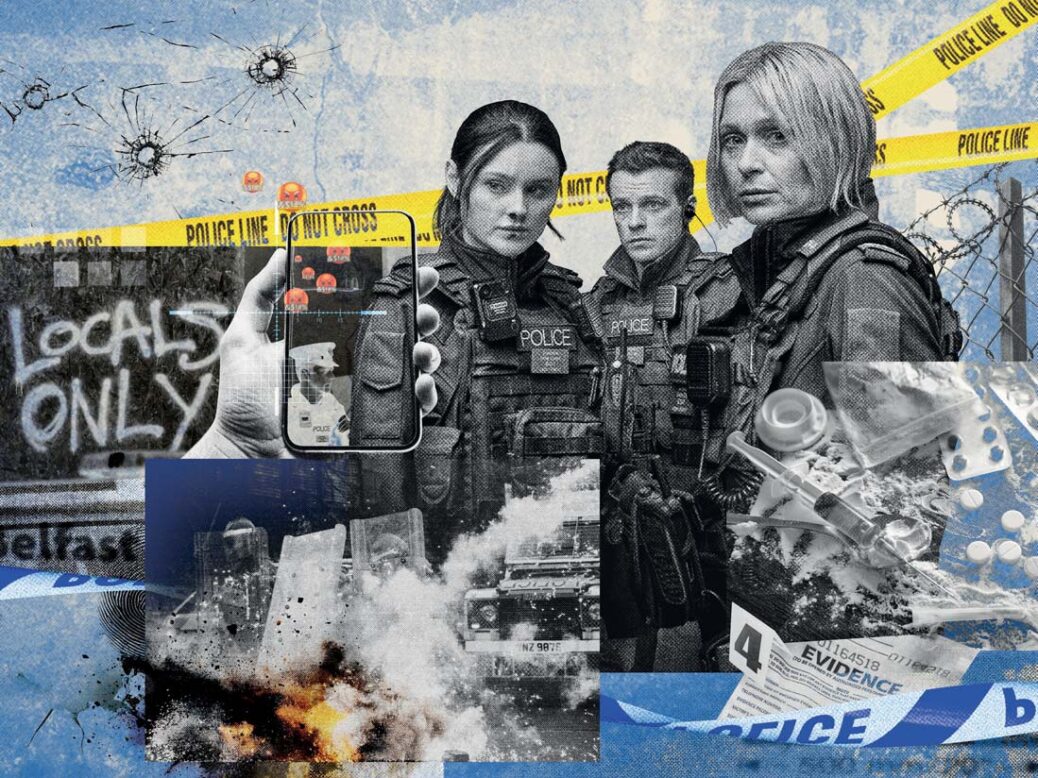
In June last year, I sat in the writers’ room for Blue Lights season four, reading a Facebook page in which people were listing their house number and ethnicity, in the hope that their homes would not be burnt down. A few days before, in Ballymena, County Antrim, two Romanian teenagers were arrested on suspicion of the rape of a local teenage girl. Those charges were dropped five months later, but at the time the incident was sufficient to strike a match. Serious violence ensued, as large groups of masked men began burning migrants out of their homes, while taking on the police with bricks and missiles.
I’m from Ballymena. Throughout the Troubles, it had always been a relatively quiet enclave, compared to Belfast, Derry or South Armagh. Yet here, all over the news, were riots and house-burnings that looked like they belonged in the 1970s. As I got drawn in to following the events in my home town, it became clear that the news reports didn’t quite capture the visceral reality that the TikTok accounts did. Reel after reel, post after post, it was up close and personal. Houses burning, people running, bricks being thrown.
These individual social media accounts fascinated me. The “citizen journalists”, as they called themselves, generally took great care during their live streams to distance themselves from the action with quasi-legalistic caveats such as “I’m not taking part – I’m just here to film this”. And yet, looking down the comments on the live videos, there was overwhelming support for the violence from accounts in both Great Britain and Ireland. Some of those filming had a few hundred followers, yet tens of thousands of people were watching their content. One of those filming – a young woman – giddily exclaimed: “I can’t believe how many people are watching this.” I was conscious, of course, that I was one of them.
And then there was the Facebook page. I won’t name the street in Ballymena, but I knew it well, as it was on my way to school. People who lived there or who had family there were posting door numbers online with messages like “No 76. My mum lives here, British, Ballymena born and bred, please avoid”, or “No 92, local family, from the town”. There were scores of these posts, some anxious and plaintive, identifying themselves and their families as local and therefore not to be attacked. It felt like a social media Passover: a modern version of the lamb’s blood on the doorpost, asking for the Angel of Death to pass by.

I sat, 30 miles away, in the comfort of a TV writers’ room, with its coffee and pastries and sense of detachment. That’s how you can feel in a writers’ room, as if the narrative currents of the world are all just dramatic possibilities, ideas you can play with. Except it didn’t feel like that this time. It felt like reality was clawing at the door.
In truth, the idea of violence and unrest around migration had been on our radar for some time, and on mine personally. I’d written a dissertation for a law degree a few years earlier about the astonishingly low prosecution rates for hate crime in Northern Ireland, and I had covered these issues several times as a journalist with the BBC in Belfast.
By this point, Blue Lights had a track record of tackling some difficult and complex subjects; the mechanics of the middle-class drugs trade run by paramilitary organisations, child trafficking, illegal money lending, the mental health crisis within the police and outside of it; all of them drawn from real-life research. And yet I knew, as did every writer in the room, that dealing with migration in Northern Ireland was going to be different. It would be controversial, divisive and problematic. Social media comment sections would accuse us of a political motivation, from all sides of the debate. In the end, the producer of the show Stephen Wright turned to me and said: “How can we not do this?” I knew he was right.
So, some facts. The latest figures suggest that there are just under 2,300 people on asylum support in Northern Ireland, which is about 0.1 per cent of the population. Over the last three years, the number of new arrivals claiming asylum has been declining. No figures are available for how many people have been granted refugee status specifically in Northern Ireland, because the government only publishes those figures nationally.
We do know that Northern Ireland is not experiencing a big population increase due to asylum or wider migration; in fact, it’s barely experiencing any population growth at all. Just over 1.9 million people live in Northern Ireland, and last year, the population increased by just 600.
It’s therefore difficult to argue that migration is putting significant overall pressure on public services or infrastructure. Even the figures are telling. In 2024, net migration into Northern Ireland stood at 5,800 people. In 2025, net migration turned negative – 800 more people left than arrived.
And migration from outside the UK in 2025? This seems like an important figure, since it is the one that contributes most to what we could euphemistically call the changing complexion of Northern Ireland. That number was 12,100, including healthcare and hospitality workers, international students at university, and those seeking asylum – overall 0.6 per cent of the population. According to the last census, about 6.5 per cent of the population of Northern Ireland were born outside the UK, about ten percentage points fewer than in England and Wales.
So why the purges? Where is the deep anger coming from? I spent eight years volunteering for an anti-poverty charity in Belfast, and because of where our branch was, the vast majority of our clients were either asylum seekers or working-class loyalists.
Over those years I spent a lot of time talking to both groups, both as a charity volunteer and sometimes as a journalist. My personal experience was that some loyalist communities have indeed seen a big change because that’s where the private companies who allocate housing to asylum seekers were able to find cheap, available accommodation.
Asylum seekers were not competing for social housing, but were being placed in properties owned by private landlords, and so some communities were voicing concerns about school places, doctors’ appointments, and access to other public services. The problem wasn’t the wider implications of asylum seekers or migrants in Northern Ireland – which remains negligible in a general sense – but rather it was rooted in specific communities who were seeing a difference.
These people articulated to me time and again that nobody was listening to their concerns in a political sense, and from what I could see, nobody was. These are communities that feel disenfranchised and voiceless on myriad issues; employment, education, and housing. They were now adding inward migration to their list of grievances that nobody in power wanted to hear about.
In episode two of Blue Lights season four, the anti-migration campaigner Katie Close (played by Tabitha Smyth) articulates that her community has seen significant negative change due to migration, but that middle-class politicians – and even police officers – don’t care in the slightest. It’s an argument to which Grace, the cop listening to her, has no answer.
Does this disgruntlement in certain communities explain three consecutive summers of violence against migrants that have shocked people both inside and outside Northern Ireland? Not fully. For that, you need a wider narrative in place that allows the anger of young people like Katie to be channelled into something bigger.
We have to look towards social media, and the “end of Western civilisation” hypothesis that has become so influential across the Western world. It is this narrative that has led to some surprising – and shocking – developments in Northern Ireland’s discourse.
In August 2024, in the wake of the Southport knife attack, anti-asylum protestors from Dublin travelled north to attend an anti-immigration protest in Belfast. They stood next to their loyalist counterparts, the Irish Tricolour next to the Union Flag. Nobody had ever seen anything quite like it. The image travelled around the world.
In 2025, TikTok videos of the Ballymena riots made their own global impression, shared and commented upon by thousands of people who had never been to Northern Ireland, but who were certain that the region was generally dealing with an orchestrated invasion of foreigners that was overwhelming the local population.
In June 2026, a horrific knife attack took place in Belfast. A local man was repeatedly stabbed in the street, with the assailant only stopped by passers-by wielding hurling sticks. A Sudanese refugee was charged with attempted murder. The video from that evening was deeply shocking, and enough to prompt more house-burnings and panic, giving rise to a city paralysed by fear. There were even unofficial checkpoints by anti-migrant protestors, attempting to establish the nationality of car occupants.
In that latest round of unrest, I saw another trend on social media: the transformation of digital support into physical solidarity. English anti-migration influencers were not just supporting online: they were getting on planes to join the protests, posting from English airports as they boarded their flights.
This was no time for statistics, or the nuance of Northern Ireland’s special circumstances as a post-conflict society in which social deprivation seems a baked-in cost to our fragile peace. In fact, the level of political analysis was so ignorant as to be laughable.
One English influencer posted a picture of a protest taking place in a loyalist area and said he was on his way there “to stand with my Irish brothers”. I almost laughed out loud, thinking to myself: “These are British loyalists. I hope you don’t call them Irish when you meet them.” It was not a time for nuance.
So how do we deal with this in Blue Lights? We merely attempt to show a few things: the terror of your house being attacked, no matter who you are; that some communities in very specific parts of Belfast see absolutely no political acknowledgement of their concerns; that, as one character says, “there are people from outside who want this place to tear itself apart”. And, of course, the role that social media plays in amplifying violence.
In the show, we get across the point that constant unrest around migration in Northern Ireland suits one group most of all – criminals, who revel in the fact that a police force with extremely limited resources must now devote a portion of its intelligence-gathering capacity to keeping tabs on young people with smartphones attending anti-migration riots.
Do we come to a pleasing solution dramatically? No, and it would have been a disservice to provide one. We introduce the possibility that the anti-migrant protestor Katie, having survived an attack on her own home, may finally be realising the horror of violence when it comes to your own front door, and might even – at some point – meet Amira, the migrant leader she has been persecuting. But we leave a lot of things up in the air, where, for now, they belong. We don’t know Katie’s future, or Amira’s, because at this point in Northern Ireland, we have no real conception of our own.
Declan Lawn is co-creator and co-writer of the Bafta-winning police drama Blue Lights
[Further reading: Doireann Ní Ghríofa: “Reading is a dark magic”]
Content from our partners



Related
This article appears in the 21 Oct 2026 issue of the New Statesman, Sally Rooney is a writer, not a terrorist
Join the debate
Subscribe here to comment