
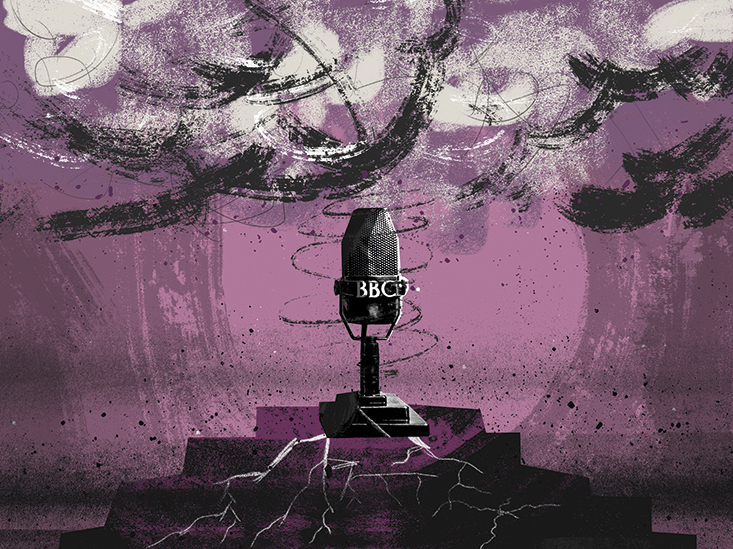
What would the UK feel like with no BBC? It’s not a fantastical question. The organisation that sustained the country’s sense of self through the Second World War and the postwar period is in profound crisis. Its future existence should no longer be taken for granted.
If you think that is a scaremongering outsider view, don’t take my word for it. The latest BBC annual report says that “a Charter that simply maintains the status quo will not be enough to deliver any recognisable version of the BBC in the years ahead”. Continuing would instead “abandon the BBC to managed decline”.
As the corporation grinds through another round of cuts, of around £500m, Amol Rajan – one of the high-profile Today programme presenters to have left the show, with Emma Barnett reportedly announcing her departure soon, too – has warned that it is “screwed“ on its current trajectory and destined “to get smaller at an accelerating rate”.
One factor contributing to the BBC crisis is that it has been suffering for some time from a resignation problem as internal self-confidence collapses. While Barnett is reported to be remaining at the corporation to front a current affairs podcast, Rajan is pursuing his own project on YouTube (though the BBC is kindly keeping his profile up by having him as a contestant in the new series of The Celebrity Traitors) because he has said he wants to ensure he is not “behind the curve”.

It’s a fast and dangerous curve; the media world is fragmenting at dizzying speed. Ofcom analysis shows the big picture: there’s a clear fall in the consumption of news on television generally; both online and social media as new sources are growing fast; live radio is holding steady; and newspapers face the worst decline of all.
Recent polling, for instance, by Find Out Now, shows hostility to the BBC’s values: 52 per cent of those surveyed said they didn’t trust the BBC to provide high-quality and impartial news coverage (only 28 per cent said they did). And the money follows the polling: during the current Charter decade, licence-fee income fell by 25 per cent – more than £1.3bn. That was partly because of successive freezes, but also because more people are refusing to pay. In the 2025-26 financial year alone, the number of TV licences fell by 539,000.
That number sets off the alarm sirens. But this is less a crisis of income than one of faith and gut. People just don’t like the BBC in the way they used to. After more than two decades working for the corporation, I am stopped in the street all the time by people who appear to loathe it. Older, Reform-minded people see it as woke, insufferably metropolitan, deceitful and, frankly, anti-white. Younger people, more to the left, complain that it is biased in favour of Israel, and power in general, and can’t be trusted to tell the “real truth”. Polling suggests that the numbers accusing it of left-wing bias are almost double those who think it is too right wing. Many of the first group have defected to GB News, and the second to online bubbles.
Yet this is not the moment for the BBC or its supporters to abandon hope. In polling about media trust, the BBC still far outpaces new rivals such as X or TikTok, never mind newspapers. And the decline in support for it closely matches a more general collapse in national optimism.
The think tank Demos conducts regular surveys about pride in Britishness and British institutions. It found that, whereas 15 years ago, the net pro-BBC rating was +48 per cent, it has now crashed to -11 per cent. That is a terrifying collapse. However, pride in Britishness was down from 74 per cent in 2011 – really not so very long ago – to just 47 per cent today. What these numbers suggest is that a fight to regain faith in the BBC is not unconnected with the fight to regain national optimism.
So, let’s return to the original question. How would we feel if it went completely? The worst news for the BBC is that the provision of high-quality, impartial commentary and factual reporting would continue perfectly well. To suggest otherwise is to libel other broadcasters and news providers. To declare an interest: as an LBC presenter, I think commercial radio, as well as Sky and the other private-sector TV broadcasters, do a good job in explaining and reporting. Without the BBC there wouldn’t be a sudden, dramatic, world-shifting information gap.
Instead, there would be something harder to describe: a further diluting of a national identity, the rug pulled from under togetherness. If you care about this country, and the possibility of us speaking together across the political divide in a reasonable tone, that should worry you. The question is: what can be done?
One advantage is that, in the new director general, Matt Brittin, a former Google executive, the corporation seems to have found a leader generating real enthusiasm internally, and with the energy to make big changes. Among his earliest challenges is finding a credible head of news. I’m told he approached Emma Tucker, the former editor of the Sunday Times,but was turned down. There are three internal candidates, but given the poor performance of news recently, he should keep looking outside. My personal suggestion would be Fraser Nelson, a Conservative and the former editor of the Spectator, but also a journalist of unusually independent spirit who knows how to lead.
As important, there needs to be decisive reinvestment in news and current affairs generally. This is the BBC’s spine and brain, and it isn’t worth saving without it. It has lost an astonishing number of experienced correspondents from around the world in just a few years. Whether in science, religious affairs, business or the less well-known trouble spots of the world, there has been a thinning out of knowledge, understanding and analysis.
Take Mark Urban, the best security correspondent in the country, who has left Newsnight for more welcoming pastures. Ask yourself who the best defence correspondent is. Once, you would assume a BBC name. In fact, by general agreement, it’s Deborah Haynes of Sky – the same broadcaster that also, in Ed Conway, has the best economics journalist. In Nick Robinson, the BBC has a fine political broadcaster, and its political team is hard working and experienced. Katie Razzall, the BBC media editor, is another fine broadcaster. But the loss of Rajan and Barnett should have shocked their managers. On the other side, Sky’s Beth Rigby and Sam Coates are a formidable pair and it seems a weird snobbishness on the part of the BBC that it hasn’t been trying to recruit them. There are many, many other examples.
In today’s media market, which offers so many opportunities to the best, it’s hard for the BBC to retain or poach them. But there seems to be a dozy, inattentive, slipshod attitude to journalistic talent, which costs the corporation far more than most managers realise. “Oh well, there’s another one gone. Never mind.” If the BBC doesn’t have better journalistic talent than its rivals, there really is no point in the licence fee. There is now apparently a lively debate about whether or not to continue with the job of Europe editor. This is madness.
As for much of the rest of its output, it is often better done elsewhere. The big drama event for most British viewers this autumn has been the return of Slow Horses, with the comedy-drama Ted Lasso not far behind – both are shown on Apple TV. BBC bosses can comfort themselves with the huge success of The Traitors, but there’s nothing specifically British or BBC about it. It is the achievement of the production company Studio Lambert, based on the Dutch series De Verraders, and it has spin-offs all around the world. It could have been broadcast in the UK by anyone.
As the BBC chases “reality” and entertainment shows, few of them unique, its old powerhouse of factual documentaries on history, culture and politics has been quietly demolished. David Attenborough, the great, much-loved Galápagos tortoise of natural history (I hope he won’t mind the metaphor) keeps on. But even today, TV about natural history is largely made and funded by outsiders. The BBC’s once remarkable stream of historical and cultural films has largely vanished.
Both the BBC’s head of history, Simon Young, and the head of natural history, Tom Watt-Smith, have reportedly had to warn employees about the shortage of money. The BBC series Wild Isles was part-funded by two charities, the World Wildlife Fund and the Royal Society for the Protection of Birds. A blue-chip natural history programme can cost up to £2m per episode; true crime costs around £150,000 per episode and it gets an audience of a similar figure. This, in granular terms, is how the BBC’s mission to educate dies.
This collapse of original factual programming has had a devastating effect on a specialist national workforce. These sound and camera operators, directors, and researchers – who once comprised a forceful, innovative and world-beating little industry without headquarters, flag or leader – have often been invisible. But all around the country, small independent filmmakers who had been dependent on the BBC have gone bust. I hear stories of people storing their Baftas away in cardboard boxes to retrain as yoga teachers, locksmiths, cabinet-makers or, in one case, an ice-skating tutor.
According to the broadcasting union Bectu, nearly half of Britain’s unscripted and factual television workforce was unemployed in 2025: unsurprisingly, a third are preparing to leave the industry. This is another crisis ministers really ought to get a grip on. If Labour wants to recreate the national self-confidence of the 1960s, it has to think more seriously about culture, including filmmaking and including a revival of the art colleges.
Like the Prime Minister and Chancellor, the BBC’s new director general didn’t understand, or wasn’t told, the full scale of the financial crisis before getting the job. The cuts he still has to make – his Budget, if you like – won’t make him popular.
Many clever people have tried to come up with a better funding model than the licence fee, which is now deeply unpopular. But there is no good answer. Household taxation, bound up with council tax, goes directly against Andy Burnham’s promises on the cost of living. Taxing smartphones would be difficult to police. Mutualisation is a lovely idea but it doesn’t solve the money problem.
Meanwhile, Brittin can focus on tough challenges that are solvable. One is the poor performance of BBC Studios, the broadcaster’s commercial wing, which brought in earnings (before interest, taxes, depreciation and amortisation) of a flat and paltry £263m in 2025-26. To help the corporation survive, BBC Studios has to multiply that figure by five. But if the BBC really wants to fight in the world of drama and entertainment, this is the fight it has to have. Brittin must also exploit the BBC’s vast back catalogue, a cornucopia that could transform the corporation’s reputation. There are complex legal issues about rights, but a revamped iPlayer brimming with the great dramas, documentaries and arts shows currently available only to BBC staff for research purposes would make the licence fee the key to a much greater treasure trove. Many of us would pay more, with pleasure, to have it.
Brittin is alert to the technical as well as financial weaknesses of today’s BBC. In the hugely successful Chinese broadcasting behemoth Bilibili, he has a model for a mix of commissioned and community-originated broadcasting, miles away from the vicious vortex of porn, racism and violence offered by today’s Western social media.
Without the BBC, this country would feel less confident, more American and more vulnerable to the quirks and idiosyncrasies of social media’s barons, none of which feels like a good outcome. Insiders compare Brittin to Burnham in this as well – he’s an enthusiast who realises how high the stakes really are, and who will soon have to take decisions that will make him unpopular.
And time may be short: a Reform government would gleefully put the corporation out of its misery. In the recent past, the BBC has behaved gutlessly, terrified of outside criticism, managed by people who in some cases neither know nor care about its fundamental purpose. Now, however, it’s in the fight of its life. It’s time to rally round.
[Further reading: Ed Davey asks Lib Dems to keep the faith]
Content from our partners



Related
This article appears in the 24 Sep 2026 issue of the New Statesman, A Sense of Power
Join the debate
Subscribe here to commentAndrew Marr throws Fraser Nelson’s hat into the ring as a potential head of news for the BBC. Nelson, as editor of The Spectator, allowed its columnist Rod Liddle to make personal attacks on George Monbiot for having the temerity to disagree with him. On one occasion, after Liddle attacked Monbiot for being sent to public school by his parents, rather than publishing an apology Nelson published the Spectator columnist writing that it didn’t matter because so few people read Monbiot.
It may be that Nelson’s treatment of Monbiot was an isolated case and Marr may have evidence that he is an ethical, principled individual of the kind that should be head of news at the BBC. I would submit that Nelson has, at the very least, questions to answer about his treatment of Monbiot.
So many of us gave up on the BBC in appalled disgust at its facilitating stenography (i won’t use the word ‘coverage’) of the Gaza genocide. Nelson is from the same Establishment cabal of right-wing neoconservative journalists as Marr himself. The recommendation, while laughable, is hardly a surprise.
I think it would be easier to defend the importance of the BBC’s news and political coverage if the standard and focus of their work hadn’t deteriorated so far and fast since Brexit.
This has been characterised by a desperation to give profile to Farage and his supporters regardless of their real importance (probably because they felt that as an institution they were out of touch with Leavers) and an obsession with day to day Westminster gossip – and its notable how poorly briefed BBC presenters are now compared to a decade ago.
I think any effort by the new BBC leadership to restore credibility needs to recognise that they have an internal quality problem more than systemic bias
the spectator slid (further) into the cess-pit under Frasers direction. Some very nasty stuff indeed
I would also add – can BBC News be trusted? I was a faithful watcher and listener for over 20 years, valuing the objectivity in BBC reporting. All of that crashed when the Telegraph revealed the manipulation of President Trump’s speech in a documentary. I am by no means a right wing conservative (I’m a registered independent), but the casual editing of words and lack of accountability from the producers has negatively impacted my trust in the BBC.
You’re surely not saying that the admittedly rather sloppy, editing of the Trump speech so long after the event made everything reported by the BBC suspect? Especially as it was reported by the, anti BBC, Telegraph. You’re very easily swayed.