
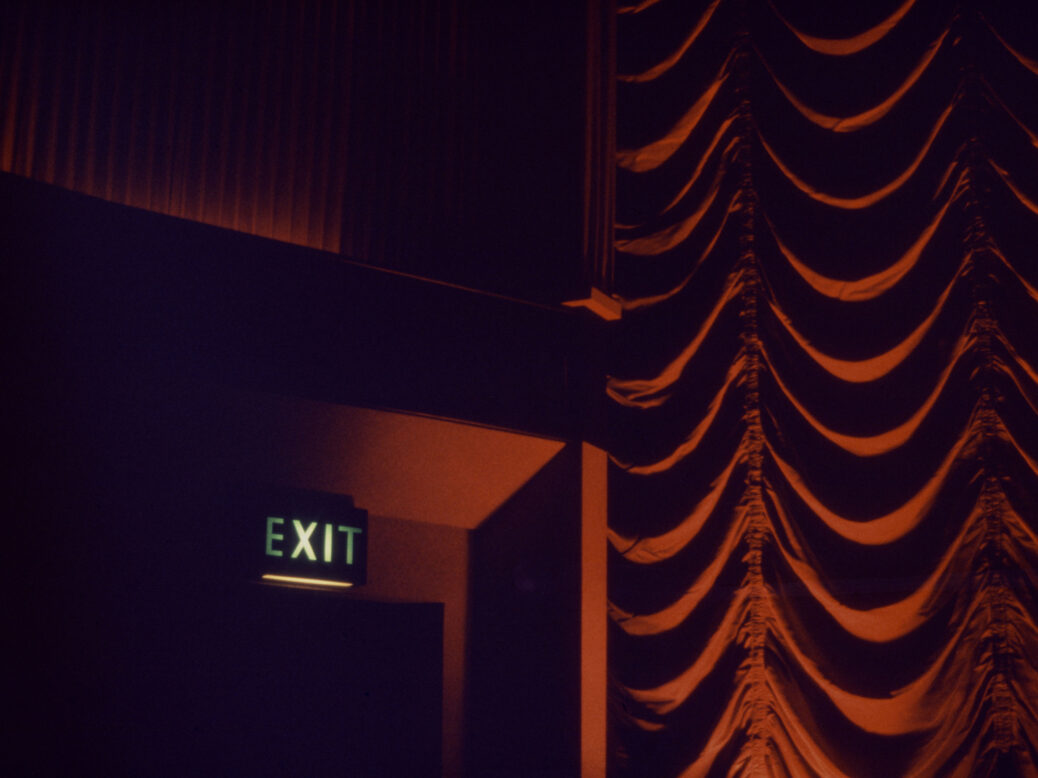
Lowestoft, the most easterly point in the UK, is the kind of English town where you can drink a £2.90 glass of wine while the faint smell of fish wafts in from a once-mighty herring port. Just off its high street you can find the Marina Theatre, home to Sunrise, Suffolk’s largest film festival.
As if you were swimming in the sea nearby, everything in the marina’s main auditorium is blue: velvet-blue chairs, sky-blue walls and a blue-and-yellow scallop carpet. The festival is advertised on a stark fluorescent purple screen. “Locally everyone recognises our branding, recognises our posters,” the festival director Joshua Freemantle, who founded Sunrise in 2021, told volunteers ahead of this year’s festival in August. “They know we’re coming.”
Sunrise was nearly cancelled this year. On 25 February, Access Community Trust (ACT), the festival’s funder, suddenly entered administration. Freemantle, who worked full-time at ACT, found himself unemployed, while the festival lost its assets and £4,000 of FilmFreeway fees overnight. Freemantle himself paid for Sunrise to become a community interest company, saving this year’s edition (most funding bodies require a formal corporate structure to be in place for festivals to apply for grants). It relied heavily on its volunteers.
The domination of streamers and studio filmmaking has pushed the UK independent film industry to the brink, accounting for only 6.8 per cent of the UK and Ireland box office in 2025. While the BFI’s 2026-29 National Lottery plan increases provisions for the sector (including £33.5m for independent cinemas and festivals and £10.8m for the Film Audience Network, which funds Sunrise), independent festivals are stuck in a downward spiral, forced to quantify their worth by the size of their audiences, despite BFI statistics showing cinema admissions last year were 30 per cent below 2019 levels.

Local festivals sit at the bottom of a complex funding ecosystem, outflanked by major festivals like London and Edinburgh and national institutions like the BFI and Screen Scotland. With Ipswich starting its own international film festival in October (part of its attempt to become the UK City of Culture 2029), Freemantle has found himself having to back the town’s bid, fearing funding would be redirected away from Sunrise.
The UK film industry has crafted a system that is incredibly successful at attracting international productions but leaves the independent industry in constant uncertainty. Britain is a hugely successful production location for studios, largely due to tax incentives and filmmaking infrastructure (from highly skilled crews to VFX houses), yet the influx of studio financing hoovers up British actors, crews and audiences, stymying the independent sector. According to the BFI’s 2025 statistics, 85 per cent of the UK’s £6.8bn production spend on film and high-end TV came from foreign investment (for film alone, this reaches 90 per cent).
But independent British cinema is important in its own right. The BFI’s 2022 Economic Review of UK Independent Film found that the sector produces “cultural value over and above the economic value it generates” because it is a training ground and platform for filmmakers to take creative risks. Some of the UK’s most-beloved directors – including Danny Boyle, Terence Davies and Andrea Arnold – all started in independent productions. Local festivals like Sunrise give the next generation of on-screen and off-screen talent a place to launch their careers. “The best way to get my name out there is to meet directors at places like this,” says Jane Martin-Smith, a 36-year-old actor with no formal training. For 30-year-old Leah Finegold, director of the short film Please Do Not Resuscitate, Sunrise (a British Independent Film Awards-qualifying festival) is just as important in her festival strategy as the film’s premiere at the Academy Award-accredited Short Shorts Film Festival & Asia in Tokyo. “With local UK festivals, there’s more of an intimacy and support for first-time filmmakers,” she says.
No one in Lowestoft expects a lot of money for independent film, but filmmakers hope for better funding at the local level and more information about accessing it. That, and a recognition of how much their sector brings to the UK despite how little it is supported. “There’s this idea that people investing in distribution are taking the biggest risk,” says Chloe Malone, the 27-year-old producer of Sunrise-screening Heartbreak who has experienced homelessness in the past year. “The creative industry has so many people living pay cheque to pay cheque or sofa surfing. They would never consider themselves homeless because that’s the norm.” She references Sally Choi, the art director for the indie horror smash hit Obsession, who was paid just $6,741 after taxes, despite the film grossing over $500m worldwide.
Obsession’s success was an outlier. Of the UK’s top 20 releases last year, 17 were part of a franchise, sequels, remakes or based on pre-existing IP. A Minecraft Movie, the UK’s highest-grossing release (at £56.9m), is based on the best-selling individual video game of all time, a built-in advertisement to millions of players. In comparison, only ten UK independent releases earned £2m or more.
Malone understands why multiplexes show Hollywood blockbusters over indie festivals: “With the cost-of-living crisis, people go to the cinema once a year and they need something they know is going to make them happy.”
Meanwhile, a lot of Lowestoft residents have never heard of Sunrise – even those walking past its advertising. Two friends, Connor and Steven, are heading to a multiplex in Norwich to watch David Robert Mitchell’s The End of Oak Street. They laugh at the prospect of seeing the film in their hometown. “It’s not a great cinema.” I ask a few residents for the last film they watched in the cinema. “Spider-Man,” say both Holly, 18, and Barbara, 82, proof of the ageless attraction of the franchise film – and men in Lycra. Stacy also prefers a man in a suit. “I went to see the last Bond film,” she says. “I love a bit of Daniel Craig.”
Many of those involved in the Sunrise festival work normal jobs and accept they will never make a real living from their films. They are driven by their own passion, and the desire to entertain a small audience. Some of the results are exceptional. From Poppy Brown’s eccentric documentary The Hamster Racing Man to Rosie Brear’s stylish Bloodsuckers, there is nothing like these films on national screens. What a shame.
Note: This article was amended on 18 September 2026 to correct inaccuracies relating to the Sunrise Film Festival.
[Further reading: Our island stories]
Content from our partners



Related


Join the debate
Subscribe here to commentI buy 10 movie pack to a British Film festival in Australia each year, ‘The Ballad of Wallis Island’ is my fav, but there are heaps of great movies. Its the best value for money ever spent!