
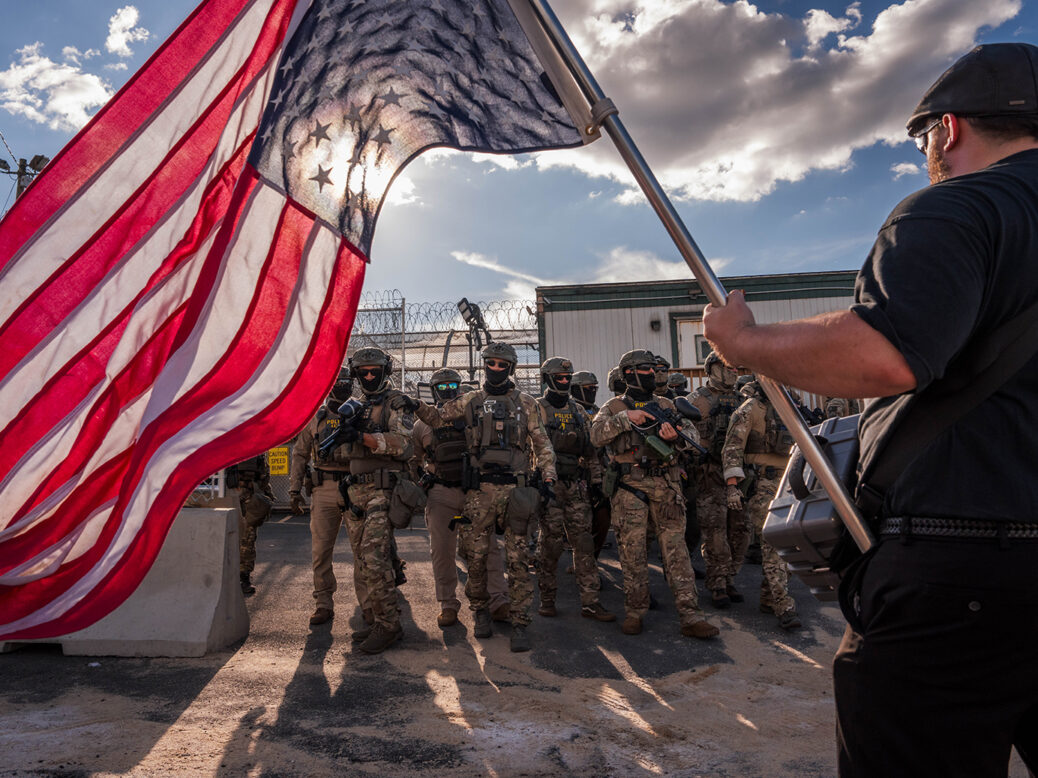
I must confess to a hesitation. It has become fashionable to describe things you don’t like in extreme terms. This is, I think, largely driven by algorithmic changes to our modes of communication. If you wish to be heard on social media, you will need to say something different and forceful, and how far the remark travels will be dictated by its capacity to provoke those listening. This has bled into other ways we talk. As the far right advances, we are told the fascists are at the gate. But this is where I have hesitated, at least until recently.
Fascism is not conservatism. Its building blocks are well known: authoritarianism, national supremacism, militarism and demagogy. Usually, it aims at some form of national rebirth under the guidance of a charismatic dictator, often accompanied by the aggressive expansion of a nation’s physical territory, while leveraging symbols and language as instruments of power. The context that has given rise to it is important too: economic collapse, technological revolution, national humiliation.
My view is that if words are to mean anything, you should not cheapen them with misapplication. If an everyday Tory becomes a “fascist”, then why would anyone heed the alarm as brownshirts march towards them? Saying so also undermines the specific horrors of the 20th century and minimises the suffering of totalitarianism’s victims, the millions persecuted and exterminated. But what about the new iterations of the right that are not Tory but something else? How are we to think of Donald Trump, Marine Le Pen, Alice Weidel or our own Nigel Farage? Even as the Trump administration deployed Ice militiamen across the US, obsessed over aesthetics, and toyed with the annexation of Canada and Greenland, while UK and European political parties embraced “remigration”, I hesitated. The Canadian author Naomi Klein, though, believes the time for hesitation is over. Last month, she published End Times Fascism, with co-author Astra Taylor, which argues that fascism has evolved for the modern age, no longer an army of marching goons but an alliance of religious fundamentalists, tech oligarchs and ethno-nationalists. I found it compelling and horrifying in equal measure.
In my recent interview with Klein, she made me reconsider the idea that 20th-century fascism was unique. She connected the treatment of black people under the American South’s Jim Crow laws – which were introduced from the late 19th century onwards – with Germany’s colonisation of Namibia in the 1890s, and its subsequent extermination of the Nama and Herero people, arguing that “fascism has a prehistory; it was not a rupture in time and space that came out of nowhere”.

What happened in Europe’s colonial outposts, in other words, was the rehearsal. Skulls from the camps in Namibia were shipped to Berlin for German race scientists to measure, while Nazi lawyers studied US race law before drafting their own.
Klein’s second argument is that history does not repeat itself. It moves in a spiral rather than a loop. Each turn looks familiar, but you arrive somewhere new. The fascism of last century matched the economic methods of the time – killing on an industrial scale. Our world, in contrast, is atomised and monetised, with influencers instead of generals and algorithms where there used to be production lines. If you’re looking for a rerun of the 1930s, you will never find it. “Why wouldn’t it look like us?” Klein told me. “It comes from us.”
I still wouldn’t call a Tory a fascist, but a word saved purely for fascism that existed in the 1930s is redundant. We won’t see it like that again, but that doesn’t mean we won’t see fascism ever again.
Trump’s Ice more than doubled its workforce last year by scrapping the age cap for applicants and offering signing bonuses of up to $50,000. Perhaps the brownshirts I was waiting for arrived in balaclavas on federal salaries. Then there is Britain. Reform’s Zia Yusuf has promised a UK Deportation Command capable of removing up to 288,000 people a year from a country he says is being “invaded” – up from less than 10,000 “enforced returns” currently being enacted by the Home Office. Reform’s proposed “command” would be nothing like Ice, Yusuf insists, because its officers would not carry weapons and Britain is policed by consent.
But consent is exactly what such a programme cannot count on. Klein credits the neighbours of Minneapolis, organised through churches, mosques and unions, with forcing Ice into retreat. The people of London and Glasgow were organising in a similar fashion long before then. In 2021 the residents of Kenmure Street in Glasgow’s Pollokshields surrounded a deportation van until the two Sikh men inside, held over immigration violations, were released.
The prospect of similar seizures happening thousands of times every week across the country assumes a level of public apathy and acquiescence that I simply do not believe exists. The practical reality of Reform’s immigration plan, then, is that it will demand a display of authoritarian force we have not seen in this country at least for the duration of my lifetime if not far longer. Does that mean such policies are, therefore, fascist? Klein knows her own mind on this question, though I still hesitate. Yet she has convinced me of one thing: whatever fascism will look like in the future, we should rid ourselves of the illusion that it will be as easily recognisable as what came before. It will not – because it will look like us.
Listen to Naomi Klein in conversation with Oli Dugmore on our interview podcast The Exchange
[Further reading: The “Zionism is racism” fallout]
Content from our partners



Related
This article appears in the 14 Oct 2026 issue of the New Statesman, Fool Britannia
Join the debate
Subscribe here to comment“I want to call people fascists, but they don’t fit the definition of fascism – lets change the definition and call them fascists”.