

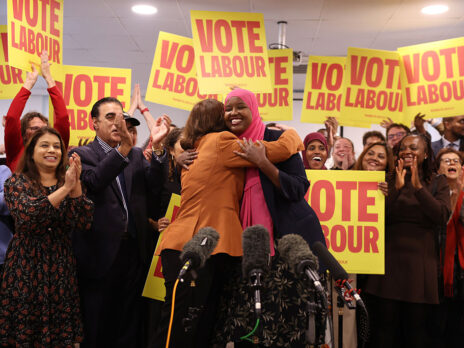
In the 1983 general election, Labour presented itself to the voters with a bold slogan: “The New Hope for Britain”. It was a hope, however, that involved disarming the country and breaking our economic ties with Europe, and the voters of Britain naturally viewed such policies as a madness they would never inflict upon themselves. Labour lost three million votes and remained out of power for another 14 years. And so, when picking a new slogan for the Labour Party, you definitely want to avoid combining hope with novelty. Or that’s what I would have said if I’d been invited to the meeting in which the new motif for this year’s Labour conference was decided, but I wasn’t, and so there it is, on signs and banners across the Liverpool Experience Campus, projected on to the wall behind Andy Burnham and his cabinet as they address the party: “Hope again”.
“Hope again” can be read as an imperative – quick, muster some more hope! – but it does also have the unfortunate ring of a party sighing to itself: “Hope, again?” Despite Labour’s failure to deliver Change, despite everything that’s going on in the world, despite the obvious success other parties are having with Anger and Fear, we’re going with Hope, again?
That said, there’s no such thing as an honest political slogan. You can’t deliver a speech in front of a banner that says “Let’s Swerve Between Rage and Indifference”, or hand out leaflets that say “We’re Sceptical But We Don’t Have Any Better Ideas”. That’s just not politics. You can’t put John Healey behind a lectern that reads “We Couldn’t Afford Change So We’re Switching to Aspiration”, however accurate that might be.
An important truth about Healey, and one that’s rarely discussed, is the fact that he looks like a butcher. This isn’t down to a single feature, such as the carefully trimmed beard that made a young Zack Polanski look like a stage magician. It’s just a general air of butcherishness. He would seem comfortable under a striped awning. There’s just something about him that suggests he has a couple of Barnsley chops in a fridge.

This might seem like a frivolous and insulting way to talk about the Chancellor, but it’s actually a carefully constructed and clever political insight. To understand why, we must return briefly to the 1983 election. In the handful of seats to which Labour clung in that disastrous wipeout, two future prime ministers began parliamentary careers: Tony Blair and Gordon Brown (Jeremy Corbyn also became an MP that year). Under Keir Starmer, Labour found itself in Blair’s insistent, weirdly muscular embrace. Starmer spoke at Blair’s Future of Britain conference, promising “growth, growth, growth”, and was surrounded by advisers and cabinet ministers who played similar roles for Blair. This is also true of Burnham to an extent – his chief of staff, James Purnell, was a special adviser to Blair – but in spirit, this year’s Labour conference felt more Gordon than Tony.
This was clearest when Healey delivered his speech on 28 September. The Chancellor wore a tie with a smeary red pattern – perhaps it had been used to wrap up a pound of chuck steak – which was, he revealed, a treasured icon. In 1999, Brown had returned from a meeting of finance ministers in Washington to speak to Labour’s conference in Blackpool. He prepared with his special adviser, Ed Miliband, his mentee, Douglas Alexander, and his parliamentary private secretary, John Healey. Moments before the speech it was realised: “Gordon needs a red tie!” and Healey gladly removed his own, which he wore again for the first time this week, during a speech in which he made it clear that his relationship with Brown was the foundation stone of his political career.
As Healey finished speaking he was embraced by Burnham, who fondled the tie – it really is a spectacularly ugly tie – and asked if he could borrow it for his own speech the following day. As it turned out, Burnham, didn’t wear one at all; presumably the garment was being used to hold together a boneless chicken. But the Prime Minister, too, quoted Brown in his speech, and compared his plan to cope with whatever the hell is going to happen with AI to Brown’s handling of the financial crisis.
When Brown was PM, civil servants would receive emails, written before dawn and in capital letters, about policy ideas or things that needed putting right. Healey still gets those emails, and reads them with relish. Healey, Miliband, Alexander and others in Burnham’s cabinet, such as Yvette Cooper (and Burnham himself), were advisers to Brown and ministers in his government. They care more about bus fares, care workers and council houses than statesmanship and security, and consider themselves to be the real Labour Party. Burnham’s speech was a powerful tribute to his father. But he and his allies are also Gordon’s children.
You can hear it in the way they talk. Blair’s messianic confidence allowed him to associate with anyone – Silicon Valley centibillionaires, crypto fraudsters, despots – because he believes power comes from influencing such people. Brown’s lot are not visionaries on a quest for transformation. They are individuals who recognise that things have gone wrong, and they are genuinely annoyed. Miliband’s speeches are best when they’re angry. Burnham practically shouted that Britain had been “broken up and sold off”. He fumed at water companies and the “vested interests” on whose behalf he says Britain has been run. In Healey’s speech, he distinguished between an “economic must” and a “moral duty”. For Blair these would simply be the same thing. In Blair’s world the government has a responsibility to keep the housing market afloat; in Brown’s world it is the government’s responsibility to take on scumbag landlords. Burnham said in his speech that the failure to fix social care was not just something that had happened; it was an act of cowardice.
There is a strong echo of the Brown years in the situation his political offspring find themselves. They arrive in power, as he did, with about three years to make the best of a dodgy situation. Brown arrived in No 10 on 27 June 2007, just as the US investment bank Bear Stearns was collapsing under the losses incurred by its mortgage-backed securities. Burnham and Healey have arrived just as government bond yields and inflation expectations are reaching uncomfortable new peaks, and the world’s most powerful tech companies are pre-emptively apologising for the apocalypse. There is now, as there was in 2007, a strong sense that while the shit has not yet hit the fan, the shit is almost certainly airborne, and the fan is running at full speed.
On the Albert Dock I saw a middle-aged man in a grey suit carrying a transparent plastic box full of little buses. The box had leaflets on top that threatened to blow away; the buses clattered around inside as he attempted to control the situation. This is a large part of what makes up a political party conference. The speeches are the tip of the iceberg, which is itself made up of party members voting on policy motions and lobbyists carrying around a landfill site’s worth of tote bags and branded stationery. In this respect, every Labour conference is fairly typical – the same miles of carpet to traipse, the same meetings and panel discussions and drinks in large-yet-windowless rooms. What changes is the overall sense that emerges from all these people of how things are going, and this year, things are going Brown.
[Further reading: John Healey renews old ties to New Labour]
Content from our partners


Related

This article appears in the 01 Oct 2026 issue of the New Statesman, Sunshine and Rain
Join the debate
Subscribe here to comment