
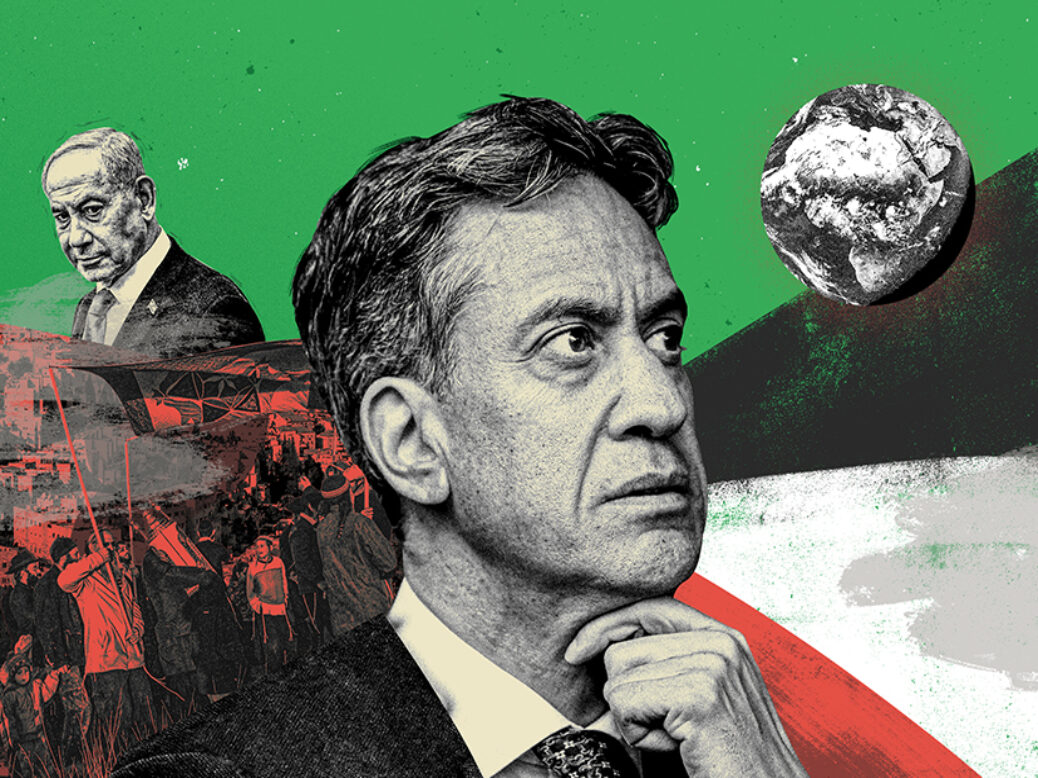
It was at one of Westminster’s summer parties, in a room high up, overlooking the Thames, with warm white wine swirling, that Ed Miliband made his first extended public remarks as the UK’s new Foreign Secretary. It was the kind of event Miliband loves, a think tank party, full of wonks and academics, who care about ideas and publish papers – the sort of people who love Miliband, and Miliband loves them. In his decades thinking about climate, political economy and ideas, they have always been his people.
“I want to say something about my job,” he said. “I used to think the best job in government was being the energy secretary. I now think foreign secretary is the best job in government.” The crowd roared with affectionate laughter. “I really do!” he went on, grinning. “It’s so exciting!” He knew why they were laughing: not because of what was said, but what was unsaid.
In a certain telling of Labour history, Ed Miliband could have been, even should have been, Andy Burnham’s chancellor. He was, at one point, Burnham’s pick for the role, and he would have been well suited for it, having spent years practically preparing for the job, as someone who thinks deeply about political economy, green economics and progressive economic policies. He knows how to run rings around the Treasury from his days advising Gordon Brown; he knows how to get things done; and he pushes the boundaries of what is politically possible. Even some cabinet ministers who are not natural Miliband fans believe he should have been given the role. Instead, Burnham chose John Healey, perhaps a more compliant character, while Miliband to everyone’s surprise has found himself in another Great Office of State that he had never coveted or expressed much interest in. “He’s spent the past decade thinking about political economy,” a friend remarks after Burnham appointed his cabinet. “Now suddenly he has to think about foreign policy!”
But this is Ed Miliband, one of the most dynamic, albeit divisive, politicians in parliament – a Michael Gove character who can’t help but put his stamp on whatever he touches. No one watching that speech, or who has any familiarity with Miliband as a politician, would ever have doubted that as a Foreign Secretary he would be very interesting. “I’m not the sort of chief ambassador of the UK government,” he announced in that speech. “I’m a politician.” Only a week into the role, Miliband had decided that his job was to inject values and politics into British foreign policy. He told the audience that evening that he would do “everything I can – and I feel this very, very deeply – to end the suffering of the people of Gaza, and fight for the two-state solution with security for the Palestinian people and the Israeli people. It is about applying our values as a party and as a government.”

Now, almost two months into the job, Miliband has unveiled the biggest reset in UK relations with Israel for decades. On 8 September, he announced a ban on imports from illegal Israeli settlements in the West Bank, and described the situation in the territory as ethnic cleansing and settlers as “terrorists”. But it was also a much bigger statement about Israel and Palestine: defending the right of Israel to exist and emphasising Britain’s “unshakeable bonds” with the Israeli people while condemning Benjamin Netanyahu’s government in a tone not heard before from the British government. He described what has been happening in Gaza as “a stain on the conscience of the world and of this country too”, and announced the start of “a new approach… that not only calls out injustice and suffering but acts”. Behind him, on the front bench, cabinet colleagues appeared visibly emotional. Miatta Fahnbulleh, the Energy Secretary, wiped tears from her eyes. “Ed’s statement was one of the most powerful pieces of oratory that I’ve seen in the chamber since I became an MP,” one cabinet minister reflects. Another says it was a “proud, historic moment”.
From day one of Miliband’s appointment as Foreign Secretary, he and Burnham were in agreement not only on a new approach towards Israel, but specifically that they wanted to respond to accelerating settler violence in the West Bank. Miliband spent the summer working intensively on the details of the sanctions package, while both men made a push behind the scenes to bring allies on board. “There was a huge diplomatic effort over the summer from Burnham and Miliband to make sure we move with allies,” one government insider says. They were delighted when, to the surprise of commentators downplaying its significance, they were able to announce the move alongside France and Canada, with other countries announcing their intentions to join soon. It’s a new direction, with one insider saying it’s part of seeking deeper alliances with like-minded middle powers.
Miliband cares deeply about these issues and feels well-placed to defend the two-state solution as a proudly Jewish man. Miliband’s grandmother made Israel her home after losing 60 of her family members in the Holocaust, and he has fond memories of visiting her in Tel Aviv as a child. While others further to the left equivocate over Israel’s existence – with a motion on whether “Zionism is racism” due to be debated at the Green Party Conference – Miliband is steadfast that his family’s story is one of many reasons why he will always defend Israel’s right to exist as a homeland for the Jewish people.
He sees no contradiction between his support for Israel and his support for the Palestinian cause – he believes a two-state solution is the only route to freedom and security for Israelis and Palestinians. Support for the Palestinian cause is just as deep in Miliband’s heritage as for Israel, because his mother campaigned on the issue for years. She died in May, “so today was a bit for Marion too”, a friend reflected after his statement. “Ed’s moral clarity on it comes from her,” another ally said.
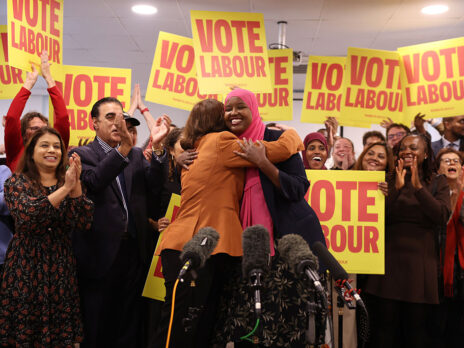
In early July, days before becoming prime minister, Burnham released a statement apologising for the way Labour responded to Israel’s military action in Gaza. “Labour’s initial response to the treatment of Gaza caused huge hurt. We got it wrong,” he wrote on social media. Keir Starmer’s comments to LBC in the aftermath of the 7 October attacks – he said that Israel “had that right” to turn off electricity and water in Gaza – have haunted the party in the years since, even as government policy has moved, with insiders saying it caused a huge breach of trust with Muslim voters and other progressives who care deeply about the Palestinian cause. Burnham was one of the high-profile Labour figures calling for a ceasefire in Gaza by late October 2023, at odds with Starmer. In the 2024 general election, while winning big, Labour lost a handful of seats to “Gaza independents” over the issue.
Labour insiders insist that Burnham and Miliband’s move to sanction Israeli settlements is not about domestic politics or winning back lost voters. “The reason we’ve done it is because we think it’s the right thing to do,” one government insider says. And it matters a great deal: polling by Opinium in June found that more than half of former Labour voters who intend to vote for a different centre or left-wing party in the next general election cited Labour’s position on Israel and Gaza as a factor.
Inside the Labour Party, there is widespread jubilation at the move. “We should have acted earlier,” Miliband said on 8 September. “It has taken the new Prime Minister to come in to recognise the gravity of the situation and recognise the degree of public concern.” “I am sure Ed’s immediate predecessors feel some ruefulness today,” another minister notes. “But we got there.”
Burnham and Miliband’s shift isn’t without political risk. As well as backlash from Israel, the American diplomatic reaction has been sharp. The US ambassador to Israel, Mike Huckabee, accused the UK of “Jew hate”. Again, Miliband hopes his Jewish heritage and staunch support of Israel’s right to exist will reassure the Americans, and emphasises the difference between targeted West Bank sanctions and the BDS boycott of all Israeli goods that Miliband himself opposes.
The Foreign Secretary has made Israel-Palestine his top priority, and has no plans to change focus after unveiling the sanctions package. “We are probably the global progressive leader on this so we will keep going,” an ally suggests. Miliband intends to use the UN General Assembly later this month to shine “the clearest and harshest spotlight on what is happening and what must change” in Gaza, he told the Commons. Labour MPs don’t rule out the possibility of a ban on arms sales to Israel at some point in the parliament if the situation continues to deteriorate.
And Miliband will continue being Miliband on climate, too, even though he no longer holds the energy brief. He has taken his climate campaigning global, too, with a big push on climate diplomacy and a win banked in: that Burnham – a Prime Minister focused on domestic priorities – will attend the Cop climate conference with Miliband this autumn. The Foreign Secretary will seek to integrate climate into security policy thinking in the coming months, too. Another area to watch is whether Miliband pushes to reinstate the 0.7 per cent of GDP target on aid spending.
After watching Ed Miliband’s impassioned statement, some Labour MPs began to reflect that appointing him to the Foreign Office hadn’t been such a waste of his skillset after all. “He is maybe the only sitting Labour MP who could have done it, on reflection,” a minister says. “But it also required Andy’s consent and support and his perceptive decision to appoint him to that role.” For all of the disappointment among his allies that he wasn’t appointed chancellor, in the end, they believe he suits this moment as Foreign Secretary perfectly. And he’s only just getting started.
[Further reading: Could Labour lose London?]
Content from our partners



Related
This article appears in the 10 Sep 2026 issue of the New Statesman, The World According To Ed
Join the debate
Subscribe here to commentAt last! A small twinkle of hope. And I haven’t voted Labour since the Iraq war but am socialist to my socks (sent to sleep as a baby by my mum singing the Red Flag) and a political nomad for 22 years. And no, I am not without cynicism and doubt and know I cannot come home just yet but in this move is the return of just the ghost of the principles i treasure and a small hope that the Labour Party should be about more than just winning elections
Miliband and Burnham have taken a very important step towards containing Israel, probably the most that they could have in this first policy move. Now they need to go a step further and accept the opinion of most of the world, and of the ICJ, that a genocide is occurring in Gaza. As a party Labour will of course be hoping to win back pro-Palestinian supporters, but there is more than electoral cynicism at play.
It is a pity that on all sides of the issue it is common to talk about Israel’s “right to exist” – or not. This a discussion that Miliband referenced in his Commons speech. There is more than the normal obfuscation in this and other language used discussing Israel/Palestine, and it would be helpful to aim for more clarity. As the legal scholar and UN Special Rapporteur on the occupied Palestinian territories Francesca Albanese explained in a video, no nation has a right to exist. The Israeli state exists, until such time as it doesn’t. The same goes for the UK, and every other state. Currently Scotland exists as a nation, but not as a state; if the Scottish people were to vote in a referendum to have their own state, it would also exist as a state, until such time as it didn’t.
This is more than semantics. Whatever fantasies some people might have, no other state is going to destroy a nuclear armed Israeli state. But it is quite likely that the Israelis will do it themselves, in the fullness of time. Making Israel a pariah state, with targeted sanctions and even full blown BDS, should speed up the process. But that does not mean that Jews should cease to have a homeland in the Middle East, only that the theocratic, apartheid, anti-democratic state of Israel would cease to exist.
The comparison with apartheid South Africa is helpful. The anthropologist and political scientist Mahmoud Mamdani (father of Zohran) lived in South Africa through the period of Truth and Reconciliation that dismantled the South African apartheid state and he has argued, in “Neither Settler nor Native”, that the way to defend a Jewish homeland has to be through a similar process, with Jews and Palestinians creating a new secular state that guarantees the rights of all citizens. Calls in the USA to stop arming Israel, led by Bernie Sanders, are giving a powerful push in this direction.
(1) Does the timing of this announcement not risk pushing wavering Israeli voters towards supporting the current government, by reinforcing their erception that the owrld os against them and only hardliners can maintain the secuorty f the state?
(2) Are there practical difficulties identfyng goods and services from occupied territor rather than Israel proper?
Exactly. Whatever you think of the measures themselves (not much in my case) the timing is extraordinary for just that reason. 7 week wait is all it would have taken.
Are people only now realising that there are practical difficulties in imposing sanctions, were they really unaware that there were difficulties in imposing sanctions on South Africa, Russia and Iran? That does not mean that sanctions are not a valuable tool.
7 weeks? People are being displaced and terrorised TODAY.
No “new approach”. Labor continues its long standing “impassioned” policy as the protectorate of certain Middle Eastern and Northern African groups and their increasing diaspora in the West. Also known as fighting Islamophobia. In fact, Milliband could have lifted his remarks from recent speeches from Prime Minister Pedro Sánchez of Spain or the Mayor of NYC.
Aggressive foreign policy, yes. Winning propaganda wars, maybe. Improving Labor vote numbers, just look at Germany last Sunday..
Britain and Europe have a real legitimacy problem of political leaders year after year running public approvals below 30% while delaying elections. Burnham looks to be no different.