
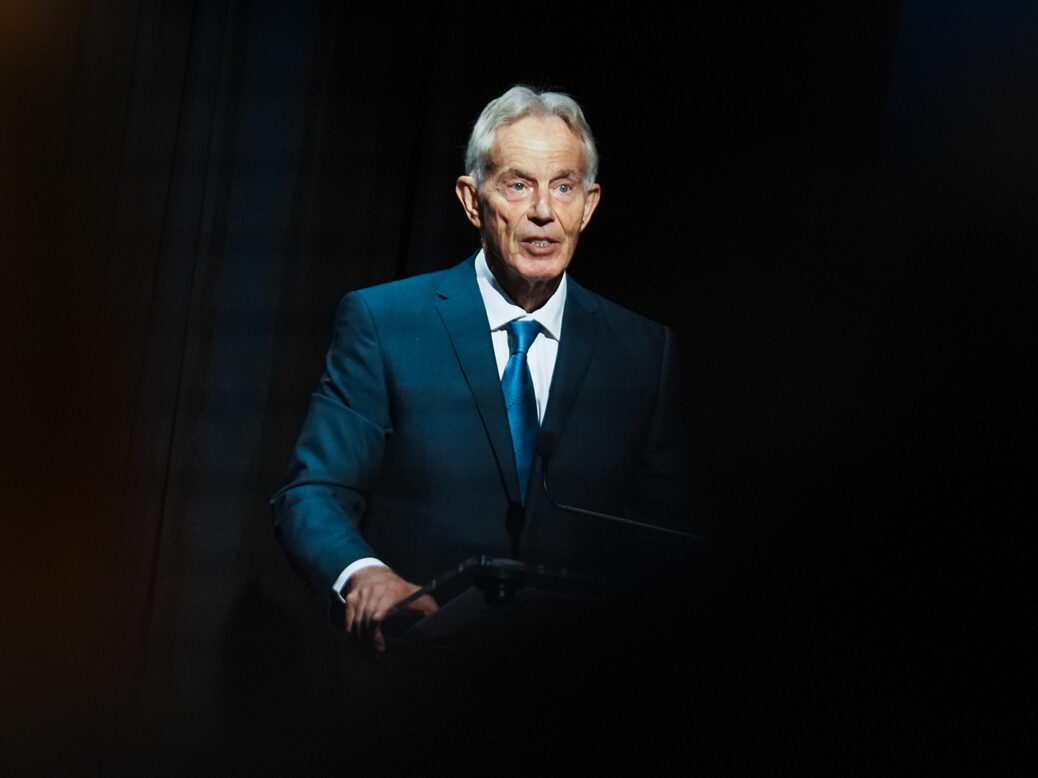
Tony Blair’s interventions in British politics can no longer be described as “rare”. The former prime minister now has a habit of blasting through the news agenda with more-in-sorrow-than-anger reflections on the poor quality of political debate along with policy suggestions for the government of the day, for example when he successfully urged Boris Johnson to vaccinate as many of the public as possible with a single Covid-19 jab.
Now Blair is back again to advise/haunt the new Prime Minister Andy Burnham, who first became a junior minister in one of Blair’s governments. In a foreword to a paper by his Tony Blair Institute (TBI) this week, the former PM called for “a structured formal relationship” while the paper itself, drafted by wonks, said Britain could consider joining “a significantly reformed” EU.
As No 10 prepares to publish its “Ten Year Plan” for Britain, Blair is trying to get a firm commitment to Europe into the document. He is also trying to stop Labour from dropping the ball on the issue of Europe.
While Burnham is perhaps Labour’s most pro-European leader since Blair (he has said he would like Britain to rejoin the EU in his lifetime), the party’s attitude to Europe has chopped and changed even in the lifespan of this parliament.

As the party prepared for power before the 2024 election, the scars of its 2019 defeat had not healed and there was a fear that “reopening” a debate about the EU would only alienate key voters. This led to the drafting of a series of “red lines” on engagement with the EU (no customs union, single market or freedom of movement in this parliament), self-imposed rules the party has still not broken despite a volatile global situation.
But towards the end of Keir Starmer’s premiership, Britain’s relationship with Europe was a topic of increasing interest to Labour ministers and MPs. In January I wrote about how the EU ultras in the party were organising. By April the PM was explicitly picking fights with the right over Europe, pledging to use sweeping government powers to align more closely with the EU. But it was too late.
A Starmer-era advisor reflected to me recently that, once Rachel Reeves’ Budgets failed to launch the growth bounceback they had promised, the party began to scrabble around for other, progressive ways to turn the country’s economic fortunes around: the thing most often landed on was Europe.
Plus “banging on about Europe” was a shrewd move for ambitious players in a party whose membership is overwhelmingly pro-European. Perhaps that is how we explain Wes Streeting’s unauthorised calls for a customs union with Europe in the dying days of the Starmer government.
Now the fear among some is that Burnham will fall into the same pattern as Starmer: avoiding the European issue during the “honeymoon” period when political capital is high, because it is difficult and messy, then returning to it as a “break glass in case of emergency” option when times get tough.
In an essay published just before the fall of Keir Starmer, Blair criticised both Burnham and his potential leadership rival Wes Streeting for having a 20th-century approach to Britain’s problems. He also said, reflecting his increasingly close association with artificial intelligence bosses, that “The politics of the future may be better understood by those presently outside politics.”
While he called Streeting “a huge political talent”, Blair described Burnham as “an outstanding member of my government”. It wasn’t quite equal flattery, and Blair has been more scathing in private about Burnham in recent years, deriding his apparent leftward drift and even sometimes feigning ignorance about the various positions Burnham held when he was prime minister.
Blair’s position remains as it was then. He considers much of the rhetoric from Burnham’s first few months of office to be Old Labour nostalgia and suspects his proposals for Britain’s problems are not 21st-century solutions. But a bold move on Europe, for example scrapping the red lines, might change his mind.
[Further reading: Labour MPs pressure Burnham over reindustrialisation]
Content from our partners



Related


Join the debate
Subscribe here to commentBlair really needs to be kept away from the political discourse. surely he realises that just by associating himself with any particular policy….he in turn poisons the issue for most Labour voters…..has he not yet grasped just how hated he is within the movement?