
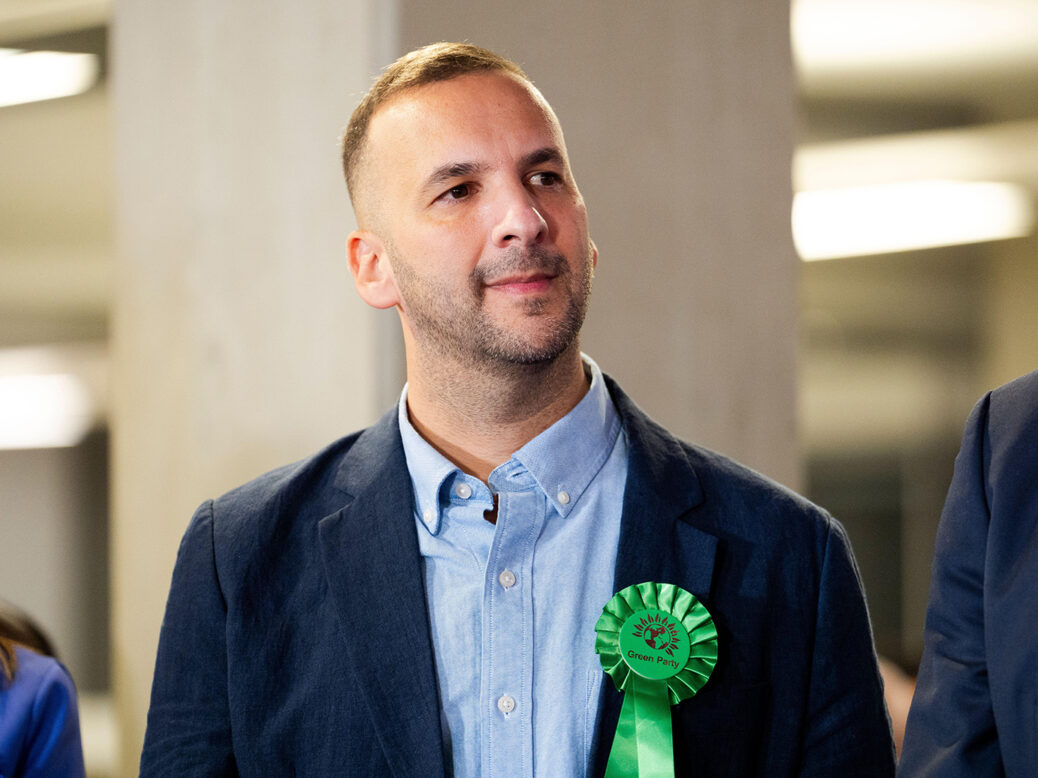
Zack Polanski has lost the Holborn and St Pancras by-election. The leader of the Green Party came second to Labour’s Sagal Abdi-Wali, the leader of Camden Council, who took 45 per cent of the vote. The Greens came second with 33 per cent.
In the end, the result was not close; the Green Party conceded half an hour before the official announcement. A party spokesperson said, “Taking the fight to Labour in one of its safest seats shows just how far the Greens have come.” But in comparison to the party’s victory in Gorton and Denton – which saw a 26.4 per cent swing from Labour to the Greens – does this result really show how far the Greens have fallen?
Though the party saw a 20-point swing from 2024, Polanski’s 33 per cent showing was undoubtedly aided by the decision by Andrew Feinstein – the Gaza independent who ran against Keir Starmer in 2024 – not to stand. His vote share combined with the Greens’ in 2024 was 29 per cent – four points below this morning’s result (9 October). But this by-election was always Labour’s to lose. Holborn and St Pancras has been held by the party since 1983. In 2024, Keir Starmer – whose resignation from parliament triggered this race – won the seat with a majority of 11,572. Though the Greens made a breakthrough on the local council in May and now form the opposition group, their victories there did not compare to the success they saw elsewhere in London such as Waltham Forest or Hackney.
There are other factors behind Polanski’s defeat. Six months ago, when Starmer’s government was at its lowest ebb, the Green Party leader might have won this seat. But since then his own national popularity ratings have begun to decline, though he remains well-liked among his base – young, urban, financially insecure voters. After this result, it is clear that speaking to those voters alone will not bring wider electoral success.

Some figures within the Green Party have already begun to raise the alarm on this. Long-serving Greens such as former leaders Adrian Ramsay and Caroline Lucas have started to urge Polanski to shift the party’s focus beyond its base, targeting seats that are not just straight Labour-Green fights, but where the party could feasibly help to squeeze out Reform. Others are thinking about how the party could improve its ground game to target voters more effectively. Over the course of polling day, campaigners reportedly knocked on 15,000 doors. Their work translated into fewer than 9,000 votes.
Though it is difficult to ascertain the electoral impact of the passing of the “Zionism is racism” motion at last weekend’s Green Party conference (4 October), Polanski is certainly set to face further questions over his handling of the situation over the coming days. Shortly after polls closed, Caroline Lucas criticised Polanski on Newsnight for not voting on the motion himself. This view is shared by other long-serving figures within the party, who think that his presence on the conference floor might have encouraged more members to vote through the two amendments (which Polanski supported) that aimed to soften the motion. We can expect public interventions on the party’s strategy from senior members of the party.
Speculation over Polanski’s position as leader will undoubtedly follow. But he will be safeguarded by several factors, not least the fact that he currently has no obvious successor. With one year left in his term as leader, unless he resigns, 10 per cent of the membership would need to petition the party to force him out. And, as one Green Party insider notes, these are the people among whom Polanski remains deeply popular. “There’s a cult of personality around Zack,” one Green source quipped. This is a divergence – between senior Green figures and the membership base – that we are likely to see more of in the coming weeks.
For Labour, this was a proof-of-concept by-election. A source at the count told the New Statesman that the party was proud of the “positive campaign” it ran, with a “strong” local candidate in Abdi-Wali. But most revealingly, they said there had been a noticeable change in the conversations the party was able to have on the doorsteps after Andy Burnham’s conference speech on 29 September. The Prime Minister’s message – on public control, housing and hope – cut through with voters in Holborn and St Pancras. Could this be proof of the so-called “Burnham bounce”? The new Prime Minister appears to have made it easier for Labour to entice left-wing voters back into the fold, though Holborn and St Pancras was already a Labour stronghold.
This by-election was a mirror image of the race which took place in Gorton and Denton just over seven months ago. On the morning of 27 February, the Green campaign team was laughing and cheering, having knocked the ruling party into third place. On the morning of 9 October, it was the turn of Labour’s campaign team, who hugged and cried as Abdi-Wali used her first speech as an MP to give thanks to the borough that brought her up and reiterate her party’s message of “hope again”. In Gorton and Denton, Labour ran a negative campaign against the Greens. In Holborn and St Pancras, it barely mentioned Polanski at all. And this time, instead of another by-election ushering in more internal wrangling for Labour, it is the Greens who will spend the weeks to come arguing among themselves.
[Further reading: Labour holds Holborn and St Pancras: listen to New Statesman podcast analysis]
Content from our partners



Related
Join the debate
Subscribe here to commentIn fact, Zack polled well in Holborn. Not enough to win but with the Burnham bounce and selecting a Moslem woman Labour were always favourites. But strange though it might sound there was a swing….in favour of the Greens and a ….swing against Labour.
I think Zack made a mistake in fighting the seat in the first place and then vesting a lot in his belief he could win. A misjudgement? Very probably but not enough to remove him as party leader.
I also think that to blame the defeat on the conference motion that said Zionism is racist is fundamentally flawed. To begin with well actually if you look properly what Zionism stands for instead of assuming that it is vaguely pro the continued existence of Israel anyone would agree that it is racist. I would say that this row might have damaged the Greens nationally because nobody likes a split party but in the Constituency and given its make up I would say there is as much evidence to suggest it helped the Greens rather than hindered them.