
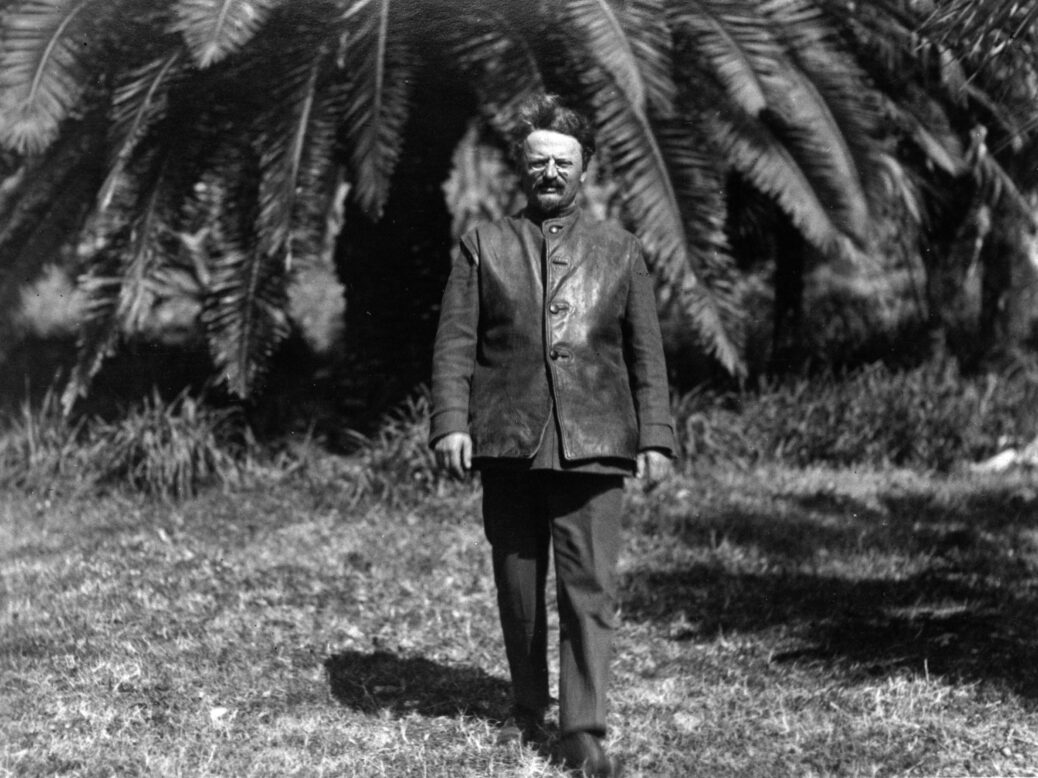
In 1934, while living in exile in Barbizon, a small village near Fontainebleau in France, Leon Trotsky pioneered the political strategy that is now vexing Zack Polanski. It was here that he started encouraging his supporters to deploy a new method to shift the political debate: entryism.
Concerned that the Communist League – a French Trotskyist group founded four years previously – did not have the size or influence to act alone, Trotsky encouraged its members to dissolve the group and join the larger French Socialist Party. Ever since then, the term entryism has been used to describe any incident of a smaller group joining a larger organisation in order to advance their own agenda.
Discussion of this tactic has appeared once again after Green Party members passed the controversial “Zionism is racism” motion at their party conference on 4 October. Grandees, such as the party’s former leader Caroline Lucas, have expressed concern that in failing to adapt the Greens’ ultra-democratic systems for a new era of mass membership, the party has left itself open to this tactic. Writing for the New Statesman last week, Lucas said: “Entryism has been a problem for many parties, but with our commitment to direct democracy and our cumbersome internal accountability mechanisms, the Greens are woefully exposed.”
Under the current system, Green members can propose or vote on motions at the party’s spring and autumn conferences as soon as they have joined the party. There are no barriers to entry; anyone can join. Though this is standard for other political parties, Green Party members have unique power over deciding policy, because anything they vote through will then be adopted. Annual membership costs £60 with no concessions. Other tiers are offered for reduced and concessionary rates – all come with full voting rights on party policy – and the lowest is £6 per year.

Ahead of the “Zionism is racism” vote, Greens for Palestine, the group behind the motion, shared various graphics on their social media encouraging those supportive to sign up and vote. The post had three QR codes, one with the link to join the party, another with a link to sign up to attend conference, and finally one to join a WhatsApp group of others backing the motion. Critics have argued that these posts suggest the group was encouraging entryism.
Another Green source, not involved in party management, told the New Statesman, “The Green Party is vulnerable on these kinds of counts because its structures were built on the assumption that its members were going to be people who behaved reasonably and above board. Sadly that assumption has proven less and less true in recent months and years.” But sources close to the leadership have pushed back on accusations of entryism. “We don’t see signs of that in the party,” said one Green source. Senior elected officials such as the Green Party’s parliamentary leader, Ellie Chowns, and deputy leader Rachel Millward, have spoken publicly about the need for the party to reform its democratic systems – though any specific details are forthcoming.
One option is moving the party to a system of delegate conferences, by which each local party has a quota of members it is able to send. Another option floated by some in the party is introducing a system of vetting those members who might want to get involved in the policy making process, or a grace period between signing up for membership and being able to vote on party policy. The source described this debate as “long overdue”. Any changes, of course, would need to be put to the party’s membership and if those changes are perceived to negatively encroach on the democratic power afforded to members, they could prove unpopular.
This is not the first time that concerns about entryism have sparked a debate on the British left. In 2015, under Ed Miliband’s leadership, the Labour Party changed the structure of leadership elections, moving from an electoral college system to “one member, one vote”. The price of Labour associate membership at the time was £3, leading to worries within the party around entryism, particularly after Jeremy Corbyn (the race’s ultimate victor) became the frontrunner. Indeed, there was entryism from right and left: an editorial in the Daily Telegraph at the time encouraged people to sign up for membership in order to vote Corbyn in as Labour leader and “destroy the Labour party”.
Ahead of the vote, some Labour staffers made a concerted effort to weed out those members – nicknamed “three pounders” – who it could be claimed were not genuine Labour supporters (those who held membership of other parties, for example). The party reported at the time that 15 per cent of new applications were from people who had never voted Labour before. It was cannily dubbed “Operation Ice Pick” – a reference to Trotsky’s grisly assassination in Mexico City in August 1940. At the time, Corbyn himself sanguinely pushed back on the accusations: “The entryism I see is lots of young people who were hitherto not very excited by politics coming in for the first time.”
But the most famous example of alleged entryism came in the 1970s and 1980s: the rise of the Trotskyist Militant Tendency within Labour. The group – which was founded in 1964 from the Revolutionary Socialist League – managed to get itself into positions of influence within the party and on the ruling National Executive Committee. The historian Kenneth O Morgan has suggested that the group did so with “the aim of capturing the Labour Party for the cause of revolutionary socialism”. Michael Foot, himself sitting firmly on the party’s left, described Militant as a “pestilential nuisance”.
The most prominent positions that the group achieved were in Liverpool, where Militant members rose to positions on the city council’s administration. Derek Hatton, the council’s radical deputy leader, came to be Militant’s figurehead and is still the tendency’s most recognisable figure, becoming a bête noire of Margaret Thatcher’s Conservative government. Under Militant’s leadership of the council, the administration passed an illegal budget in June 1985 which smashed through the authority’s income, resulting in it being unable to pay staff wages.
But Militant’s downfall began in the mid-1980s when Neil Kinnock, then leader of the Labour Party, staged a counter-attack in his 1985 conference speech in Bournemouth. “I’ll tell you what happens with impossible promises. You start with far-fetched resolutions; they are then pickled into a rigid dogma, a code, and you go through the years sticking to that, out-placed, outdated, irrelevant to the real needs,” Kinnock boomed, “and you end in the grotesque chaos of a Labour council, a Labour council, hiring taxis to scuttle around the city handing out redundancy notices to its own workers.” Liverpool’s District Labour Party was suspended by the party’s ruling National Executive Committee later that year. Hatton was finally expelled from the party in June 1986.
The Green Party’s decision to allow members to develop and change its policy was probably well intentioned. But its internal mechanisms have not kept pace with the exponential growth it has experienced. Allegations of entryism are difficult to prove and are often received with hostility. Yet some Green figures are clear: if they want to prevent another fall-out like this, changes will need to be made, taking on the principle of direct democracy in the party.
[Further reading: Burnham’s Brexit reversal]
Content from our partners



Related

Join the debate
Subscribe here to commentBy assuming entryism is to blame for the Green’s ‘Zionism Is Racism’ motion those who subscribe to this explanation overlook the sheer helplessnes and frustration engendered by our government’s complicity in Israel’s unending slaughter of Palestinian and Lebanese civilians. I would argue that such emotions are as likely to be felt by long standing members of the Green Party as they are by new members (and are epitomised by British pensioners willingness to be repeatedly arrested). Andy Burnham confirms his complicity in Israel’s war crimes by going so far as to conflate anti-Zionism with anti-semitism in order to accuse those who voted for the motion as being anti-semitic and by attacking local councils. And its pointless to cite his policy of economic sanctions against illegal Israeli settlements since these settlements do not have an economy separate from that of Israel as a whole.
Quite. You oppose genocide and would like the UK to take action – what party are you supposed to join? Labour?
Labour has been pretty strong in its stance against Israel now.
Now yes Starmer may have had to be dragged there kicking and screaming but the moves since 2024 have been pretty big.
I think a motion that calls for Israel to cease to exist entirely and says that Jewish Greens who go to Synagogue, which are mostly Zionist, are racist is pretty problematic and is anti-Semitic.
How on earth do you interpret the Greens motion as “ calls for Israel to cease to exist entirely?” This accusation is duplicitious and amounts to the weaponisation of anti-semitism. It is Palestinians who are being erased and by a colonising regional military superpower supported both by the US, Europe and the UK. Circumstances which hardly makes Israel vulneralble to being destroyed, quite the contrary given Israel’s attacks on its neighbours.The Israeli military are clearly employing levels of terror designed to make life so unbearable for the Palestinians that they will be forced to leave their homeland. This has been the long term aim of Zionist nationalism, to create an exclusively Jewish state rather then one based on a shared existence with Palestine’s Muslim and Christian population.
Another instance of political affairs going in cycles. Human nature is a ‘wonderful’ thing.