
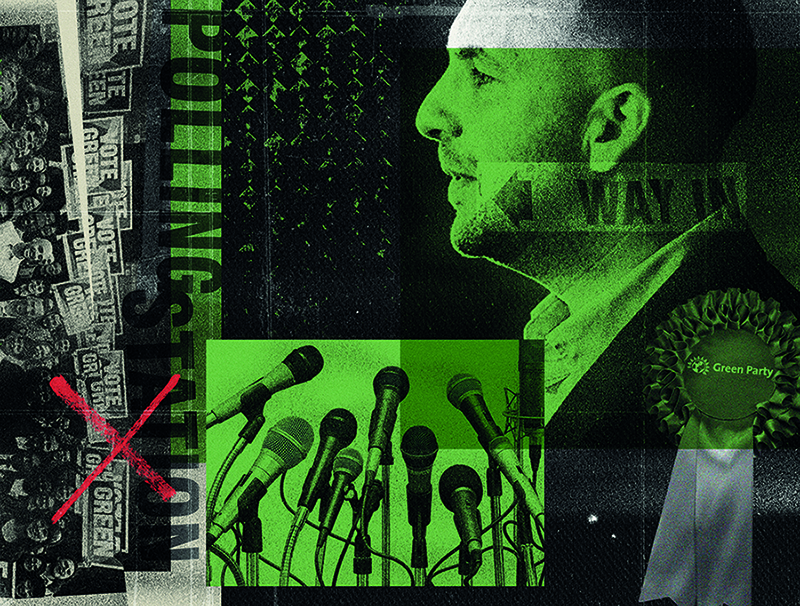
At around 9pm on Tuesday 22 September, a WhatsApp message pinged into Green Party members’ inboxes. “Cancel your plans!” it ordered – “And that includes conference.” The missive came from the party’s field team for the watershed Holborn and St Pancras by-election on 8 October. It urged members to demand refunds for their tickets to the party’s annual autumn conference, taking place in Brighton from 2 to 4 October.
Instead, the message went on, the party should redirect its efforts to campaigning in the north London constituency, in the very heartland of the left-leaning metropolitan elite. The election was triggered when Keir Starmer decided to stand down from the House of Commons. The poll can be seen as a battle for the future of the British left. Zack Polanski, the Greens’ eco-populist leader, is the party’s candidate, and much is riding on its outcome.
The text message has sparked consternation in the party as it was not officially sanctioned; the press team had no idea it was going to be sent. No one is quite sure who was responsible. For some members, it was infuriating, revealing a telling lack of discipline. “It suggests we’re not confident about the by-election,” one Green Party source fumes.
Others claim the backlash was over-played. “Of course members feel more strongly about campaigning to get Zack elected instead of going to conference,” one source muses. Polanski himself will only be in Brighton briefly on 2 October, to deliver his leader’s speech. Then he will dash back to rejoin the fight in the by-election battleground – one that will go some way to determining whether the Greens can truly become a major electoral force.

Another, smaller group inside the Greens suspects the party establishment is to blame, and that the move is a bold bid to distract attention from the controversial “Zionism is racism” motion scheduled to be voted on by members at the conference. One party source describes this claim – which they call a conspiracy theory – as “laughable”.
The WhatsApp fracas perfectly captures the internal dynamics within the Green Party: there are vicious splits of policy, direction and personality.
But where have these tensions come from? The answer is simple. In the last 12 months, since Polanski became leader at the beginning of September 2025, the party has ballooned. It has grown from 68,000 members when he was elected, to 230,000 today. That huge increase brings about problems, one of which is: does the party want to remain idealistic, or does it want to professionalise?
The Greens – with their proud commitment to member-led democracy – have never had to deal with so many people in the party before. Their internal structure was designed in a time when its appeal was much more modest; now, the party is struggling to adapt it to the Polanski-inspired influx. As it takes on its most significant electoral challenge yet – attempting to get its leader elected in such a totemic seat – the frailties of a political organisation that has struggled to keep up with its own growth are emerging.
Starmer triggered this by-election on 1 September, the House of Commons’s first day back after the parliamentary summer recess. After being dumped as prime minister, he no longer seemed to relish the thought of sticking around on the back benches, after 11 years as Holborn and St Pancras’s MP. Perhaps he also wanted to pose a problem for the man who had deposed him in Downing Street. The Greens had been preparing for a race in the constituency at some point, but no one expected an election to happen so quickly.
Almost immediately after the announcement, speculation abounded over whether Polanski would stand. When criticised by the Labour Party for refusing to put himself forward at the Gorton and Denton by-election earlier this year, the Green leader said he was waiting instead on a race in Holborn and St Pancras. One Green source, often sceptical of Polanski, said at the time that because of his earlier comments it would be “cowardly” of him not to take up the fight. Others, drawing on Andy Burnham’s ambitious Westminster comeback, spoke of it as Polanski’s “Makerfield moment”. Either way, the 43-year-old was effectively cornered.
Nonetheless, there was some apprehension over whether he should take it on. Polanski’s candidacy in the seat is a high-stakes move – Holborn and St Pancras has been a Labour seat since it was created in 1983. The Greens did well in London in the May local elections, particularly in the councils that cover the constituencies of Walthamstow, Hackney North and Stoke Newington. Some thought Polanski should hold out to run in one of those seats instead, perhaps waiting until the general election. The Greens’ performance in the Camden election, which made them the opposition group on the council, was not as impressive.
And this by-election takes place as Andy Burnham shifts Labour to the left, with his challenge to 40 years of Thatcherite neoliberalism and recent sanctions on Israeli settlements in the West Bank. The so-called Burnham bounce explicitly threatens the Greens’ popularity and their attempts to paint themselves as the truly progressive force in British politics.
In the last few weeks, though, Green Party confidence has quietly grown again. “There’s a really energetic base that really wants a change,” one party source says. “It’s a winnable seat.”
Polanski – whose Labour opponent is the popular Camden Council leader, Sagal Abdi-Wali – is enjoying a mixed reception there. In the council estates to the south of the constituency, in Holborn and Covent Garden, where there is a high Bangladeshi population, he is met with the friendly honks of car horns and voters asking for selfies. Further to the north, and particularly in Starmer’s Kentish Town stronghold, there is wariness of the Greens and an ironclad loyalty to Labour. But party insiders suggest they’re still confident. One says: “Undecideds are starting to break for us – it’s a turning point.”
Then there’s the conference. Some Greens think Starmer quit in order to trigger a make-or-break by-election just days after the party’s upcoming – and potentially controversial – yearly gathering. He knew, so this thinking goes, that Polanski wouldn’t be able to resist running, and so a trap has been laid for him.
Conferences are where party policy is made. This year, one motion has dominated all discussion: A105, “Zionism is racism”. It was brought by a non-affiliated splinter group, Greens for Palestine, and calls on the Greens to position themselves as an anti-Zionist party and support the establishment of a “single democratic Palestinian state”. Its backers first attempted to bring the motion at the party’s spring conference in March, but ran out of discussion time. It is guaranteed to be debated and voted on this time around.
A spokesperson for Greens for Palestine tells the New Statesman that current Green Party policy “is outdated. It fails to reject the two-state position and does not confront Zionism as the racist, settler-colonial ideology upon which Israel was built.” They add that the proposal “also clarifies that opposing Zionism is not opposing Jews; it protects Jewish people who reject this racist ideology from being conflated with it”.
“Zionism is racism” is, of course, deeply controversial. Defining Zionism is always a sensitive topic, which has for decades been debated within Jewish communities. There is much apprehension in the party about what the consequences might be of a binary vote on such a contentious issue.
The leadership is split. The Greens’ five MPs are reportedly unhappy. It is likely they will use the conference to try to defuse the situation. Should the motion pass and become their party’s official position, the MPs may well avoid advocating it in the Commons.
Polanski is uncomfortable. Until mid-September, he had not spoken about the subject publicly. In an interview on 14 September, he said he didn’t think it was a “big jump” to describe the actions of the Israeli government in the name of Zionism as “racist”. But he described the motion as “unhelpful” and a “distraction”.
He also revealed that he would back two amendments to the motion: one which softened the stance on a single-state solution, and another which added safeguards for Jewish members.
For some, though, Polanski’s suggested amendments are not enough. “Even if it passed with those amendments,” one source says, “the party policy will still be that Zionism is racism.”
Internal discussions around this motion and the wider question of the Green Party’s position on the Middle East have, at times, become toxic. One member – who does not support the motion – describes the atmosphere around it as “obscenely nasty”. When asked for a response to those members who have felt uncomfortable about the motion, a spokesperson for Greens for Palestine says: “Supporting this motion says the Green Party should be a principled, anti-racist, anti-colonial party that does not flinch from naming injustice, even when it is ‘uncomfortable’ or ‘controversial’.”
After the motion could not be debated at the Greens’ spring conference, some of its supporters suspected a conspiracy within the party to stop it from being heard altogether. There are allegations that members who explicitly back the motion are being targeted.
The New Statesman understands that exchanges have become so toxic that at least one volunteer involved in internal party administration has been the subject of what they consider to be a death threat from a member. A spokesperson says that the party takes the safety of “everyone in the party… very seriously”, and that they have “taken steps to ensure security measures are in place”.
There is concern that when the motion makes it to the floor, the debate could be a real low point. “A lot of people are feeling very apprehensive about the conference,” one source says. Some members, worn out by the infighting, plan to stay away.
“Zionism is racism” will likely be heard on 4 October, just four days before Polanski’s big moment in Holborn and St Pancras. The timing is, to say the least, difficult.
But seven months have passed since this motion first appeared, and the sense of disappointment in the leadership cuts deeply. It does not only relate to those opposed to motion A105. “All this time has been taken up by ‘Zionism is racism’ when we could have been talking about the cost-of-living crisis,” one supporter admits. Members fear that press coverage of the controversial motion will affect Polanski’s chances of success.
Perhaps, though, this was always going to happen. The Green Party prides itself on being “ultra-democratic”. But the forums in which it exercises these rights were convened for a party whose membership was upwards of 50,000, not closing on a quarter of a million. “The party desperately needs internal democratic reform,” one senior source says. “It has become much more urgent given the membership is larger now.” Rachel Millward, one of the Greens’ two deputy leaders, has spoken about the need to shift gear now the party has expanded.
To some members, reforming the party should involve Polanski taking a step back. “Zack is a fantastic public speaker,” one says, “but he doesn’t have the political know-how to deal with party management.” Another hopes that if Polanski is elected as MP for Holborn and St Pancras, it might present a good opportunity for him to bow out as leader, after achieving all that he promised, and allow someone with better political nous to take over.
For now, though, Polanski has no obvious successor. But the longevity of his leadership will depend on his ability to get a grip on the Green Party. To survive, he must contend with the ease with which it descends into factional infighting, and keep its focus on promoting its progressive policies.
The Green Party is at a crossroads. Its biggest annual conference to date is coinciding with a monumental test of Zack Polanski’s ability to win over and retain progressive voters. The outcome of both will reveal whether the Greens can truly be a contender for power on the British left. And if not, will the successes of the last few years prove to have been little more than fleeting flashes of protest?
[Further reading: Britain in the crosshairs]
Content from our partners



Related
This article appears in the 01 Oct 2026 issue of the New Statesman, Sunshine and Rain
Join the debate
Subscribe here to commentIf Green party policy is made at its Conference, then it is made by those who are enthusiastically activist (and have the spare time / money) to attend the Conference. Those are unlikely to represent even the party’s wider membership, let alone the several million who might vote for it. Imagine the Tory party allowing its policy to be formed that way – “bring back hanging and birching”, “rebuild the Empire”, “ban electric cars”, “No to wind turbines and solar panels”, “reinstate Secondary Modern schools for 80% and grammar schools for 20%”, “tax relief for private healthcare and public school fees”, etc. Which is not to say that “Zionism = Racism” is factually incorrect or necessarily electorally damaging, it’s a wider observation about the Greens.
Funny how this article omits what is for me the fundamental reason for these problems: that over the last few years the Greens – especially those in urban areas – have been colonised (no other word for it) by the anti-Semites and monomaniacs that Starmer drove out of the Labour Party. They have, quite rightly, concluded that the Continuity Corbyn Your Party (actually ‘His Party’ would be more accurate) is, and always will be, a total waste of time and space and have, therefore, reverted to their default tactic of ‘entryism’. So, I suppose, the current state of the Greens and their likely future prospects are, like everything else in the UK right now, irretrievably broken thanks to Starmer. It’ll be Trans rights and TERFS next. The Greens are going to have to grow up fast and begin the task all mature political parties have to carry out sooner or later: chucking out the idiots.
“like everything else in the UK right now, irretrievably broken thanks to Starmer”
Oh, Starmer ran down UK defences 2010-2024, privatised water and rail, failed to build enough prison cells, created record NHS waiting lists (now reducing), reduced the court system to chaos, presided over record net immigration, presided over growing inequality and very poor productivity growth….? I think you’ll find those were due to a bunch of privileged-from-birth people wearing blue rosettes.