
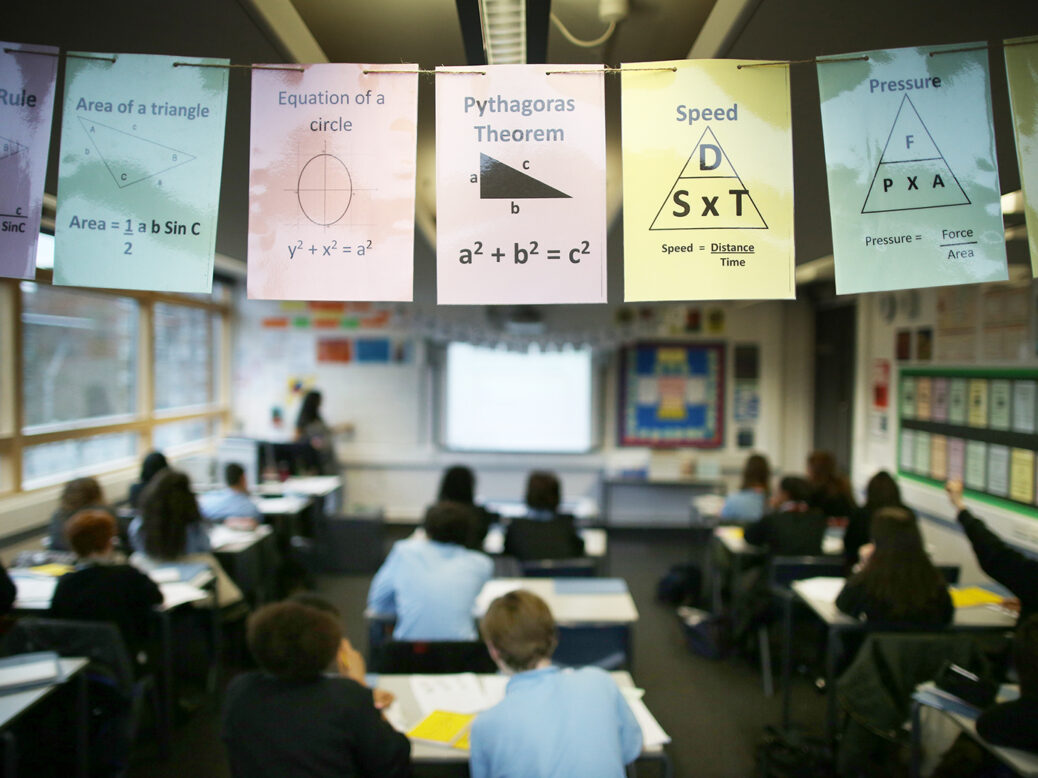
It’s Saturday morning and my mother is spraying cold water in my face, her preferred form of parental violence. I have to get up and go to school. I’m 11, and I’ve been dreading this day. “Lord, magnify me in knowledge,” I hum nervously in Arabic. My father is tense. For weeks now he’s been driving out to the school to recce the location, to master all possible routes. I am not going to my usual school, you see, and this isn’t a school day: I am being taken to the edge of London to sit the eleven-plus exam.
Why all this fuss to get into a grammar school? Many schools are in easy reach of our home – decent places, good enough for most. Couldn’t I go to one of them, as my friends would? Their parents aren’t making them do the exam, objecting – not unwisely – to the prospect of tedious bus journeys or breaking up friendship groups. These are not considerations for immigrant parents like mine; success is expected at any cost.
White British children are now a minority at the country’s remaining grammar schools, having fallen from two thirds of enrolled pupils a decade ago to 44 per cent. At some schools in Essex, Kent and the Midlands, numbers have almost halved. Rupert Lowe is irate. For the hard right it’s a case of race replacement, emblematic of a people becoming a minority in their own country. But what is actually going on?
I passed the eleven-plus and got into the grammar. In my time there, South Asians had already become the majority. In the data published by the Times on 12 September, there my alma mater was, right at the bottom: zero per cent white British. So it was even two decades ago. But Redbridge, the east London local authority in question, is far from zero per cent white British, and South Asians remain a minority there. The largest community in my time at the school, the Tamils who had fled civil war in Sri Lanka, were, and remain, less than 2 per cent of the local population. The Asian families getting their children into the school were not only outnumbered but significantly more disadvantaged.

Except in one respect: motivation. Our immigrant parents had determined that everything was riding on the success of the second generation. They had endured sacrifices and indignities and a wounding loss of status to get here, and it was up to us to recoup it all. It was unacceptable to fail the eleven-plus, though many did – and were made to feel miserable. Every spare minute or penny was spent tutoring children to within an inch of their lives. My father, frugally, tutored me himself; he had left school in Pakistan at 16 with unrealised academic ambitions, which I knew it was my duty to fulfil. Every night, we puzzled our way through textbooks and practice papers.
It felt like punishment. The tests were narrow-minded and soulless. But they did level the playing field. If it were left to teachers, we might not have been selected. I was on the special needs register at primary school; to have English as a second language was thought a learning difficulty. But the eleven-plus stressed “non-verbal reasoning”, so bright children with little to no English passed. That’s why competitive exams appeal to the immigrant mindset: here is a pathway to riches that bypasses discrimination, poverty, lack of social connections or cultural capital. These are factors which make education the best ladder available to second-generation immigrants, now outperforming white children from the eleven-plus to university admissions. It’s also why we gravitate to professions entered via examination – accountancy, engineering, etc – rather than those requiring contacts. Even working-class communities have inroads into various trades; it’s hard to learn one if you don’t have links with local businesses, and if you’re new to the country, you don’t.
A diverse society with meritocratic ideals will always see minorities thrive; that’s the system working, uncovering the talent veiled by deprivation and prejudice. And it always makes the majority anxious. On the one hand we are, in Matt Goodwin’s words, “goat-herders” (ie talentless); on the other we are job-stealers (so, too talented). When Jews began arriving, and excelling, they met the same suspicion. “There were a great many swots because there were a great many Jews,” wrote GK Chesterton, a notorious antisemite, of the scholarship boys at his school. Before the influx of South Asians, waves of Jewish swots passed through my school before rushing into medicine and law just like my classmates. We are in the same lineage, a point made in Alan Bennett’s grammar-school-set play The History Boys: “Jewish boys often are [clever], a role… being taken over by the Asian boys, intelligence… the fruit of discrimination.”
The settled majority will never have cause to be so fanatical about education. Observing my white friends at primary school, I could sense the gulf between our worlds. They were from happy, modest families at ease with society. They had family holidays and birthday parties, which we never had, and at the weekend, I’d see them dining at the Harvester by my house, where, unbeknownst to his children, my father worked his second job. It’s not that we couldn’t afford meals out or birthday presents; they were, back then, frivolous distractions. (With the next generation, I see that nervous ghetto energy relaxing; it thrills me to see my nephew and niece spoiled with luxuries their father never had.)
If parents, white or otherwise, aren’t putting their children through the joyless academic rigours so many immigrant families insist on, it might be because they see more value in happiness than success. Aspirations are good. They can also sometimes be too high.
[Further reading: The Booker Prize 2026 shortlist]
Content from our partners



Related


This article appears in the 24 Sep 2026 issue of the New Statesman, A Sense of Power
Join the debate
Subscribe here to commentAn excellent analysis of the immigrant attitude to education. I am of Irish origin and I can see parallels with my education in the 1960s and 1970s. My home town of Luton had gone comprehensive in the mid 1960s but I had the benefit of a faith based education having been educated in a the Catholic state school system. Those schools had more than 50% Irish pupils in the 1960s simply because of larger Irish families but also they were built with funds raised by the local Catholic churches which had large Irish congregations. My parents were lower working class and unskilled but they did value education and they bought me a set of Arthur Mee encyclopedias and a chemistry set before I was 12 years old. Irish jokes of the time also motivated me to prove those ‘comedians’ wrong. I owe my education to all these factors but most of all to my parents. In the end I went on to a PhD in biochemistry and a career in the pharmaceutical and chemical industry. Immigrant parents can do wonders for your life chances. It’s a lesson parents of all backgrounds should bear in mind. As a bonus I ended up with an Irish passport.
Agree totally but even Rishi Sunak a perfect example of immrgant aspirations was derided as a second choice PM foisted upon his party.A modicum of talent with a self earned personal wealth counts for very little in the eyes of Lowe or others who worship ancestry and inherited privilege.
Sure true enough and as Luton Irish, I never considered going into British politics of any sort. Too many sensitive issues! My private sector career was full of hard nut US corporations but I still tried to join a trade union when possible!
Having also attended Ilford County High, the author is correct in so many ways. The school then was around 20-35% Jewish depending on the year group. As the local population changed – the Jews moved out, other immigrants moved in – so the cohort at the school changed too. Our parents and grandparents knew that education, in all of its forms, was everything and that sacrifices would be made to ensure the success of the next generation.
“British children are in a minority” Could that not be phrazed differently? Thank goodness only lefties are reading this.