
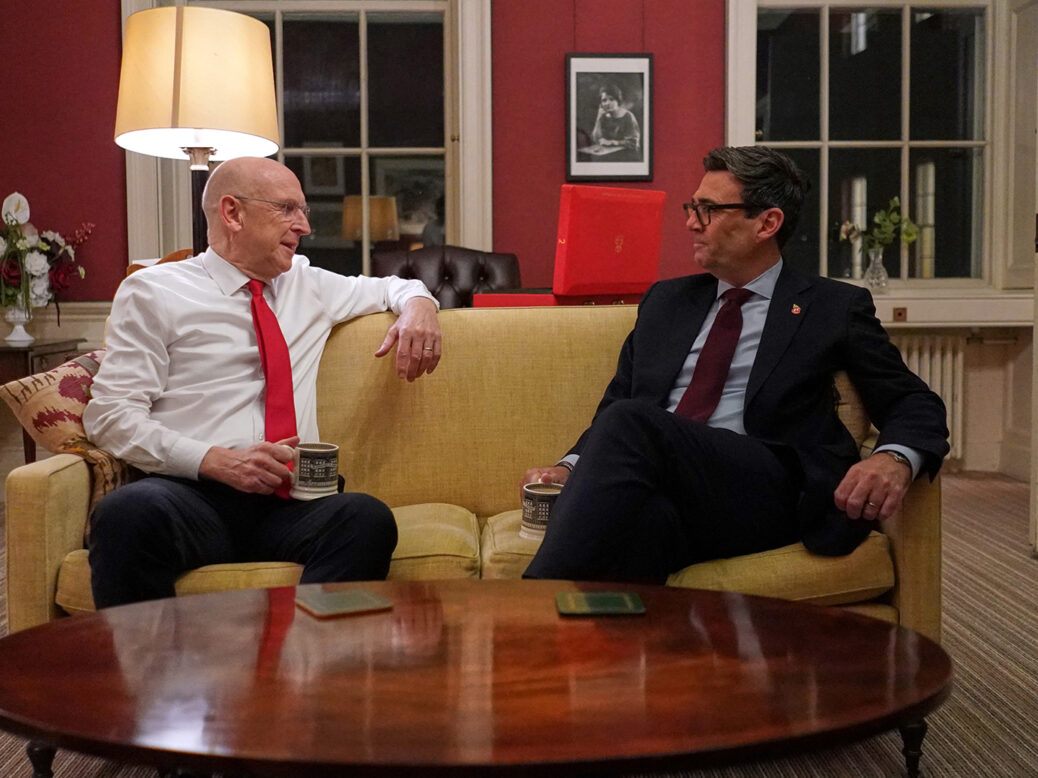
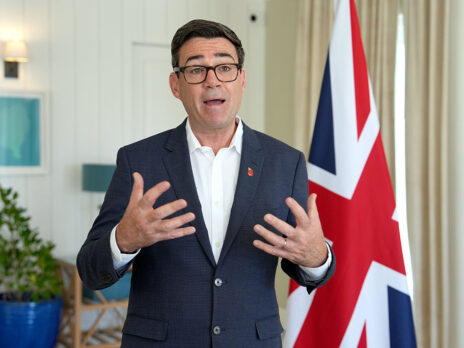
The revolution deferred. Deferred by economic circumstance, deferred by political inheritance. When he came to power in July, Andy Burnham promised a radical rewiring of British politics and an end to what he sees as 40 years of deadening neoliberal consensus on the economy.
In the Burnham ministry’s first Budget on 28 October, Chancellor John Healey delivered a cautious package and a softly spoken speech. He tried to be optimistic, despite swimming against a strong tide of bad news, announcing a raft of small measures intended to keep the public on side while promising better times ahead.
As expected, the Office for Budget Responsibility (OBR) report that accompanied the Budget showed that the hit to the British economy from Donald Trump’s war with Iran has been and will probably continue to be severe. The fiscal watchdog reduced its growth forecast for 2027 and predicted a nasty rise in inflation to near 4 per cent. It forecasts a significant increase to the cost of government borrowing, and the Chancellor’s fiscal headroom has shrunk by around £8bn since the Spring Statement delivered by Rachel Reeves in March.
That Statement, Reeves’ final fiscal event, came so soon after the outbreak of the war that the OBR did not have time to account for its effects. Instead, it was left to Burnham and Healey to face up to the delayed economic backlash from it.

Nevertheless, Healey tried to present a Budget that could give an optimistic political picture in spite of the numbers. His rabbit out of the hat was a £100 bung, paid to 80 per cent of households in England this winter, part-funded by a tax raid on banks.
The “Household Energy Payment” will be transferred directly to the bank account of every council tax payer in bands A to D, the four lowest bands, from January next year. The payment is estimated to cover about 20 million households. While it was described as a specific assistance for rising energy bills over the winter, the government has indicated there will be no limits on what the money can be spent on, as it will be a straightforward cash transfer. The government hopes this money will go some way to softening the blow of the energy price cap rise anticipated for January and the large consequent increase in bills, and buy the government a bit of goodwill with the public.
Is it enough? In comparative terms, the measure is a slightly more modest version of the £150 council tax reduction to households in bands A to D that was announced by Chancellor Rishi Sunak in February 2022. Though he had a few warm words for the banking sector, Healey was explicit about the politics of this. He said that British taxpayers had funded bank bailouts during the 2008 crash and would now be supported with the cost of living by a greater contribution from the sector. He challenged Kemi Badenoch to disagree with this framing on class terms.
Healey also unveiled some additional taxes on wealth, through an increase to taxes on income from property and savings, but balanced this rhetorically with changes to capital gains tax for some entrepreneurs. (In a sign of the political tightrope the Chancellor is walking, I have already heard him condemned by left and right for this combination of measures – as both an anti-business chancellor and as a friend of the rich).
Healey, who resigned as Keir Starmer’s Defence Secretary over what he thought was an inadequate defence spending outlay, used the Budget to say he would meet the funding of the government’s Defence Investment Plan through some capital reprioritisation. But on the broader question of how to rearm the nation, Healey asked us to wait for decisions that will be made down the line in the government’s forthcoming Ten Year Plan and next year’s Spending Review.
In the greatest sign of the Prime Minister’s imprimatur on this Budget, Healey announced radical fiscal devolution to the regions by gradually handing tax and spend powers to the metro mayors. He said that by the end of this decade, mayors would retain locally 100 per cent of business rates revenue and, from 2028, a share of local income tax receipts. He also confirmed a previously announced proposal for an “Overnight Visitor Levy”, available for mayors to levy on tourists on their patch.
These devolution proposals came towards the end of this speech and have not made the biggest headlines. But if fiscal devolution is the future of British politics, as Burnham hopes, we may remember these measures as the more significant tranche of this Budget. Defending the move, Healey said the new powers were “not sentimentality but supply-side economics,” because mayors know best how to spend public money in their areas.
Overall, this Budget gave us conventionally progressive moves on devolution and some economic populism, mixed in with measures for business relief and economic forecasts predicated on the opening up of oil and gas in the North Sea. In Burnham and Healey we see a more pragmatic No 10 and No 11 team than the early write-ups of the new Prime Minister, as a straightforwardly leftward shift, originally suggested.
The pair were clearly more constrained by circumstance and the manifesto they inherited from Starmer than was fully recognised when the Prime Minister came to power in the heady afterglow of the Makerfield by-election, promising to end 40 years of Thatcherite hegemony. But the Chancellor’s team has urged people to see the bigger picture: this Budget will soon be followed by the extensive “Ten Year Plan” before Christmas and a Spending Review next year which will apparently help rewire the way the British state works.
The answer to the question of why Burnham’s revolution has been deferred is fairly simple. He is hemmed in by the pledges – on tax, on Europe – of the 2024 manifesto, which were made not just by a different political team, but in a different world from the one we now live in: before Trump 2.0, before the war in Iran. The revolution Burnham promised can now probably only come after an election in which he gets his own mandate for all of the sweeping changes he has promised.
[Further reading: Abolish the Budget]
Content from our partners


Related
Join the debate
Subscribe here to commentShort version: Politician is limited by… politics.
A certain lack of courage might signal wavering conviction.