
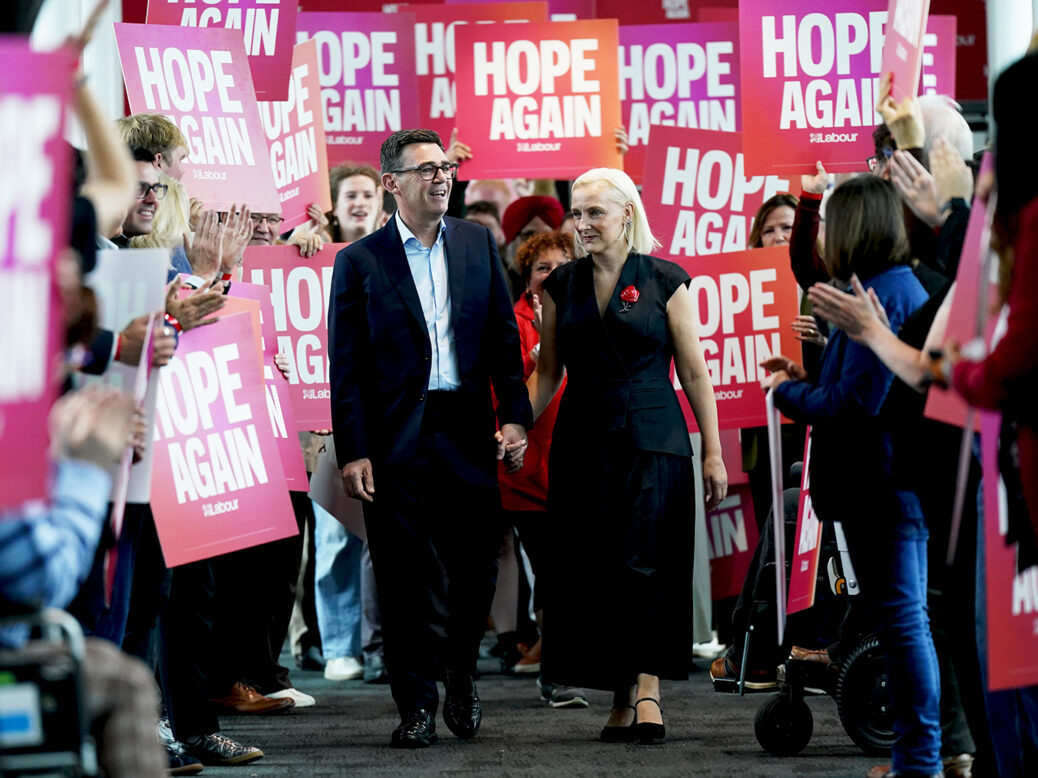
Andy Burnham has announced that he would “adjust” the triple lock policy on the state pension, and explained that this would be done in order to free up money for a national care service. This makes sense politically, because the triple lock is seen as something that protects the incomes of older people, and older people are also the most likely age group to need long-term social care. Does this actually amount to “breaking” the triple lock? Will it actually happen? And will it pay for a revolution in social care?
What Burnham announced is that from April 2030, the state pension will rise by inflation or 2.5 per cent, whichever is higher, and that it will also “hold its value relative to earnings over time”. So that’s a state pension that is guaranteed to rise – that is, you might say, locked – by three principles.
It’s this change in the wording around earnings that is significant. It was important that either prices or earnings were removed from the formula, and here’s why: if prices rise in one year, wages don’t rise immediately to meet them. Millions of people ask for pay rises, to meet the cost of the things that are now more expensive, and get them the following year. In the past this has meant that a period of inflation would cause the state pension to rise twice – once with prices, and then again with wages. It is this “ratchet” effect that has been broken.
What has not been broken is the unifying principle of the triple lock, which is that whatever direction the wider economy takes, however bad things get for people in work, the state pension never stops becoming more generous. Remaking the triple lock also cuts spending by relatively little in the short term – it might not actually save anything, to begin with – but it does have significant long-term effects. These will help with future spending forecasts, and because bond markets tend to like fiscal consolidation, there might be a short-term benefit through reduced borrowing costs.

This would also depend, however, on the market’s confidence in Labour either winning a majority at the next election or the likely winner committing to the same policy. Investors only bet on things they think might actually happen, and no-one knows if Andy Burnham will still be Prime Minister in 2030.
A better social care system would also save money, because the healthier people are (especially later in life) the less expensive they are to the state, broadly speaking (unless they go into a life of crime, or become leader of the Conservative Party and push through a poorly executed budget). But again, the real savings are well into the future. In his speech, Burnham said that better care means also less pressure on the NHS over time, but he didn’t say how the upfront cost of a new national care service would be covered. What we do know is that whatever the immediate savings from a rejigged triple lock, they will not cover it.
It’s worth remarking that policy is often made the other way around. Chancellors such as Jeremy Hunt and George Osborne were skilful at devising policies which pushed political and fiscal cost into the future. The Prime Minister has said he’ll do something which will have an immediate fiscal and political cost to his party, and which will provide political gains to other politicians, perhaps other parties, in the years to come.
This depends, of course, on how it lands with the public, who have a confused view of the triple lock. Older voters love it (wrongly, because they have the least to gain from keeping it) and younger voters dislike it (again, wrongly, because they have the most to gain from keeping it). We also know how badly Theresa May’s attempt to reform the triple lock went in 2019. But as we saw today, Andy Burnham is a very different politician.
[Further reading: Andy Burnham’s conference speech: A new Britain begins]
Content from our partners



Related

Join the debate
Subscribe here to comment