
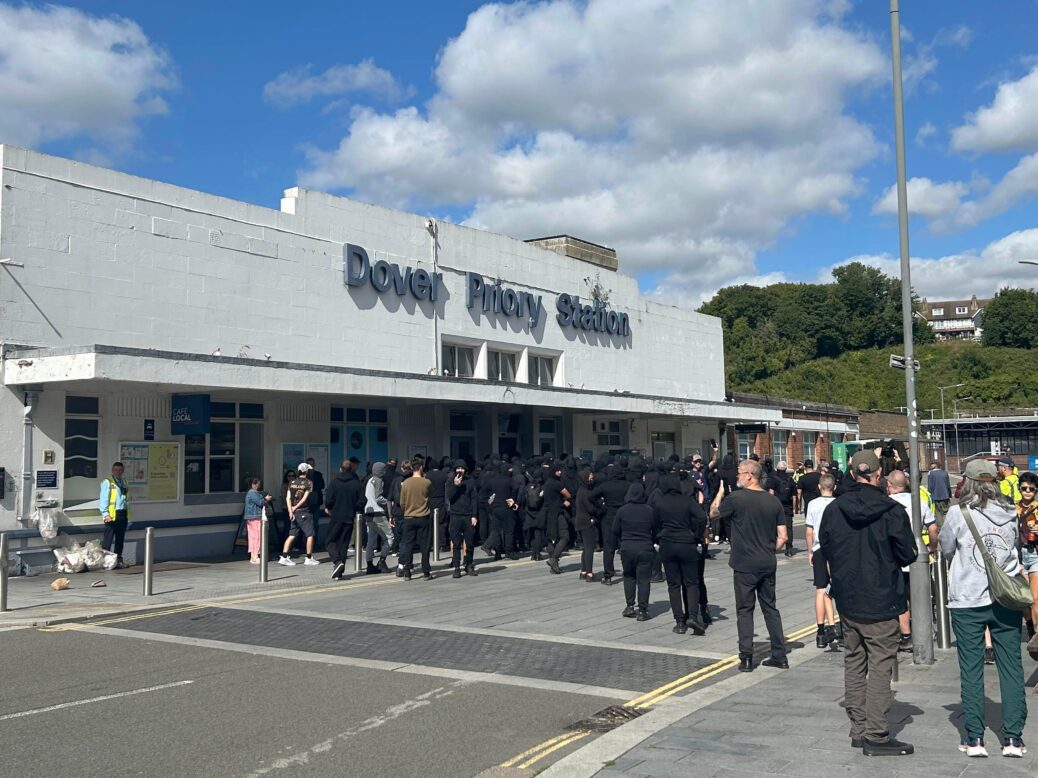
A planned, coordinated and “exceptionally well-organised” protest sees the Port of Dover – the UK’s biggest and busiest ferry port – shut down for hours. Despite footage showing hundreds of demonstrators in black balaclavas blocking roads, as of yet no arrests have been made, with Kent Police still insisting the protest was “spontaneous”. The next day (Sunday 6 September), a similar protest, organised by the same individual, erupts in Portsmouth, again blocking roads, intimidating locals and causing chaos.
Yet according to the Hampshire police and crime commissioner, the Conservative politician Donna Jones, this act of civil disobedience was not an obviously condemnable effort to breach the peace, but rather a “wake-up call to the government… that the British people are fed up with the lack of control of our borders”.
The implication is clear: descending on a particular location to prevent the free movement of cars or lorries or people is an understandable (if regrettable) reaction to feeling as though those in power are not taking your grievances seriously. And the focus for the government should be not on the people causing the damage, but on the grievances. There has been a flurry of politicians, including from the government, stressing that it is “legitimate” to have concerns about immigration – as though this in some way explains the disorder.
I wonder if Jones’s assessment would have been the same had the masked protesters not been agitating against immigration and small-boat crossings but, say, climate change. Would she and other politicians be so quick to call this a wake-up call for government? In 2022 when Just Stop Oil protesters brought the M25 to a standstill, it led to mass arrests and five activists sentenced to years in prison. Nor do I recall much discussion at the time of how anxiety about the ever-heating state of our planning and Western world’s slowness in moving off fossil fuels is a legitimate concern, at least not from anyone near the levers of powers. Instead, we got new legislation handing police sweeping powers to curtail peaceful protests – including ones simply deemed too noisy.

To be clear, taking the law into your own hands by causing mass disruption with a side order of economic damage is not an acceptable form of political engagement, at least not in a democratic society. Since the advent of universal suffrage, British adults have had a one main way of communicating their preferences in how they would like to be governed: voting. If they don’t think the politicians they elected are taking those preferences seriously, they have the chance to get rid of them at least every five years, and to protest – peacefully and in line with rules on disruption and notifying police – in the meantime.
The line that anti-immigration sympathisers is that direct action is necessary because the relationship between voter and elected representative has broken down. “No one voted for this” is a frequent refrain on net migration numbers, which kept rising even as successive prime ministers promised to bring them down. But now they are falling: net migration was down by almost half between December 2024 and December 2025. Small boat crossings are also down substantially this year, as are other emotive metrics like the number of asylum seekers being housed in hotels. The intensity of the feeling which has apparently led hundreds of men to don masks and take to the streets does not correlate to the actual facts.
Still, the idea that some causes are so important such action is justified persists. We have seen it on the right three summers in a row, with the riots in the wake of the Southport stabbing attack in 2024 that killed three little girls, then again last year centred in Epping after an asylum seeker assaulted a 14-year-old girl. The perpetrators of both crimes have faced justice in the British courts. But both incidents led to days of demonstrations that in some cases bled into outright violence, property damage, assaults on police officers, and general intimidation.
The left, too, has causes deemed worthy of breaking the law for, climate change as previously mentioned first and foremost among them. For a time, protests were planned with the explicit aim of activists getting arrested, all the better for publicity. Bridges blocked, roundabouts brought to a standstill, buildings vandalised, artworks targeted. Twice, activists have thrown soup over Van Gough paintings. Their justification? “Future generations will regard these prisoners of conscience to be on the right side of history.”
Or take the Palestine Action activists who broke into the UK site of an Israel-based defence company with crowbars, destroying £1m worth of property and fracturing a policewoman’s spine with a sledgehammer. “I can say with absolute certainty that this is the best thing I have ever done,” one of the defendants declared at the trial. “There is a good chance that because of our actions that night, innocent lives were saved.” Again, some causes – in this case, the war in Gaza – apparently transcend the rule of law.
I have no doubt that all these cases involve individuals who truly and sincerely believe in the justifications for their actions, who feel let down or ignored by politicians they don’t think are taking their priorities seriously enough. In social media echo chambers, they are egged on by like-minded conspirators, encouraging them to believe democracy is pointless and only direct action will get the country’s attention. Neither facts nor reasoned arguments are any match for the seductive power of being cast as a fearless crusader for the most important cause of our age.
This is a dangerous trend. As Jonathan Sumption, the former justice of the UK Supreme Court, writes in his 2025 book The Challenges of Democracy: “Those who engage in direct action instinctively feel that the end is so important that it justifies the means, but they rarely confront the implications of their acts.” Those implications are that the consensus in a society for how controversial matters are resolved – via debate in the public sphere and the cycle of democracy – breaks down completely, giving licence to others who feel similarly strongly about a different cause to make their opinions known in just as disruptive way. Sumption warns that “the contempt for politics expressed by so many activists is potentially a mortal threat to our democracy”.
So maybe the masked demonstrations in Portsmouth and Dover are a wake-up call for the government – but not about the strength of feeling on immigration on anything else. Maybe they’re a wake-up call that an increasing number of people now do not believe in democracy as the vehicle for advocating the changes they want to see, and are resorting to more radical means. Whether politicians sympathise with their particular concerns or not is irrelevant. The more this behaviour goes unchecked, the more people will deduce that if the rules don’t apply to everyone, they shouldn’t apply to them.
[Further reading: Reform, or revolution]
Content from our partners



Related

Join the debate
Subscribe here to commentPeople have always protested throughout history and its a shame to see the new statesman engaging in the idea of some sort of moral equivalence (or any equivalence ) between climate activists and anonymised racists at the port of dover – and the rather glib conclusion that ” if the rules don’t apply to everyone, they shouldn’t apply to them” does nothing to substantiate this article’s flimsy rational.
They ARE equivalent, it’s just that some people favour one set of beliefs and others prefer the other, while others again support both and others support neither. Law-breaking does not become OK because you support the underlying cause, while law-breaking in support of a cause you don’t support is wicked.
i would argue they are not equivalent for the following reason : While both use public spaces to express dissent, one uses masked perpetrators who target specific human populations, and the other uses unmasked perpetrators to bring attention to policy and its associated global ramifications. If you dont agree with this could i ask you ? Are there ever protests that are not morally equivalent ? Hers’s one example that I personally dont think are : Blackhirts vs The Suffragettes ? So you can see that not all protests are created equal .