
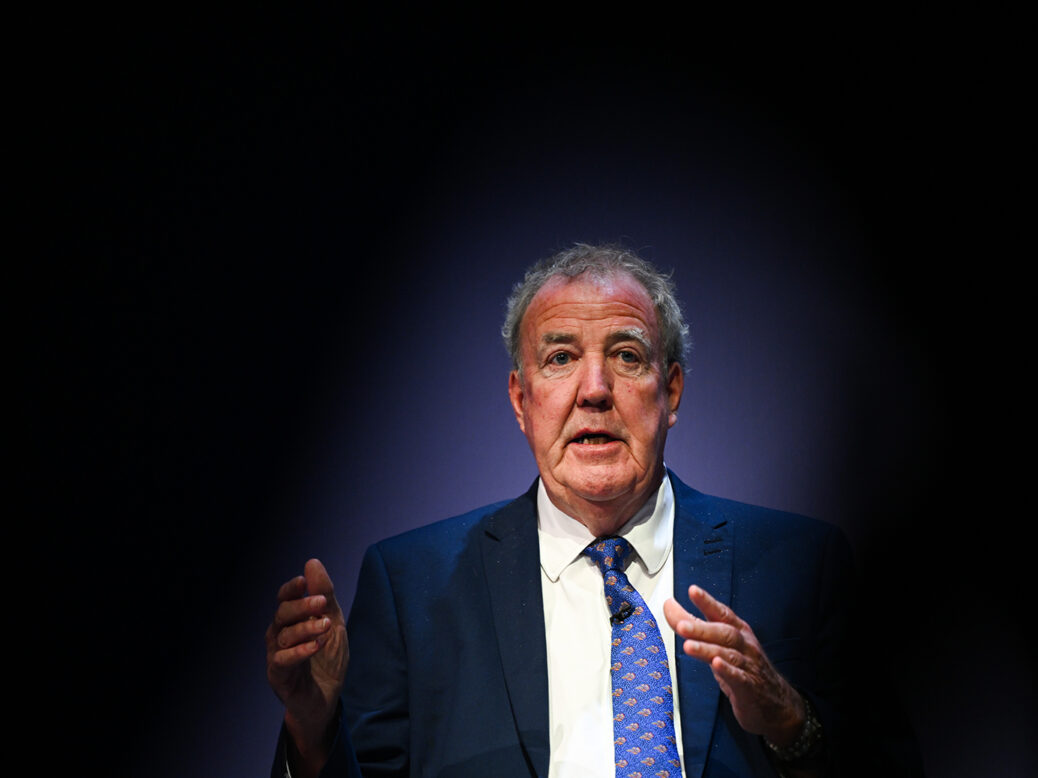
Jeremy Clarkson has emerged as the star attraction at the Conservative Party Conference, after his surprise appearance in Birmingham. In a panel event in the main hall on Monday afternoon (5 October) alongside the shadow environment secretary Victoria Atkins, the former Top Gear presenter vented frustrations about the Labour government, claiming farmers are under attack and asking: “Why would anybody set up a business in this country right now?”
Dressed, with appropriate reverence, in the dark suit and tie of a politician, Clarkson nevertheless entertained the audience with flippant asides that would not have been out of place in the studio. Referencing a recent remark from a Labour MP who said black labradors and warm ale were part of a “far-right nostalgic vision of Britain”, Clarkson said his own red labradors and taste for cold lager proved he was a socialist.
Clarkson has appeared in public with Kemi Badenoch before, when he campaigned with her against the Keir Starmer government’s inheritance tax changes. But his decision to attend the conference and show support for the Conservatives on their home turf marks the final consummation of a long-running dalliance: even back in the days of William Hague’s leadership, the Tories tried to get Clarkson to back them throatily. Instead, throughout the 2000s and 2010s, he stayed in the grey zone: a public figure with centre-right views who was friends with leading Tory politicians such as David Cameron but not a true player in the grubby world of party politics.
In recent years, though, Clarkson has started at least to look more classically Tory. Having cast off the baggy jeans and leather jackets of his motoring magazine days, at the beginning of the 2020s he put on a Barbour jacket and rebranded as a farmer (a pivot which, he admitted, started out as an inheritance tax wheeze). When, in the early days of the Starmer government, Clarkson stood on Whitehall surrounded by tractors and made a stump speech denouncing changes to inheritance tax, there was speculation that he could become the most popular politician in the country if he chose.

Just as the TV faces of yesteryear appeared to be moving with Reform – Jeremy Kyle was a star of its conference in September – Clarkson will at least create a few headlines for the Conservatives. Yet the arms races for celebrity endorsements between the political parties is quickly becoming a thing of the past. At the last election Labour HQ had its own dedicated member of staff for securing backers who were famous off the telly – the Celebrities and Endorsements Manager hired at the peak of Labour’s opposition polling bounce.
In a sign of changing times – and the moving of eyeballs away from linear TV and towards phone screens – the party’s current leader is instead becoming a social media celebrity in his own right with millions of online engagements. The most immediate change in prime ministerial style, in the transition from Starmer to Andy Burnham, has been that the Prime Minister’s grinning visage is suddenly everywhere, up close and curated for the vertical video format rather than behind a distant lectern. Likewise Nigel Farage, the leader of Reform and, to an extent, Badenoch herself, who has had some viral moments. All seem to anticipate a future in which politics is a branch of entertainment and politicians are celebrities with their own big followings.
In such an environment, what does Clarkson’s public backing for Badenoch’s Conservative Party actually show? Enthusiasts would say it’s the latest evidence of the “Kemi bounce”, as a popular national figure with both celebrity status and backing from the farming constituency jumps on the Tory bandwagon. As the Tories desperately struggle to reconstruct a social base in the country, after the pensioners ran for Reform and the rest of their voters ran for the hills, this could be a promising sign.
Yet the critical view would be to look at how Clarkson really makes his living, as a “media luvvy” at home in London as much as the countryside, with a newspaper column and moderate right-of-centre views. Such people already make up the hard core of Badenoch’s outriders, regularly praising her successes in the pages of the Times, the Mail and on TV. Perhaps Clarkson is just another, admittedly starry, addition to that roster. In that reading, the Clarkson endorsement is yet more evidence that Badenoch’s Tories are the Liberal Democrats of the British right, a glorified pressure group with little purchase beyond pockets of upper-middle-class enthusiasm and esoteric regional support. And if Clarkson is a symptom of that malaise, he cannot also be its cure.
[Further reading: The Tory war on Neets will punish parents instead]
Content from our partners


Related
Join the debate
Subscribe here to comment