
When Mo, an English teacher from Iran, spent a year and a half staying at the Thistle City Barbican hotel in 2023, he noticed that there was “always someone filming outside”. Now 29, Mo rents his own flat and works in admin at a chapel. He recalls that whenever he or his fellow asylum seekers left the hotel, they would be met with at least one man with a camera.
I have seen these men myself, often holding selfie sticks and live streaming themselves from their smartphones, outside asylum accommodation. They call themselves “citizen journalists” or “auditors”, and broadcast live on YouTube, Instagram and Facebook.
When I was covering a protest at the Bell Hotel housing asylum seekers in Epping last summer, I briefly became a subject for one of them, who pushed his camera in my face and asked which side I was on. My silence clearly gave him cause to follow me down the road, repeating his question. I must still be captured on a feed somewhere, rain dripping into my eyes from my cagoule hood, trying to look professional.
With some feeds attracting significant followers, this is a parallel news ecosystem that generally claims to tell the “truth” about migrants that the mainstream media don’t want you to hear. Growing alongside and within this world is a fringe vigilantism. Handfuls of men in some towns and cities in the UK have formed “patrols”, meet at “fight clubs”, or call in earnest social media posts for the men of this country to “stand up” and “protect” their women and children, their future. The government has lost control or is colluding in destroying Britain, goes the theory, so they must take things into their own hands.

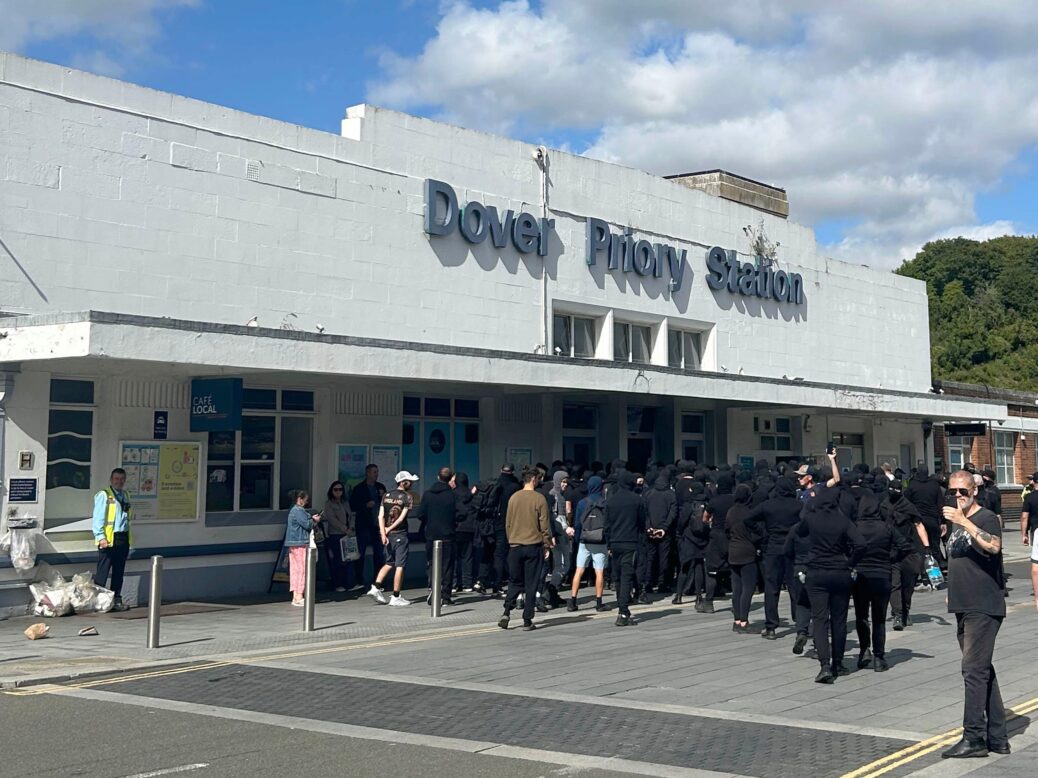
Daniel Thomas – or “Danny Tommo” – an associate and former bodyguard of the far-right agitator Tommy Robinson, has harnessed these pockets of localised vigilantism in a network called Patriot Platform, founded over the summer. Travelling around the country, he has signed people up to local Patriot Platform chapters. They even have an app. Members of these groups were among the 400-odd balaclava-wearing men in black who brought Dover to a standstill in protest against Channel crossings on 5 September.
The action closed the town’s main roads for hours, leading to long tailbacks and blocking access to the UK’s busiest port. It clearly caught the police and other agencies by surprise. Most anti-immigration and far-right demos are advertised publicly, and well in advance, whereas this one had been organised through clandestine channels. But when I visited a nearby village where the men had stopped off on the night before the Dover protest – parking their cars all over the main road and blocking spaces at the butcher and village hall – locals told me it had quickly become clear what they were planning to do.
“For too long, we’ve been walking down fucking roads, waving flags and thinking that’s somehow gonna save us,” Thomas said in one clip. “I’ve been part of that for ten years and I’ve come to the realisation, like many others, that something else needs to occur.” That “something else” includes the ballied-up Dover mob.
Patriot Platform “differs to most far-right groups in that it can mobilise smaller anti-migrant groups across the country at short notice, without publicly promoting the action,” said Alex MacKinnon, a researcher at Hope Not Hate, an anti-fascist campaign group. “Typically, a gathering of 400 people like we saw in Dover would require heavy public promotion.”
Other recent schemes dreamed up by Thomas haven’t come to much, including mobilising Brits to travel en masse to Calais to stop people making the crossing (he ended up being banned from France), and fundraising to buy a boat to stop dinghies in the Channel himself (it sank). Even some prominent figures in the far-right movement are sceptical. Thomas has a reputation as someone who leads people into situations where they get arrested, while he leaves the scene (he denies this characterisation, and no one at the Dover action was arrested).
In one recent video shared, he simply described himself as a “roofer”: the mythology of the Concerned Citizen summoned to obscure a decade of dedicated activism – and past criminality (Thomas was jailed in 2016 for taking part in an attempted kidnapping). His Christianity, too, is deployed as some kind of reputational shield. “I now go to church every Sunday and pray for forgiveness,” he once said.
But this is a man who, on the night following the Dover protest, had a big enough following to gather a group of 200-odd demonstrators spontaneously in Portsmouth. This was to try to block the arrival of 120 migrants who had been directed to the Eastney Landing port, where ferries run to Hayling Island – which happens to be Thomas’s home.
The men clashed with riot police and some officers were injured and vehicles damaged, according to Hampshire Police. Protesters waded into the sea to film, and called RNLI volunteers “traitors” and “scum”, posting pictures of them on social media, where there have been calls to identify them and their families.
The migrants in question had made an unusually long crossing from the Normandy coast. Perhaps ironically, this new route is probably the result of a significant crackdown by authorities in Calais; the number of people migrating across the Channel is down 43 per cent on last year. Not that the numbers matter much in the parallel world of vigilante Britain.
[Further reading: Andy Burnham can’t explain the economy]
Content from our partners



Related

This article appears in the 10 Sep 2026 issue of the New Statesman, The World According To Ed
Join the debate
Subscribe here to comment