
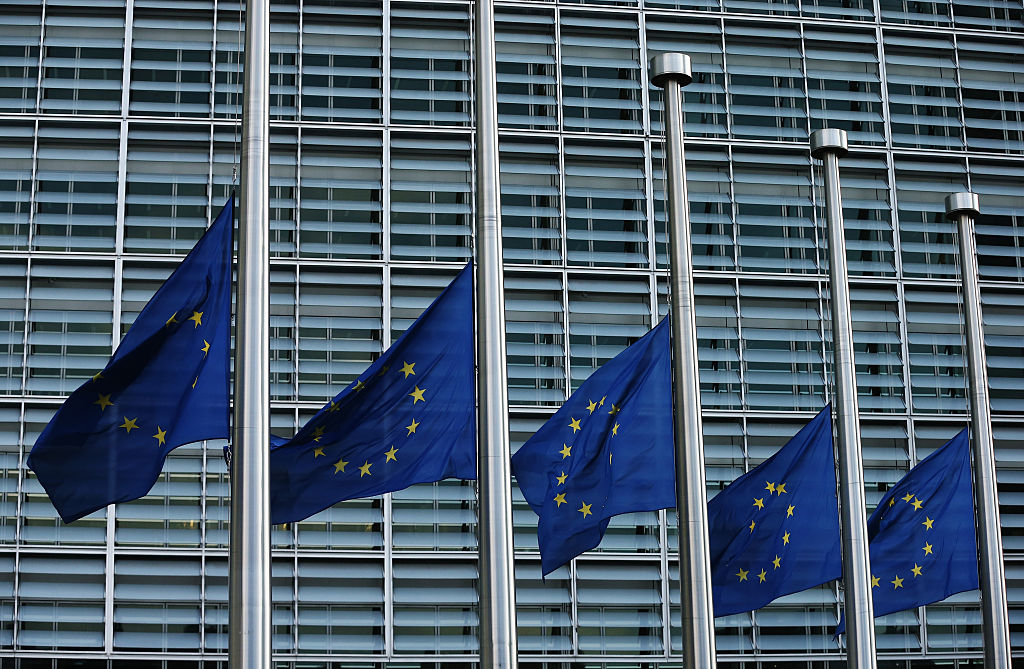
Is the European Union about to change its size and shape? And will that shape encompass the United Kingdom? For years the EU has pretended to be engaged in a parallel process of enlargement and reform. But in practice there has been neither. Twenty-seven member states have laboured on after Brexit, hobbled by antiquated confederal methods of government, under weak leadership, subject to international scorn. Meanwhile, British policy towards Europe is effectively stuck in the mire of Boris Johnson’s 2020 deal, even as the politics around the issue accelerates, with Tony Blair and Sadiq Khan urging British re-entry. But as Andy Burnham speaks today (29 September), expected to announce a new vision for EU relations, he should be confident – there is a new path ahead for Britain and the EU.
Twelve countries orbit outside the EU unable to resist the pull of its powerful regulatory regime. All those are eligible for EU membership; some have been actual candidates for accession for a long time; but none are yet ready to cross the threshold and assume the mantle of an EU member state. To the west, Britain, Iceland and Norway are so far standoffish. Switzerland struggles to accept the institutional framework that Brussels insists upon. War-torn Ukraine we know about. Neighbouring Moldova is impoverished and insecure. In the Western Balkans, ancient hatreds and modern mafia impede progress.
Then up pops Mark Carney of Canada, more clear-headed and articulate than other leaders about the purpose of European integration and the need for transatlantic security. Carney’s idea of sovereignty is not a national one. Against the hegemon and predator, Canada wants “collective resilience” by way of a much closer partnership with the EU. Ottawa has already struck a comprehensive trade deal with the EU, called CETA; it has an EU strategic security partnership agreement; and it participates in EU R&D programmes and SAFE, its new arms deal. On 17 September, Carney told the European Parliament that he wants more collaboration in the fields of energy, AI, financial services, critical minerals, space, and youth exchange.
Perhaps surprising even herself, Commission President Ursula von der Leyen suddenly invited Canada to become the EU’s “first associate member”. We should all “reimagine our partnerships”, she said, especially as the EU fast develops its own security and defence dimension to fill the gap left by a hollowed-out Nato. But what is this new category of EU associate membership? And what are its wider ramifications for the future of Europe?

Some things are clear. Associate membership means opening up the EU treaties for revision – a longstanding federalist goal. A wider and more diverse Union cannot possibly be run by a weak confederation transfixed by national vetoes in the Council and unable to settle executive authority on the Commission. The EU is already incapacitated by internal divisions on Russian sanctions, Israel, capital markets integration, fiscal union and the future budget. Without reform, an enlarged Union of 30-plus members will be ungovernable.
The EU also has a plethora of existing association agreements with its neighbours. If the present complex of partnerships is to be upgraded to a formal associate membership, integration will have to be more differentiated. Not everyone will want, or be ready to accept, a uniform package deal. If it ever did, one size no longer fits all.
Fortunately, the Commission has stopped banging on about “no cherry picking”. Despite French resistance, the Union’s true reformers, like Mario Draghi and Andrius Kubilius, take a pragmatic attitude towards third countries with friendly intent. The UK is badly needed inside the EU customs union to boost cross-Channel trade: if it remains outside it will be penalised under the EU’s protectionist “Made in Europe” legislation. Faced with Chinese competition and Trump’s tariff wars, Europe’s safety is in numbers.
That said, the EU will continue to insist on no free-riding. Associate members wanting full membership of the single market will have to respect all its disciplines, including free movement of workers. Another element of uniformity for all associate states would be adhesion to the Union’s mutual defence clause, Article 42(7), which obliges all EU states to come to the aid of another under attack. Engagement with other EU common policies, such as Schengen, would be optional. But the UK needs urgently to sign up to the EU’s new rules on asylum and immigration.
For the sake of transparency and efficiency, all associate members can be expected to conform to a single, joint institutional structure, although participation in practice will be at different degrees of intensity, depending on the policy sector. There will be one model for dispute resolution under the ultimate jurisdiction of the European Court of Justice. Associate members will need access to proceedings at the EU Courts to ensure the integrity of EU law applicable across the wider EU space. And they will be expected to observe the EU Charter of Fundamental Rights.
Ministers and officials from associate states should acquire rights to participate (without a veto) in the passage of EU laws and regulations that are to be applied within their territories. Likewise, members of parliament from associate states will be a regular presence in the committees and corridors of the European Parliament. Some of the 12 associates may never cross the threshold of full membership; others which may choose not to. President Zelensky will complain about second-class membership, but in today’s imperilled Europe, needs must. There are worse places for Ukraine to end up than with EU associate status, even for a lengthy period.
The Burnham government is condemned to fiddle around at the edges of Johnson’s Brexit deal, but it must watch closely as the concept of EU associate membership evolves. Canada may have stumbled upon partial membership of a stronger, larger and more federal European Union. If so, Britain should join the bandwagon as an EU associate state while combatting at home its own demons of nationalism and xenophobia.
[Further reading: Wes Streeting’s Blue Labour turn]
Content from our partners


Related


Join the debate
Subscribe here to commentEU citizens coming to the UK under Freedom of Movement were not, in the vast majority of cases, immigrants. They remained for a period (on average c. 5 years) to work (and pay UK taxes) and/or study and then returned home. Nor did they, in the vast majority of cases, bring dependents with them. Nor did they pose significant issues of social or cultural integration relevant to UK domestic or foreign policy. Those coming since Brexit, by contrast, in the vast majority of cases, do seek permanent settlement in the UK, do bring dependents with them and do pose such issues. EU Freedom of Movement was (is) not uncontrolled since it is dependent upon criteria for working and not constituting a burden upon member states’ domestic welfare systems. Moreover Freedom of Movement offered valuable reciprocal rights to UK citizens to work, study and retire in all states of the EU, something neither offered by those states from which we are now drawing the foreign labour our economy continues to demand, nor by and large desired by UK citizens.
“Associate members wanting full membership of the single market will have to respect all its disciplines, including free movement of workers. “
In other words, uncontrolled EU immigration, with democracy disabled by telling voters that it doesn’t matter how they vote because Brussels has mandated uncontrolled EU immigration.
I hope no-one in the Labour Party is under the illusion that there is any public demand to go back to the days of uncontrolled EU immigration.
This notion of “uncontrolled EU immigration is mistaken. Those coming here under Freedom of Movement were not immigrants, since the vast majority did not seek permanent settlement but rather stayed for a period and then returned home (on average after five years). Nor did they tend to bring dependents nor raise potentially difficult issues for UK domestic or foreign policy. In contrast to the non-EU citizens who, since Brexit, have largely replaced them in filling the ongoing demand for foreign labour in our economy. Moreover the arrangement was reciprocal, granting UK citizens rights to work, study and retire right across the EU. Rights the loss of which constitutes the greatest single deprivation of freedom for UK citizens in our peacetime history.