
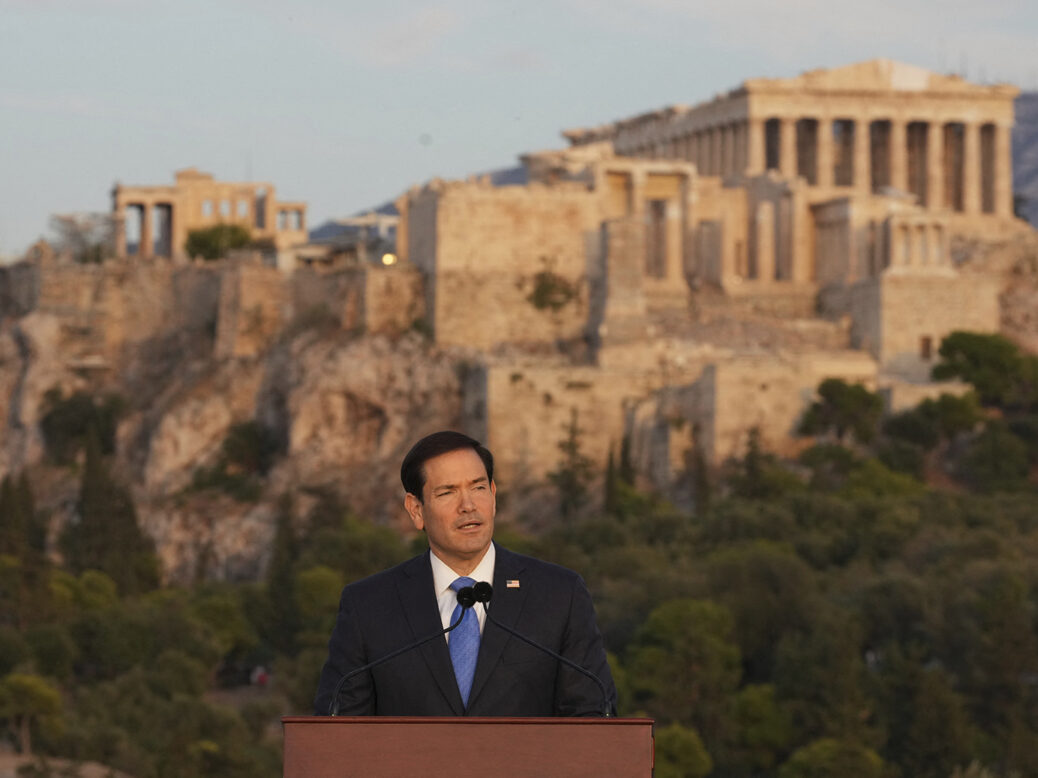
Last week, Marco Rubio flew to Athens, stood in front of the Acropolis and, with the Aegean sun setting softly behind him, made like an oracle. Forgoing the foreign policy quandaries you’d think a sitting US secretary of state would be preoccupied with, he turned to the life of the mind. “The Greeks of antiquity, they seem to have an almost mystical hold on our memory,” he burbled. “They call us back to them, again and again.”
Who would dare say he was wrong? For unless you have spent the year marooned on Calypso’s island, it won’t have escaped your notice that a film adaptation of an epic poem by a blind Greek bard who lived 2,700 years ago has somehow grossed $1.78bn.
The following day, as if to drive home the point, the Nobel Prize in Literature was awarded to Anne Carson, the 76-year-old classicist who has spent her career augmenting and deepening that “mystical hold”, by recasting the poetry and drama of Greek antiquity into a language for today.
Remarkably, not even a Nobel could make Carson the most famous living translator of ancient Greek – after Emily Wilson became a viral celebrity this year. Her translation of the Odyssey has surpassed a million copies sold. In the UK, sales were up 1,000 per cent, even as Penguin released yet another translation of it.

This surge of interest in ancient Greek literature is plainly linked to the Christopher Nolan film. But I suspect there’s more to it than that; for what, in the end, lies behind the film’s unprecedented popularity? It cannot solely be attributed to Hollywood marketing and an all-star cast. It’s not even that good a film. Something bigger, and more nebulous, appears to be at work, suffusing the ether of Western culture. A yearning to wrestle with the foundational stories in our literature. Without that, I don’t think The Odyssey could have drawn more than a hundred million people to see it in cinemas globally.
If recent decades have been a period in which our historical awareness of the Greeks had been waning – and there can be little doubt about that – then I think it’s now fair to say that 2026 might prove to be the year the tide turned, when the old stories and ideas came trickling back from Greece.
There are reasons why this is happening. In times of uncertainty, the instinct is to go back to basics, to seek out the roots that clutch. We’ve all seen it in individuals returning home, or to the family bosom, after a crisis – unemployment, perhaps, or a divorce. In Odysseus’s case, of course, it’s a war – and this story of homecoming is the archetype for all such narratives. That quest for Ithaca becomes a metaphor for the recovery of one’s identity and place in the world. Societies have the same need. They become unsettled on a grander scale, losing all convictions, their sense of where they stand. Roots nourish not only individuals; whole societies can find themselves wading through the morass of history, ideology and art in search of them. Buried among them, they might find Christianity or white nationalism; that, clearly, is happening. The idea of a Western civilisation beginning in Greece is also there in the mulch – much more fecund, I think, than the alternatives.
In some senses, the idea aligns with the Christian right. That’s where Rubio sits; for him the Greeks are exemplary settler-colonists, the perfect role models for Americans in search of new horizons to dominate. His speech makes a peculiar virtue of war, celebrating the triumph of the Greeks over the Persians in the fifth century BC as a civilisational victory (a transparent wish-fulfilment narrative). Despite passing nods to philosophy, it’s not the intellectual qualities of the Greeks that rouse him but martial ones (“their will to fight”). Even Socrates is portrayed more or less as a soldier, praised by Rubio for a willingness to die that is likened to the 300 Spartans who gave their lives at Thermopylae.
Thank Zeus, the fascination for the Greeks that we are witnessing in the wider culture is resoundingly not of this nature. Where Rubio’s speech exalts the ruthless pursuit of national interest, even conquest, Nolan’s Odyssey takes place in a world ruined by those very values – an obvious allegory for the collapse of the rules-based order that the US has accelerated. Above all, the film inveighs against the abandonment of what the ancient Greeks called xenia, hospitality to the stranger, a principle that lurks throughout the Odyssey – a tale, after all, of the shipwrecked in search of refuge, with profound implications for our own world.
Xenia is, in a sense, at the heart of all drama, too: we are confronted with a cast of strangers to whom we are challenged to extend that imaginative hospitality we now call empathy. It’s what drama is all about.
Carson’s life’s work has been to resurrect, through vivid translation – with sharp modernist fangs that bite into the contemporary – the great tragedies of Greece. They are all, in the end, about suffering; by publicly staging it – in theatres doubling as public assemblies – the Greeks made suffering, moreover, a political problem. The earliest tragedy we have, Aeschylus’s The Persians, calls into question war itself by narrating it, astonishingly, from the perspective of the defeated enemy.
If this turns out to be the year we rediscovered Greece, it may be because it is the best place to turn for a people spiritually uprooted, more than anything, by the normalisation of violence and catastrophe. To all of us stranded on the shores of 2026, these stories arrive like messages in a bottle – calling to be cracked open after long years of silence.
[Further reading: In praise of Winnie-the-Pooh’s idleness]
Content from our partners



Related
This article appears in the 14 Oct 2026 issue of the New Statesman, Fool Britannia
Join the debate
Subscribe here to comment