
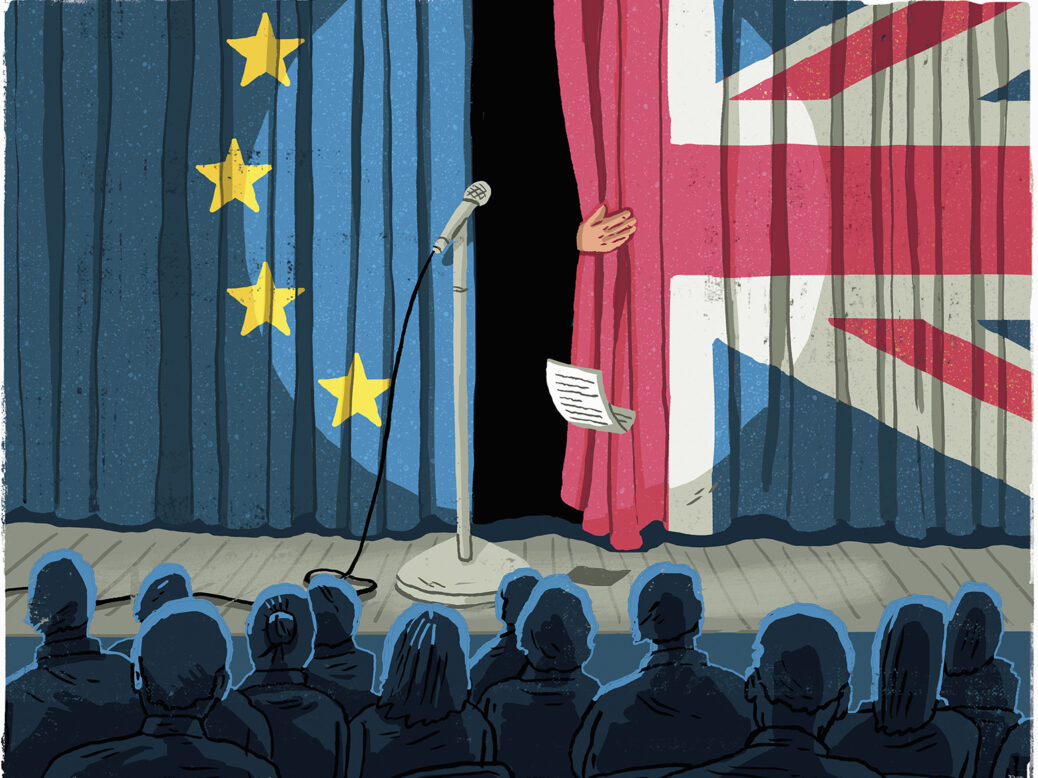
The fullest plan yet for the UK to rejoin the European Union has been published in the wake of the Prime Minister’s call for a closer relationship with the bloc.
Today the Institute for Public Policy Research (IPPR), an influential centre-left think tank, publishes two substantial reports laying out the most serious approach yet to rejoining the EU, as Andy Burnham’s pro-European tilt begins to acquire a momentum of its own.
The first report, titled “New World, New Relationship”, lays out a six-part political and diplomatic plan for British re-entry and urges the current government, and progressive politicians at large, to press ahead. The second, titled “A Durable Majority”, uses polling to measure the potential public support for doing so.
After laying out all of the possible options for a closer relationship with Europe, the authors conclude: “The UK must become a member of the European Union. Progressive and forward-leaning politicians should recognise this immediately, and say so. And the government should build this into its policy choices and plans.”

Their recommended path to British re-entry under a Labour government proceeds as follows.
In step one, they say the government should explicitly name membership of the European Union as its medium-term goal, as a prerequisite to all other steps. We may have already reached this point. While the PM’s language has been ambiguous on the nature of a future relationship, he was explicit at last year’s Labour conference that his ambition is for the UK to be back in the EU in his lifetime.
For step two, the report says Labour should “develop a new political language about Europe”. This would include emphasising how the EU has changed since Britain voted to leave in 2016, with its greater focus on defence, border security and industrial policy.
Step three says the UK should try to build new institutions in Europe now to demonstrate its seriousness about re-engagement – by, for example, pushing a continental industrial policy, defence alliance and for a “democratic resilience compact” in the face of anti-democratic threats.
Step four recommends a “multipronged political rebuild”, focused on repairing damaged relations after a decade of Brexit backlash. The report proposes that the UK should significantly increase its diplomatic presence in European capitals and especially in Brussels, arguing it should base more staff there than EU member states in an attempt to demonstrate commitment. The report also urges Labour to build stronger relations with progressive parties on the continent.
For step five, the report proposes that Downing Street draw up a number of internal tests to monitor the progress of the UK’s journey back into the EU. These would include close measurement of public sentiment on the issue, along with an eye on EU attitudes towards Britain, and how seriously the government’s intention to rejoin is regarded.
Finally and perhaps most importantly, for step six of the report Labour is urged to develop a political strategy to secure a mandate for Rejoin. This mandate would be “a manifesto commitment, an election victory and probably a referendum”.
The report is accompanied by new polling, conducted by Persuasion, which attempts to demonstrate the feasibility of obtaining that mandate. At least since the Conservatives’ decisive election victory in 2019, on a platform of “Get Brexit done”, the notion of overturning the 2016 referendum result has been something of a taboo in Westminster.
Yet the IPPR’s accompanying polling report shows that “the British public is broadly united in believing that Brexit has been a failure”. While this does not in itself directly translate into support for rejoining the EU, the paper argues that “for any government seeking a substantively different relationship with the EU as key to its broader political strategy, a durable majority of public support exists to build upon”.
The polling shows that 52 per cent would support a “rejoin” proposition with 29 per cent opposed and the rest undecided. Some 20 per cent of 2016 Leave voters would now support rejoining and even key swing voters such as the “Reform-curious Labour” contingent back rejoining by 54 per cent to 36 per cent. According to the report, rejoining has majority support in every pre-retirement age group, though support falls off sharply with over-65s.
The three main draws for supporting a “Rejoin” vote would be a perceived improvement to travel, economic performance and national security within the EU. The authors attempted to war-game the arguments of a referendum in a “realistic information environment”, testing the most powerful rhetorical techniques that opponents of rejoining might use. They found that while the salience of financial contributions to the EU and freedom of movement are not as powerful as they were in 2016, Eurosceptic campaigners could dent public support for rejoin by framing these as “sending cheques to Brussels” and “opening the floodgates”.
Questions remain over whether Burnham’s flighty rhetoric is simply a short-term gambit intended to improve relations before an important summit with European leaders in November, a medium-term political strategy to consolidate the so-called progressive bloc of British voters for Labour, or a real long-term ambition for the UK to return to the EU – or a mix of all three.
What is clear, with the publication of these reports, is that even if the Prime Minister himself is not entirely serious about a full rejoin agenda, plenty of progressive opinion-shapers in the Labour Party and its wider think tank ecosystem are indeed very serious and more determined than ever to press on with the work of reversing Brexit.
[Further reading: TikTok’s irreverent slop was made for Nigel Farage]
Content from our partners



Related

Join the debate
Subscribe here to commentAs a long term labour voter I have severe misgivings about re-opening this issue, to the extent that i’m not sure i would vote for a party comitted to rejoining the EU. Firstly, apart from the toxic divisiveness and renewed culture wars which would be unleashed, the main argument remains not so much one of economics but one of democratic soverignty and accountability – which , in a my view, IS a real defecit of the EU. Secondly, many of the people argining to rejoin appear to be doing so at a time when the EU’s growth rate is similar to, or in some cases slighlt less, than that of the UK, and at a time, as we see in France, of crisis, when parties of the right, in some cases the far right, appear likely to be in governement, or very near to government. Precisely what kind of Europe would we be joining? I’ wasn’t Brexiteer, by the way, and voted, if conflictedly, to remain but for me this would be a disastrous turn – a close relationship with Europe yes, and an internationalist perspective yes, but rejoin a definite no.
What do you mean exactly by “a close relationship with Europe yes…..rejoin a definite no.”? You should read the report. It spells out very clearly why all the alternatives less than rejoining as a full member are not in the national interest.