
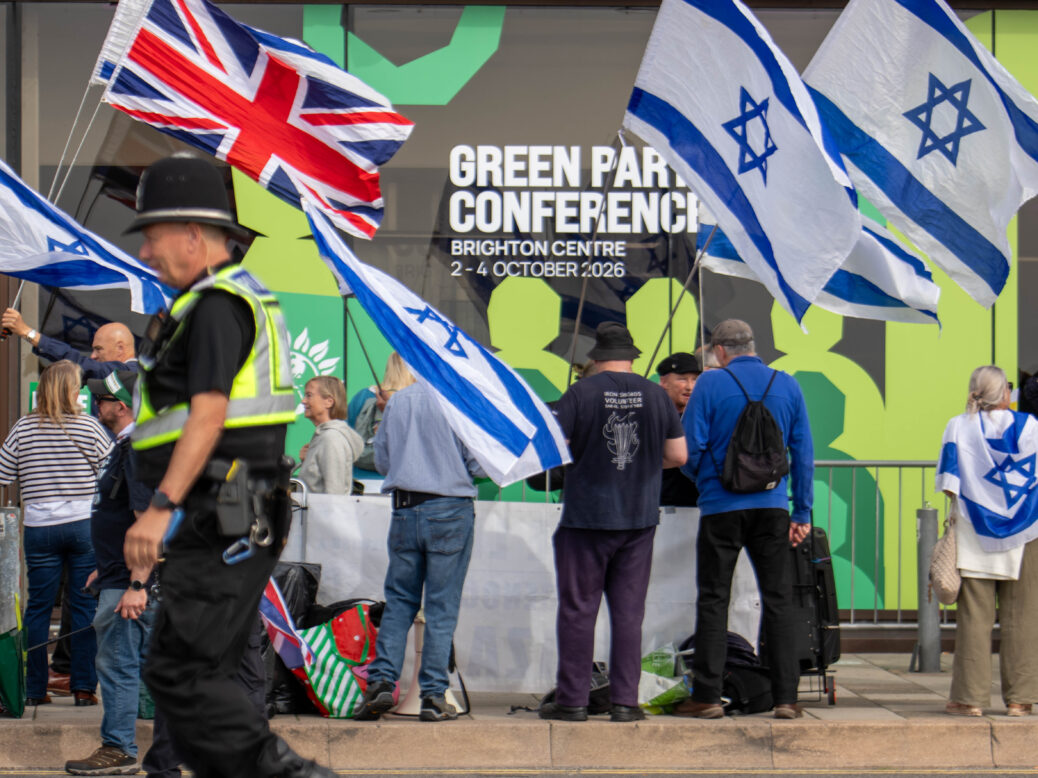
Green Party members backed a motion to describe Zionism as racism on Sunday (4 October), with 1022 votes for and 813 votes against. The tension around the conference hall ahead of the result was palpable. Due to party policy, the press were not allowed into the hall to listen to the debate. Instead, journalists lingered outside, waiting for the result.
The motion itself was first put forward in February ahead of the party’s online spring conference, where it eventually ran out of time to be heard. It is backed by the non-affiliated group Greens for Palestine. It calls on the party to back a single democratic Palestinian state, to demand freedom for Palestinian prisoners, oppose the Palestine Action ban and affirm Palestinians’ right to resistance.
Mothin Ali, the party’s deputy leader, supported the motion. Four of the party’s MPs, Ellie Chowns, Adrian Ramsay, Sian Berry and Carla Denyer, had publicly opposed it ahead of the vote, as did former leader Caroline Lucas and co-deputy leader, Rachel Millward. Two attempts to water down the motion, both backed by party leader Zack Polanski, failed. Amendment one aimed to soften the motion’s stance on the creation of a single Palestinian state, while amendment three would have made explicit provision for the safeguarding of Jewish members from disciplinary proceedings for being members of “Zionist synagogues” or other organisations that describe themselves as Zionist.
A spokesperson for the Green Party told the press huddled outside the hall that the reason amendment three didn’t pass was because members deemed it unnecessary. They said: “During the debate, the point was made that Green Party ‘E motions’ do not have a material impact on governance or disciplinary procedures and as such, conference decided amendment three was not needed”. This has done little to assuage the concern of some Jewish members who are alarmed by potential secondary consequences of the policy.

During the debate, both Chowns and Lucas made impassioned speeches on the realities of the motion, urging party members not to vote for it. Chowns, the party’s leader in Parliament, spoke remotely and told members that should it pass, “We risk being perceived as an anti-Semitic party. Please vote against this motion so we can advocate powerfully for peace and justice.” Both women were heckled during their speeches to members.
Ali, who spoke for the motion, acknowledged that the issue was contentious but reiterated his support for it. He told members he had originally planned not to take a position on the motion in order to let the membership decide.
After the vote had concluded, there were chants of “Free Palestine” outside the conference hall. A spokesperson for Greens For Palestine said: “Anti-Zionism is a protected philosophical belief in UK law. The Green Party is an anti-racist party. We do not conflate a political ideology with a religious or ethnic identity.”
Though the motion passed decisively, the party has been split over it. There is a sizable group of people who think it was a strategic mistake and will both alienate potential voters or prove to be the only thing the party is asked about in the months to come. Instead of discussing the cost-of-living crisis, or how it might build on the various successes it has enjoyed this year, Green Party members have spent the best part of today debating and discussing this motion.
During the party’s conference, announcements have been made by the leadership team around rent freezes, water nationalisation and a youth jobs guarantee. But in the weeks to come, they are more likely to now be questioned about the party’s new anti-Zionist stance than they are on its freshly announced cost-of-living policies.
Supporters of the motion are elated. In a press huddle shortly after the motion was passed, a spokesperson for Greens for Palestine said: “This motion is a unifying one. And conference has spoken and indeed we are unified.”
But there is also deep sorrow and apprehension within the membership over what might come next. One member who opposed the motion told the New Statesman, “I think it’s reinforcing a sense that the party is increasingly catering to the Socialist Workers Party base, rather than positioning for the country.” They described the motion as “performative politics”. There is also a sense among members that the party’s leadership did not do enough to defuse the situation, waiting only until the first day of conference to try and persuade members not to pass the motion instead of urging them to do so in the seven months since it was first announced.
Some Jewish members are devastated. The New Statesman is aware of at least one member who now intends to resign their membership of the party. They described the party as now “officially anti-Semitic”. Sam Alston, the author of amendment number three which was voted down by members, said: “Green Party conference had the chance today to make this clear it was not targeted at Jews. It did not. We remain welcoming to Jews but not sure if that will remain.” He added: “Our capacity to stop the genocide is weaker today.”
Polanski did not attend the vote, nor did he participate in it. He left the conference shortly after his speech on Friday to return to the constituency where he is running in what one member describes as “the biggest by-election in the party’s history”. Throughout the weekend, members were urged to leave the conference to travel to the constituency and canvass for Polanski instead. Neither of the amendments which he backed were passed. Some Green insiders remain deeply concerned about the impact that this policy will have on Polanski’s support in the constituency and his ability to win on 8 October.
The Green Party leadership will now need to take stock. A Green Party spokesperson said: “The Green Party is an anti-racist party and has consistently opposed the illegal occupation of both Palestinian and Syrian land, called for an end to arms sales to the Israeli government and spoken out fearlessly about the devastating situation in Gaza and the West Bank. Those positions remain central to our approach. So too does our deeply held commitment to equality, justice and human rights for all and opposition to racism in all its forms.”
In the hours after the vote, Polanski put out a muted joint statement with all 5 MPs and his two deputies. In it, the group pledges to never tolerate any form of discrimination or harassment and to continue to work to ensure that the Green Party is an anti-racist party in every way. “We know there is no conflict between supporting the rights of Palestinians and the rights of Jewish people,” they said. But in the days and weeks to come, party members on both sides of the motion will be waiting to see what kind of material impact this new policy has on the party. For now the party’s attention will turn away from Brighton and to Holborn and St Pancras, where their next electoral test awaits.
[Further reading: Zack Polanski’s year of magical thinking]
Content from our partners



Related
Join the debate
Subscribe here to commentOh dear oh dear as both a green Party member AND NS subscriber of many years this piece of essentially tablod style journalism saddens me. If you didn’t know by now the Green party is one of the most truly democratic parties around with members, NOT MPs or leaders deciding policy unlike say the Labour party. So the key part here is simply “the motion passed decisively”, move on, nothing to see here, other than trying to project non existent dissent and discord. How about some more positive reporting about the Green party or are you now becoming the house journal of Andy Burnham’s Labour party (like Frank Lampards Coventry city, football followers will understand that and it’s not a complimentary media schtick)
This is an extract from Megan’s other article abiout the vote:
“The Green Party runs under a one-member-one-vote system – any member can join, apply and pay to go to conference and therefore vote on policy motions. Some in the Greens, including Ramsay, think the party should introduce a delegate system where local parties send a certain number of members to conference. “That wasn’t 1 per cent that was representing members across the country, that was a self-selecting 1 per cent,” he said. “We don’t know what the other 228,000 members think on the issues that were discussed today.””
If this is true (and please say of it isn’t) its not democracy at all but more like mob rule. There is no way we could tell how representative any vote is of the party as a whole in the way say, a delegate system might tell us.