
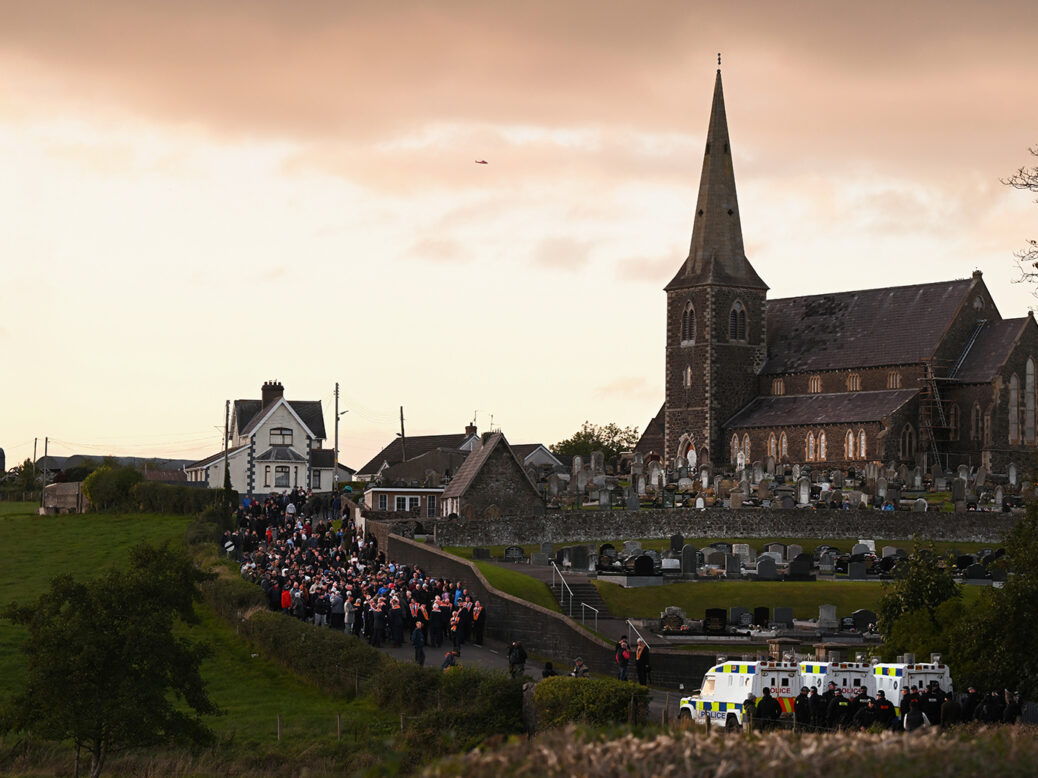
It is a case of déjà vu. The most recent stand-off at Drumcree, County Armagh, which began on 27 September when nationalists resisted an Orange Order march through a Catholic area, is a grim reminder of the tribalism that undergirds Northern Irish politics and how easily it can resurface. The scenes were of nationalists linking arms to halt the Order’s triumphalist, anti-Catholic parade through a Catholic part of Portadown, a predominantly Protestant town.
That, at least, is how it was presented. And there is some truth in that. But there is also distortion amid a confected trauma and a Ladybird-book telling of history.
The Good Friday Agreement (GFA) largely froze this conflict, but didn’t resolve it. Nearly three decades on, the GFA has brought about lower tension between the communities, but both groups still see one side’s victory as a defeat for the other.
And those communities like to present themselves as victims. One are the victims of IRA terrorism, the other of British imperialism. The political structures set up by the GFA encourage each side to look for support within its own community but not across communities. In a society that needed compromise and far-seeking politics, the system encourages intransigence and tribal vote-hoarding.

If we can think of Sinn Féin as the winners of the peace process – they are the largest party in Northern Ireland, hold the office of first minister, and the direction of travel seems to be towards a united Ireland – then the recent events in Drumcree show that there is no magnanimity, no compromise and no attempts to reach out to the Unionist community.
Though the party talks of building a “New Ireland”, a post-sectarian society in which Unionists have little to fear in a united Ireland, it seems that Sinn Féin wants a society in which its side wins. “Hearts and minds” don’t come into it.
Drumcree is a sensitive place. In 1995, the fledgling “peace process” faced increasing strain. The IRA and Sinn Féin were unhappy with the new government in Dublin, and John Major was in a political corner. That June, Sinn Féin pulled out of talks with the British. Summer means marching season in Northern Ireland, and Drumcree was one of the most contentious of the many contentious parades.
The Royal Ulster Constabulary (RUC) prevented a march down the Garvaghy Road, a nationalist area, from Drumcree parish church where the Orangemen would start their procession. The police were in an impossible position. Either allow a march and see thousands angrily take to the streets, or ban it and see thousands angrily take to the streets.
The 1995 march (and the ones in subsequent years) was allowed to proceed after a siege, as the RUC deemed it safer to permit the protest in the context of widespread loyalist threats of disorder. A heavy police presence was required to prevent violence. There was a sense that Northern Ireland was on the brink of civil war.
One of the reasons Drumcree is so delicate is because of how many killings have been associated with the stand-offs through the years, including of three young Catholic children in 1998. Since that year, the Parades Commission, set up to mediate on all marches across Northern Ireland, consistently banned the march from the Garvaghy Road, which would have seen 2,000 Orangemen attend at its peak. That changed this year. The commission allowed a parade, but with no more than 35 participants, no music and no supporters allowed on the route. It had to leave Drumcree Church by 8am on 27 September, and disperse by 9.30am.
There was a chance most residents would not have even noticed the march happening. But this is Drumcree – a place that has made and ended political careers. David Trimble took the leadership of the Ulster Unionist Party in 1995, in part for his hard-line stance there. That fear of being outflanked might have been the motivation for many in Sinn Féin to make a stand.
One of the leaders of the Garvaghy Road residents is Breandán Mac Cionnaith, a former IRA bomber who later left Sinn Féin to join the dissident republican group Éirígí, because of Sinn Féin’s acceptance of a new police force. Tony Blair was intrigued by Mac Cionnaith for his intractability. In his memoir, Blair writes that Mac Cionnaith “took unreasonableness to an art form. He conceded nothing, and I mean nothing… Where a meeting should be held… Who should be there… Who spoke first. Who spoke last. Who spoke in-between first and last.” One could imagine Sinn Féin’s fear as it saw Mac Cionnaith take control of the protest for the Garvaghy Road residents.
If Drumcree can be the graveyard of moderation, the party leader of Sinn Féin, Mary Lou McDonald, and the First Minister of Northern Ireland, Michelle O’Neill, soon buried theirs. They leveraged identity politics to whip up anger among a group of protesters that was barely even born when Drumcree was first an issue. The leaders of Irish republicanism behaved like a pair of Primark Paisleys, getting the crowds to chant “no going back” – a nationalist “not an inch”.
There is little of the danger that was present in the 1990s. But there isn’t a sense of a nationalism interested in accommodating Unionism either. An already unsettled Protestant people will take note of that. A united Ireland seems a little further off.
[Further reading: The ghosts of Drumcree return]
Content from our partners



Related
This article appears in the 01 Oct 2026 issue of the New Statesman, Sunshine and Rain
Join the debate
Subscribe here to comment