
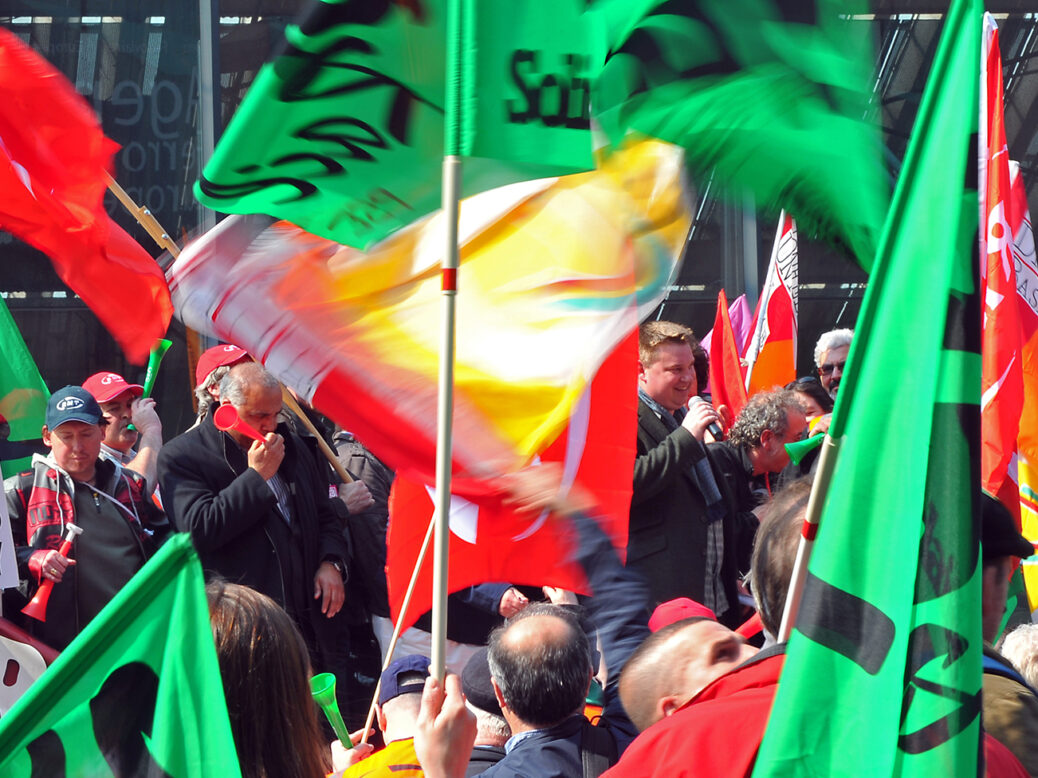
Outsourced workers on publicly owned TransPennine Express are to strike during the Labour Party Conference in a move designed by the RMT Union to pressure Andy Burnham to fulfil the government’s promise to “end the era of outsourcing by default”.
Despite the government taking several railway operators into public ownership – including TransPennine Express which was nationalised in 2023 – thousands of workers, including cleaning staff, catering staff and security guards, remain outsourced to private contractors.
At the 2024 general election, the government made a commitment to usher in the “biggest wave of insourcing in a generation” as part of their Plan to Make Work Pay. In June, then Cabinet Office minister Chris Ward reiterated the government’s promise, declaring the “age of outsourcing over”. The government has announced that by April 2027, all departments and arm’s-length bodies will conduct a public interest test to detect how services can be delivered in-house. However, the unions want the government to move faster on this.
Around 200 workers will walk out on Monday 28 September, with a flying picket of workers outside Labour’s conference venue in Liverpool from 11am that day. There has been an ongoing dispute between the RMT and TransPennine Express over pay terms and conditions for catering and cleaning staff employed by outsourced companies.

Eddie Dempsey, the general secretary of the RMT, told the New Statesman that: “Considering that we’ve got the Labour Party conference coming up, and no settlement in sight, we wanted to bring our members to call on the government to deliver on this promise for the largest wave of insourcing in a generation.” Dempsey said the union hopes the strike will encourage the government to “start discussing a plan for delivery and identifying quick wins”.
He praised the First Secretary of State, Louise Haigh, in her former role as transport secretary in which she oversaw Labour’s move to nationalise the railways. The government’s work on insourcing now comes under Haigh’s new brief at the Cabinet Office, as well as new Cabinet Office minister Mark Ferguson. “She managed to get through legislation at rail nationalisation and at pace,” Dempsey said, “she had to deal with a lot of vested interests. So, we’re hoping she’ll be able to do the same thing in outsourcing.” The union has already been working on increasing insourcing in the public sector with the Liverpool City Region Mayor, Steve Rotherham, and the London Mayor, Sadiq Khan.
New research conducted by the Common Wealth think tank in partnership with the RMT and Unison and shared exclusively with the New Statesman found that outsourcing companies made £6bn in profit from public services in 2025. They estimate that this money, if redirected, could pay for 300,000 additional adult social care workers. The research also found that 1.32 million people are employed in “publicly funded but privately run services” in what the paper dubbed the “para-state” – the private businesses which deliver outsourced services and receive the majority of their funding from the state.
Burnham has previously expressed a desire to crack down on outsourcing in the public sector. During a hustings for Labour MPs ahead of his election, unopposed as party leader, he criticised the practice and said he wanted to see more insourcing of contracts back in-house. This sentiment aligns with Burnham’s “Manchesterism” economic vision, with its focus on public control of essential services.
Dempsey said there would be fewer disputes over outsourcing contracts should more services be brought in-house. He said the RMT agrees with a lot of what the Prime Minister has been saying around public control and ending 40 years of neoliberalism, but added that the government’s action on ending outsourcing is “critical”.
“He’s going to have a tough budget,” Dempsey said, “and right now there are billions going out of our public services in the form of profits.” He argued that “Manchesterism won’t work” unless the money going out of the public purse to outsourced companies is redirected into the local community via insourcing. “If he’s wanting to make progress in this direction, this is the perfect place to start,” Dempsey said.
Andrew McClements, customer experience and transformation director at TransPennine Express, said the strike may impact cleaning and catering on its services. “I apologise to our customers travelling on this date and ask that you bear with us,” he said. “Where possible, please bring your own refreshments.”
A spokesperson for the Department for Transport said: “Great British Railways will sweep away decades of fragmentation, stopping unnecessary waste and create a railway that delivers for passengers, taxpayers and staff. As more operators come into public ownership, we will continue working with industry to ensure everyone that keeps the network safe and clean is valued and respected.”
They added: “Once established, GBR will decide how work is resourced to make sure passengers, freight users and taxpayers get the best value for money.”
[Further reading: Andy Burnham seizes control]
Content from our partners



Related

Join the debate
Subscribe here to comment