
One of the many criticisms of Keir Starmer’s leadership was that he had little or no sense of history. The same, happily, is not true about his successor, Andy Burnham, who promises to replace the neoliberal, market-driven settlement established by Margaret Thatcher in the Eighties and, with varying degrees of enthusiasm, followed-cum-accepted by the next eight prime ministers. Burnham’s historical vision of Britain since the war has a refreshing clarity to it. In essence: “1979-2026, bad” – and therefore by strong implication, “1945-79, good”. But, appraised unsentimentally, were they the good days? And is “back to the future” really the answer?
Clearly, from a left-of-centre perspective, there is plenty to recall positively about those 34 years between Clement Attlee’s Labour landslide in July 1945 and Thatcher coming to power in May 1979. The distribution of income and wealth became significantly more equal; generally low levels of unemployment prevailed; a modern cradle-to-grave welfare state was established; powerful, democratically elected local authorities provided education and housing; and, as evidenced by well resourced parks and other recreational facilities, the public domain flourished. Yet even on its own terms, there were damaging, consequential flaws in the “1945” settlement.
Take health, symbolically the gold standard. For all the marvel of having an NHS available to patients free at the point of delivery – the great creation of Aneurin Bevan in 1948 – it was apparent as early as the Sixties that it had problems far beyond those of fluctuating funding and regional inequalities. In two pioneering studies (one about hospitals, published in 1964; the other about GPs, published in 1967), the sociologist Ann Cartwright revealed in detail an inflexibly hierarchical, top-down world all too often lacking in imagination and emotional empathy, not least when it came to the treatment of children. In his 1994 autobiography, John Lydon (AKA Johnny Rotten of the Sex Pistols) wrote about how, aged seven, he spent a year in St Ann’s Hospital in south Tottenham after being diagnosed with spinal meningitis. “Every six hours I had to have penicillin injections all over,” he remembered. “Kids like me were scared of needles, and nurses did fuck all to alleviate that fear.”
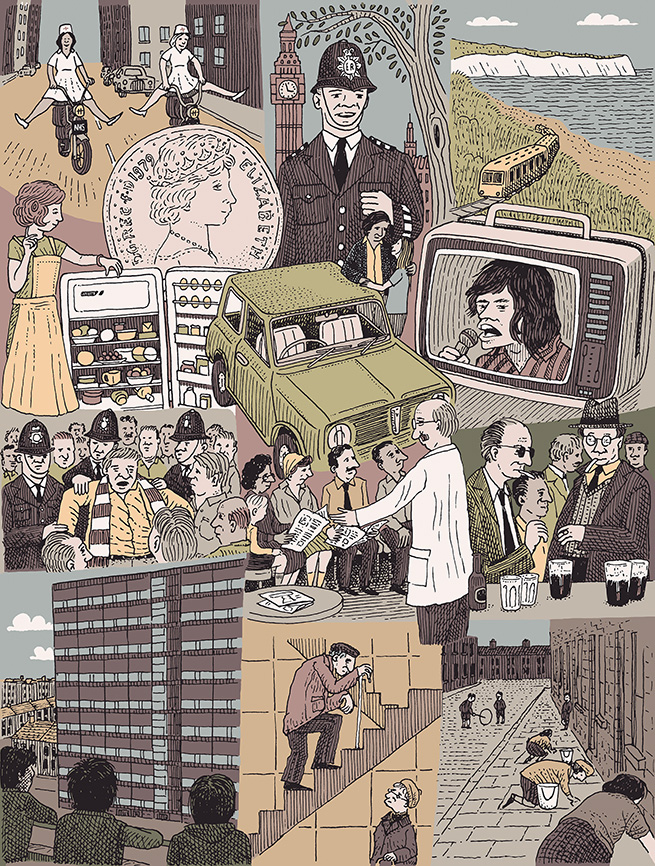
So too with housing, with social housing comprising about a third of the entire housing stock by 1979. For all the successes recorded, my series of books on postwar Britain is unavoidably full of indiscriminate, insensate slum-clearance needlessly destroying whole communities; of unsatisfactory high-rise developments, even as all the available evidence showed a widespread desire to live in a house, however small; and generally of a local-authority attitude to tenants that too often treated them as little more than statistical fodder. Perhaps nowhere was this quite so emblematic as the “Piggeries” in Liverpool’s Everton area. Built in the mid-Sixties (and demolished in the Eighties), these were three identical dark-grey, 15-storey tower blocks, soon earning their derogatory local nickname. “You had to be tough to survive,” remembered one former resident in 2015 about his family’s time there. “The stairwell was full of shit and piss and you had to walk up and down [the stairs] because the lifts never worked. It was all right for us kids; we’d have a laugh. But not for the old ones. It was a hovel.”

Even so, practical deficiencies in the new postwar settlement, including in some of the newly nationalised industries, go only so far in explaining why, in these years, the political centre of gravity lay somewhere to the right of centre. Here, it is instructive (and salutary) to look at the general elections held between 1950 and 1974 – or, in other words, after the Labour landslide of 1945 and before the Thatcher victory of 1979. If one defines a decisive win as an overall double-figured parliamentary majority, then the sobering fact is that in these nine contests Labour won decisively only once (1966) whereas the Conservatives did so four times (1951, 1955, 1959, 1970). The two parties may each have ruled between 1945 and 1979 for 17 years, but in some fundamental sense that was a deceptive parity.
Why was this? One reason is that the two dominant characteristics of British society during these years were a growing individualism and an entrenched social conservatism. Another is because the left had serious problems when responding to both of these phenomena.
Individualism first. All historians have their moments of revelation – usually not that many in a working lifetime – and one of mine came while researching my history of 1945-51, Austerity Britain. I had always seen the Forties as our most collectivist decade, the most “we” decade in 20th-century Britain. Yet by immersing myself in Mass Observation fieldwork and other sociological surveys, I found much more evidence of “me” than “we”, certainly if “we” meant anything beyond self and immediate family.
The Second World War was full of idealistic social investigators asking working-class people (in what was still a predominantly working-class society) about how they envisaged life after the war – and being consistently disappointed by the emphasis on home and hearth, to the exclusion of any sense of a bigger, more widely shared picture. “A garden that is overlooked, windows into which neighbours can see, balconies visible from the road or from houses opposite are all deplored,” found Mass Observation’s 1943 report An Enquiry into People’s Homes. “But above all, people dislike sharing a house with another family or even with one person, as many have to do.” Two years later, during the election that resulted in Labour’s historic landslide, there was still no great evidence of a widespread “New Jerusalem” mood about the possibilities of creating a more socialist world, despite the best efforts of some observers to find it.
Nor did the underlying priorities change afterwards, even in relation to Bevan’s monument to mutual collectivism. A Mass Observation survey of attitudes to the NHS nine months after its creation showed a degree of satisfaction that it put everyone on a basis of “medical equality”. But there was at least just as much a pleasure in “the obvious point of cheapness”, albeit with accompanying grumbles. Indeed, the individual grumbles seemed to outweigh everything, whether the tobacconist complaining that “the doctor isn’t so friendly as he was”, or the civil servant that “I’ve had no advantages myself yet”, or the policeman’s wife telling the story about how each time her husband went to the GP with a back injury he “more or less saw the same people” waiting in the surgery.
Over the next decade or so, on the back of increasing disposable income and consumer choice (heralded by the first publication of Which? magazine in 1957), a home-centred individualism steadily became the defining British way of life. Pubs, cinemas and football crowds started to decline, as did membership of political parties and the institutions of civil society generally. A brilliant cartoon by Trog (real name Wally Fawkes), immediately following Harold Macmillan’s 1959 “never had it so good” election triumph, in its way said it all. “Well, gentlemen, I think we all fought a good fight,” he pronounces with evident satisfaction; and his listeners are a fridge, a car, a washing machine and a TV set – those indispensable requirements for an increasingly privatised lifestyle.
Then came the Sixties. The consumer revolution continued at pace; deindustrialisation (with its accompanying loss of workplace solidarities and community identity) was under way; sociologists debated whether “the affluent worker” still possessed a working-class identity and values; Conservative promises on “Right to Buy”, a localised forerunner of Thatcher’s policy, generated eye-catching dividends at local elections in 1967; while of course, the general countercultural vibe that we associate with that much-mythologised decade had at root an individualistic desire to be “free”, whether from parental or other types of authority. And on election day in 1979 (after a decade that saw the emergence of what was not yet called identity politics), I remember taking a grim pleasure in seeing that the front page of the Evening Standard featured a photo of Mick Jagger, who had once called for fighting in the street and was now a seriously wealthy rock entrepreneur.
Little about the age of affluence was instinctively to the taste of the British left, imbued as it was with a profound, distinctly puritanical mistrust of modern commercial culture and American-style, TV-watching materialism – or, in short, that “candy-floss world” so vehemently denounced by Richard Hoggart in The Uses of Literacy (1957). Over the next two decades, the left’s relationship with affluence would remain troubled, at times even tortured, as a theoretical acceptance of its desirability collided with a visceral – and often moralistic – dislike of its manifestations. Television – with all those vulgar, consciousness-distorting ads on its most-watched channel – was a particular trigger. I recall with embarrassment a conversation in 1978 with an older friend, in which I expressed disapproval of his recent acquisition of a colour set and he just looked at me, understandably puzzled. By the time that New Labour gave consumerism its unequivocal blessing, it was arguably 40 years too late.
Benjamin Disraeli once remarked that England was “a difficult country to move”, and he was right. What has come through repeatedly in my research into the Sixties – a time which we often view through a youth-dominated, London-dominated prism – is the sheer depth of attachment to traditional habits and ways of doing things, cumulatively justifying what a northern friend said to me at university in the early Seventies: “The Sixties never happened in Blackburn.” Some examples from the decade almost at random: to the despair of housebuilders, a stubborn dislike of American-style open plan; a pork butcher in Wigan selling up to two tons of black puddings a week; untipped cigarettes still holding sway; Blackpool still thriving as the premier seaside resort (fewer than one in ten travelling abroad in any one year). When the Beatles in 1967 released the greatest of all double-sided singles – “Penny Lane/Strawberry Fields Forever” – it was pipped for the No 1 spot by Engelbert Humperdinck’s less-than-cutting-edge “Release Me”.
Crucially, most people’s underlying normative assumptions remained highly traditional. The royal family was unequivocally admired; Alec Douglas-Home, on the back of being an authentic “gent”, came within a whisker of unexpectedly beating Wilson in the 1964 election; marriage was overwhelmingly the expectation for adults; and though almost two thirds of people were willing to accept the decriminalisation of homosexual acts between consenting adults, one poll in 1965 found 93 per cent agreeing with the proposition that “homosexuals are in need of medical or psychological treatment”. Strikingly, when the Sexual Offences Act 1967 decriminalised homosexuality, it applied only to England and Wales (not in Scotland until 1980).
Labour was badly torn. “This is how Rome came down,” the unreconstructed George Brown exploded privately in 1966 about homosexual law reform. “You will have a totally disorganised, indecent and unpleasant society. You must have rules! We’ve gone too damned far on sex already.” Many working-class colleagues and trade union leaders would have agreed entirely, but not those better-educated, socially liberal middle-class MPs who by this time were becoming an increasingly prominent part of the Parliamentary Labour Party.
Yet immigration was probably the touchstone issue: the notorious Smethwick result in the 1964 election (an explicitly racist campaign producing a big Conservative swing against a national Labour swing); four years later, the London dockers marching in support of Enoch Powell’s “Rivers of Blood” speech; and through the decade, Gallup finding that the feelings of white people in relation to other races were becoming increasingly “less favourable”. Labour could only twist and turn, but even as it sought to clamp down on immigration numbers, its need to burnish progressive credentials – above all through race-relations legislation – meant that for “middle” opinion, firmly anti-immigrant, it was perceived as too soft. And when Thatcher in 1978 talked about Britain being “swamped”, it proved a devastatingly effective signal.
Indeed, I have often thought that Thatcher’s path to power lay less in her economic liberalism, and far more in her instinctive social conservatism. She articulated the trade union “menace” as a threat to authority, to established law and order; she embodied sturdy, common-sense “Grantham” values, with seemingly not a whiff of metropolitan elite. For many people the hope, even if perhaps only unconsciously, was that she would turn the clock back – to a world with fewer “coloureds”, to a world without long-haired, rebellious students, to a world where quiet suburban life could go on undisturbed.
That British society has become even more individualistic since 1979 – siloed, sharper-elbowed, with few vestiges left of the old paternalism – hardly needs saying. The BBC and the NHS survive as bruised remnants of a now distant shared purpose. But the more interesting and still relatively under-explored aspect of our most recent history is the extent to which social conservatism, far from withering away politely, is still a major force to be reckoned with. After all, for a long time progress towards an ever greater social liberalism seemed inevitable, culminating in 2014 in the legalisation of gay marriage, once almost wholly unthinkable. But then, two years later, came the seismic shock of the Brexit vote.
Explanations for the result inevitably differ, but most seem to agree that it had relatively little to do with Europe as such. My view is that at some fundamental level it represented, especially for older voters (the dominant Leave demographic), a cry of despair against, or at least a profound discomfort with, modernity and the forces of change. The sentiment was captured by Lee Anderson who said at Reform’s party conference two years ago, and which has become his catchphrase: “I want my country back.” In short, he articulated a culture of loss – that most resonant and powerful of emotions.
None of which sounds especially hopeful for a Labour Party seeking liberal-minded, progressive change. But there is just possibly for Labour a joker in the pack: equality. Before 1979, there seems to have been, among the populace as a whole, remarkably little interest in, let alone appetite for, the creation of an equal society, whether measured by outcome or opportunity. Trade unionists focused on the sectional interests of their union, and rarely on the overall relationship between capital and labour; the wealthy were respected, often admired, seldom demonised. There is only patchy evidence that the move to comprehensives in secondary education came through parental demand; polling in 1968 showed two-thirds of voters – to include a majority of Labour supporters – were in favour of leaving private schools as they were. Generally speaking, in what was still a highly stratified society, the social classes simply got on with leading their own, very different lives.
Our world is not the same. Social mobility may have stalled, but in contemporary life there is a far greater sense of fluidity, of provisionality, of uncertainty (Milan Kundera’s brilliantly prophetic title The Unbearable Lightness of Being has it just right). Arguably this is the perfect context for putting the issue of equality back on the table, especially as the grotesque gap between the very wealthy (these days seldom admirable, socially responsible figures) and the rest continues to widen. Maybe the strong vote in 2017 for Jeremy Corbyn, before being trumped by populist nationalism two years later, was a canary in the coal mine. And it is striking the extent to which Reform voters apparently favour left-wing economic policies. The “objective conditions”, as the old Marxists liked to say, give the issue its own momentum.
It is Burnham’s call. But unless he makes greater equality his central underlying purpose, it is hard to see how he can be serious about rolling back the Thatcher settlement we have lived in for almost half a century. However radical he is, my hope is that his premiership is based on a realistic – not sentimental – assessment of the people he has been asked to serve, even when it is politically inconvenient. For all its good intentions, and very far from negligible achievements, Labour went fatally wrong in failing to do that prior to 1979. Ultimately, as it took the left far too long to accept, there is no such thing as “false consciousness”.
[Further reading: The agony of Sebastian Faulks]
Content from our partners



Related


This article appears in the 24 Sep 2026 issue of the New Statesman, A Sense of Power
Join the debate
Subscribe here to commentGreat piece. I think the left have never accepted that the English are allergic to collectvism in any sense they would hope for it. This is also why the arrival of new communities with a greater sense of their own collectivism really annoys lots of people. It’s not the done thing. Young people now may appear more left leaning on this but I think they are more individualistic than ever when it comes down to it. As to your last sentence…the left have not abandoned a belief in false consciousness at all, it is arguably more of a strong belief today. Of course it is nonsense but just look at Brexit, the remainers just couldn’t accept that people might have arrived at an opinion themselves. It had to be a false consciousness or a dangerous external manipulation. Social media and the internet, the dreaded screen, is just the new television. All of the so called “misinformation” talk is very much in this same vein. There has always been misinformation, maybe the quantity of it is greater now but also the access to information to allow people to make their own assessment really seems to irritate the political classes. Open access and distribution of information is where innovation in all areas comes from though. Seeking to push a narrative one way ot another is not a way forward. I hope Burnham is realistic about who the British people really are not who he wants them to be. We have had far too much of this already from Labour.
I think you are too sanguine about misinformation – particularly when it is being deliberately promoted and disseminated for ulterior motives, whether by Putin or Xi or by (for example) American ‘Big Oil’. Germany in the 1920s was full of misinformation spread by those who aimed to gain political power by promoting it, what did that lead to? There’s a particularly toxic effect now whereby newspapers are in such desperate financial circumstances that they pander to readers’ views and create a feedback loop. We always used to complain about the top-down use of those newspapers to spread lies supported by those at the top, but what goes on now is actually worse.
Of course there is such a thing as ‘false consciousness’ – Definition: ‘People fail to see their real position in society. They accept ideas that work against their own interests.’
Why else would any working-class person vote for the grim cabal of plutocrats that is Reform. Or a trailer park inhabitant for Trump? If false consciousness did not exist, and if Capital did not need to work so hard to sustain it, the Daily Mail and the Sun would not exist.
It is also a myth that the 1960s/70s were an age of social mobility – there were lots of well paid jobs for all at difeerent levels of society but that was not social mobility. Education was the key to going up in the world. The 1963 Robbins Report on university expansion knew that most of the additional places available at university would be taken by middle class students and not from the children of the working class. When I went to the University of Bath in 1975, from a working class comprehensive, it was wall to wall middle class! Those of us that could did get out of the working class but it was a hard route because the secondary schools were not set up to teach working class kids the route to university unless the working class kid had passed the 11+ to achieve a place at a middle class grammar school. However, the extra places in higher education were there but there was a massive filter at 16 for ‘O’ levels and then again at 18 for ‘A’ levels. Comprehensives in working class areas were also poorly funded. It was also socially isolating to try for university from a working class background when everyone else was off to the local well paid factory jobs. If you could get the ‘A’ levels then it was a golden ticket because you would get a full grant and tuition paid for! Looking back to that era you had to be pretty well wired in to what the world had to offer and I obtained a lot from the telly. You soon worked out education was the route out of the working class if you had your wits about you and supportive parents. Alas, it was for a very small minority.
The seven-year-old Johnny Rotten’s fear of needles is not a valid argument against socialised healthcare. And however bad some highrises were, a major new tranche of social housing can built with the lessons of the past kept in mind. Burnham’s diagnosis that Britain needs to break with 40 years of neoliberalism is entirely correct; his biggest constraint won’t be ‘our country’s social conservatism’ as much as the Labour Party’s continuing adherence to small-c conservatism of all stripes.
A jaundiced nostalgia for that imaginary and lost “not so Golden Age”, wanting to see the doctor ..
Or just another Grumpy old goat in God’s Waiting-room ?
ULF—Yes, indeed! When is Labour not Labour? When it is conservative veiled in nuspeak.
Has there ever been a society (outside perhaps of revolutionary circumstances) that has willingly embraced fundamental societal change of the type Paul seems to envisage here. Yes – there has been a slow acceptance of aspects of change (like the sexual ones he mentions for example) but these are perhaps related to greater familiarity with people in “minority” categories as e.g. friends, cousins, siblings etc have “come out”. One of the problems for instance with immigration is the short time available for people to get used to newcomers in the way they did to the Caribbean migrants of the immediate post war years who were also closer to most Britons culturally/religiously than more recent migrants (and no – this isn’t to deny or overlook the substantial racism, even they faced and still do). Perhaps what Paul needs to do is to factor in familiarity with change as as determinant of its acceptance.
Sorry – I meant David!
This was an eye opener. As a dual UK/Australian citizen, UK-born but resident in Australia for most of my adult life, I had long held up the UK as an ideal to be placed against my frustrations and disillusionment with Australian life. The UK of my dreams was that of memory of an unfettered childhood roaming free on the Yorkshire moors, repeated visits as an adult which avoided London, focussing on the countryside, with some periods of residence and also short stays, living and touring in an inspiring environment full of myths and legend. I was a counter-culture rebel, into spirituality. It was always a puzzle to me why I kept ending up back in Australia. But now I see it, thanks to this article.
There were the other memories, attached mostly, but not always, to stays with my parents. I think I chose to suppress these as inconvenient to my personal myth. Above all, there was the encounter with embedded racism where, after the multicultural freedom of Australia where I would eat out at a huge range of restaurants serving food from different cultures, I was horrified to discover my parents would not dream of eating at an Indian restaurant. Then there was the time when I saw a man lying on the pavement, immobile, and I moved to check on him, see if he needed help, but was restrained by my parents who told me to walk on past. In a different space and place, working as a gardener on a landed estate, I was told politely that gardeners did not order the Times for breakfast. Given use of the estate car, I drove to see my grandparents, only to be told with emphatic disapproval that did not mean long-distance journeys—a distance which in Australia was a short trip. And then there were the potatoes to be dug and stored, but a communication problem with the head gardener, whose Somerset accent was incomprehensible to my Australian ear.
This article brought back to life those other suppressed memories of not-very-nice, racist, class-ridden Britain, memories which now live alongside Simon Jenkins’ glorious countryside. It has caused me to re-evaluate the relative merits of Australia with a surprising result. I despise the downside of Australia as much as ever, but am now able to balance it with an equal contempt for the downside of the UK. No longer is the grass greener. And, of course, the upside of both countries shines as bright a star on us all as ever.
This is an important article. One issue it raises is its implicit diagnosing and labelling of “social conservatism” as a thing of the past. This need not be true.
It may be possible, even probable, that far from being resistant to change, British people do want change, but change of a different sort from that being offered by any of the present political parties, including Reform and Restore. Of course, if you are only offered materialistic alternatives, you will opt for the perceived least worst and vote for more money in your pocket, whether from tax cuts or direct cost of living relief.
But what if the underlying yearning of the British people is for a move forward into greater realisation of soul values?
Andy Burnham’s search for localism frees up some of the constraints on this progressive conservatism, but does not guarantee outcomes, since local councils would be just as open to abuse of funds as their peers up the ladder.
To animate the nations, a government will need to understand the soul of its peoples. This cannot be understood via statistics or computer-generated programs.
Wherein does this forward-looking soul lie? We can point to it, without nailing it down just yet. For that would be to kill it.
It lies in Simon Jenkins’ conservative understanding of the genius of countryside. We can retrieve it from John Donne’s sublime understanding, “No man is an island, entire unto itself …”. It can be found in Rory Stewart’s passionate defence of his local constituents, grounded in their community. Or we can follow the inspirations of William Blake. And then there is TS Eliot in the rose garden: “Quick, quick said the bird …”
Behind it all lies the account of Hyperborea: of a land where the Sun shines and people sing, and play and dance to Apollo’s tune! Where joy and delight reign. This is the underlying soul resonance of every Briton who lives in these isles, no matter citizen or not, newly arrived or established. This is our living soul, our true heritage, our forward-looking conservatism which sustains us and carries us forward.
William Blake: “To see a World in a Grain of Sand / And a Heaven in a Wild Flower / Hold Infinity in the palm of your hand / And Eternity in an hour.”
TS Eliot: “Quick, said the bird, find them, find them, / Round the corner. Through the first gate, / Into our first world…”[1]
For there is the quick and the dead … the living and the dead. Better be quick …
Hyperborea: These mysteries dated back to early times of the Earth, before the Sun had separated from it. But later peoples living in the British Isles, France and Germany retained remnants of these original Sun forces. Druid initiates looked outward into the physical cosmos—the winds, the stars, the seasonal cycles of the sun—and perceived the living, active thoughts of the spiritual hierarchies directly inside those forces. Instead of reflecting about nature, the human mind became a vessel through which the Sun’s creative intelligence actively thought. It was designed to foster individual ego-consciousness and a direct, unmediated relationship with the macrocosm (the universe). Today the renewed Northern Mysteries preserve this stream (paraphrased from Rudolf Steiner with the help of Google)