
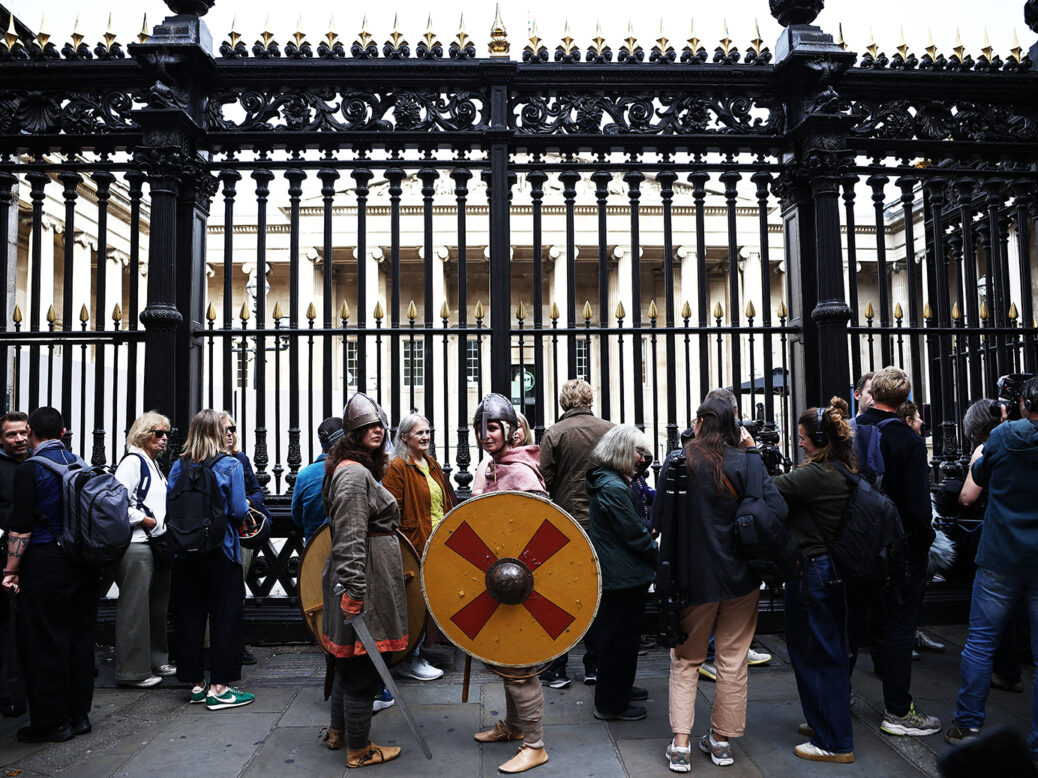
To the British Museum, along with half of London, to see the Bayeux Tapestry – or so we’d planned. We arrived in Bloomsbury to find the museum’s visitors disgorged on to the pavement. Enquiring with one of the disgruntled people milling about, I learned the fire alarm had gone off some 45 minutes earlier, and the entire museum evacuated. Once it became clear that we were not, in fact, going to be able to view the embroidery that evening, we shuffled our way back towards the Tube, tsk-ing at our bad luck.
I have to content myself with flicking through my old copy of Lucien Musset’s translation and trying to recall the term I spent studying the Tapestry at university. One of my favourite details comes when Harold Godwinson makes his visit to the Norman court. I am drawn to it not because of the particularly graphic penis (one of either 93 or 94 depicted in total – the disparity is due to disagreement over whether one might in fact be a scabbard) dangling in the lower margin, but because it features one of just three women in all 68 extant metres. We are given little clue as to her identity, other than the inscription, “Here a certain clerk and Ælfgyva”. Unhelpfully, Ælfgyva, the Latinised spelling of the Old English Ælfgifu, was a common name in the 11th century.
A favoured theory is that the Tapestry’s Ælfgyva is Emma of Normandy, the wife of two successive kings of England. She married first Æthelred the Unready, in 1002, taking the Anglo-Saxon name Ælfgifu. Though their union was designed to unite England and Normandy against Scandinavian raiders – the first time these two royal bloodlines had been brought together – England fell to the Danish prince Cnut in 1016, after which he took Emma as his wife. It was the death of her son, Edward the Confessor, that led to the succession crisis of 1066, and through her that William the Conqueror had a claim to the English throne.
If indeed Ælfgyva is Emma, the theory goes, the cleric touching her face is the bishop of Winchester, with whom she was accused of having an illicit affair. I don’t buy it. The Tapestry may have been embroidered by the losers, but its narrative was chosen by the victors. Why would the Normans want included a reminder of a rumour spread to weaken and discredit the woman through whose chastity William claimed legitimacy?

Slow and steady wins the race
Thankfully, that other cultural tentpole of the week, the return of Slow Horses – which has been in my diary at least as long as my appointment with Ælfgyva – is rather more reliable. What is the appeal of the flatulent, rotting Jackson Lamb and his lumpen band of – as Mick Jagger’s theme song puts it – “losers, misfits and boozers”? The anti-hero Lamb’s restive quasi-family, including hero River Cartwright (Jack Lowden – who, for what it’s worth, gets my vote for the next Bond), have been relegated to Slough House because they are considered in some way deficient. But in the end, the spooks who are supposed to be good at their jobs fail, and the underdogs prevail. It’s an all-too-recognisable picture of Britain: leaders are corrupt, institutions incompetent, and the only chance of anything actually getting done is if ordinary, flawed people step up. In other words, it flatters you into thinking: maybe I too could save the day.
On the road
In a few short weeks I will be flying to San Francisco, the start of a two-week road trip around California, Arizona, Utah and Nevada, through eight national parks. Having exhausted the guidebooks, I have turned my attention to literature from the region. There’s the beatniks, of course, Ferlinghetti and Ginsberg and Kerouac, but I had my beat phase as a teenager and have no particular desire to return to it. I reread Jon Krakauer’s Under the Banner of Heaven, a masterly history of the Mormon church cloaked in true crime. Next up is Edward Abbey’s audacious 1975 comic novel The Monkey Wrench Gang, which follows an oddball group of eco-activists whose ultimate goal is to destroy the Glen Canyon Dam blocking the Colorado River (spoiler: the dam is still standing and the lake it created by flooding a canyon is now a tourist destination). It is a bold, propulsive book that has me wondering why there is no equivalent today – literature about the climate crisis that is too loud, too angry, too cool to be ignored.
Damned if you booze, damned if you don’t
This month’s Labour Party Conference will be my first, so ahead of boarding the train to Liverpool, I reach out to some old hands for advice. A theme soon emerges. “If you find yourself asking whether it’s worth going to the Pullman bar for another quick drink past 10pm, don’t,” replies one. “Always, always go to bed.” Another advises a slighter later bedtime, 1am, but to match each glass of wine with a glass of water. A wise friend lays out the coming catch-22: “The only way any of it is bearable is if you do not drink. But if you do not drink none of it is bearable.” I’m starting to wonder if the much-warned-of conference flu isn’t in fact one big hangover…
[Further reading: After a delightful summer break, I am already in a state of anxiety]
Content from our partners



Related



This article appears in the 24 Sep 2026 issue of the New Statesman, A Sense of Power
Join the debate
Subscribe here to comment