
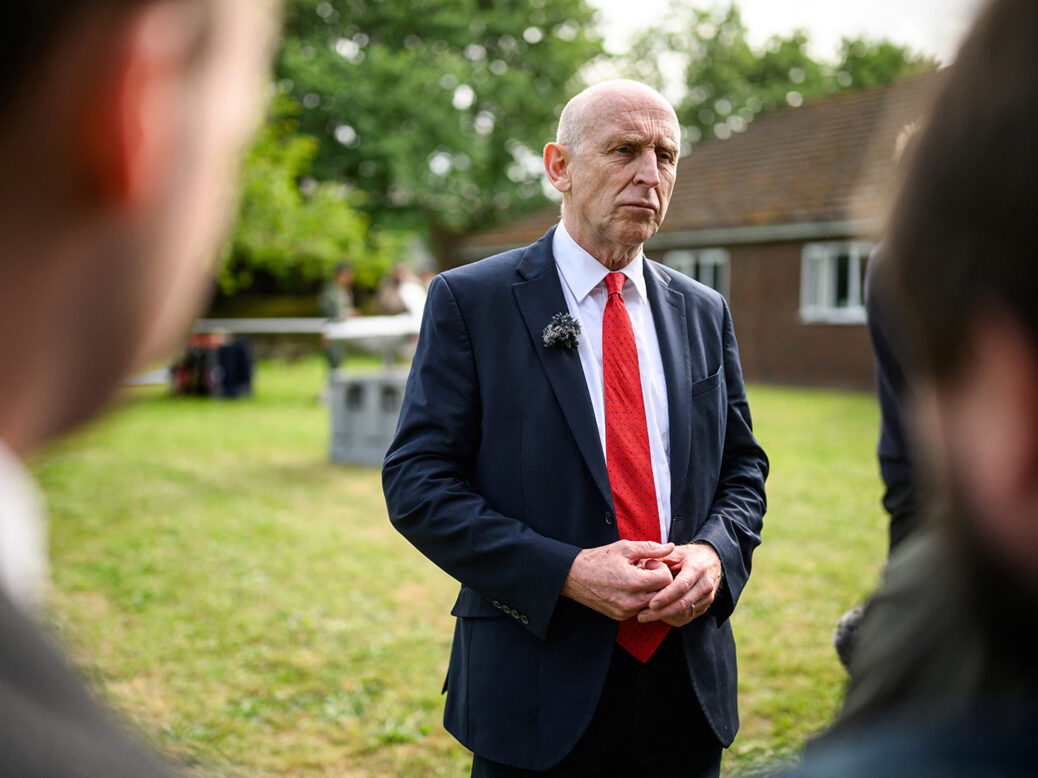
John Healey is in the uncomfortable position of a man who has just stepped into a lift in which someone else has recently farted. It wasn’t him, but everyone else who gets in is going to think it was him. If you’ve been in this position you’ll know that there is of course no question of explaining to everyone else who joins you in the lift that the unpleasant smell was not your doing. They won’t believe you, and you’ll just draw more attention to it. All you can do is stand there and quietly accept the blame for something you didn’t do.
In Healey’s case, the air in this particular lift is thick with other people’s emissions. Most noxious of all, of course, are those of Donald Trump (that’s nominative determinism for you), whose pointless, cack-handed war on Iran will cost the UK £28.5bn in lost economic growth (measured in inflation-adjusted GDP) over two years. That’s about the budget of a government department, such as the Ministry of Justice. Every household in the UK will lose £2,400 over the same period, according to one estimate, and that’s assuming the disruption of energy supplies doesn’t get materially worse.
Next, there’s the cost of debt. Healey can of course point out that interest rates aren’t set by the government, but it’s also debatable to what extent they’re set by the Bank of England. The UK raises and lowers the cost of borrowing in line with the US and Europe, even when our economy is performing differently. But Britain’s currency is widely traded, and investors prefer currencies with higher returns, so a failure to keep up with the interest rate decisions of other major economies can reduce the value of the pound, which makes imports (especially dollar-denominated commodities such as crude oil) more expensive, which adds to inflation. So, when America hikes its rates, as it did on 16 September, the UK is compelled to follow. Again, this is something over which Healey has essentially no control, but for which he’ll be blamed anyway.
There’s another central bank, further away than the US Federal Reserve, that’s even more important to the UK economy and our government finances. The Bank of Japan was once run on the principle that its presence should be as calm and quiet as a woodland shrine, as its first postwar governor put it. But until recently, Japan has been running an unprecedented 25-year experiment in the price of debt. From 1999 to 2024, interest rates in Japan were zero, or below. This was good for borrowers elsewhere, because it meant investors could borrow in yen, lend the money to someone else (the UK government, for example), and pocket the difference. This is known as a “carry trade”, and it allowed Britain to borrow more cheaply. But this is coming to an end – Japan has just raised interest rates to a 31-year high – and again, there is nothing Healey can do about it.

The decisions of foreign presidents and central banks are one thing, but Healey also has to contend with the economic interference of British politicians. One of the most consequential policy announcements I’ve heard in recent weeks was Richard Tice’s promise, at Reform’s party conference, to reduce the energy bills of every British household by £250. This is based on the idea that increasing drilling in the North Sea would somehow bring in a new era of cheap energy for the UK. But because there isn’t enough oil and gas left under the North Sea for that to happen, this is effectively an offer to subsidise energy consumption in the UK by an unknown amount – and therefore to borrow an unknown amount from the debt market (Liz Truss made a similar promise four years ago and the bond market didn’t like it then). At the same time, Tice has said that his party would frustrate investment in renewable energy, which would make energy prices higher and less stable in the long term. Reform’s other plans also imply an intention to borrow large sums; the plan to deport 600,000 people would, at the £48,800 it currently costs to deport one person, imply £29.3bn in extra spending.
The bond market does not ignore such signals. If you buy a ten-year government bond, you are effectively betting that inflation in that country will be lower than the “yield” that bond provides. So if the highest-polling party in that country is promising to borrow more (sell more bonds) and to accept higher inflation, the market will pay less for those bonds, and the yields (borrowing costs) of UK government bonds will rise. The market is not only pricing in the reality that Healey is the current chancellor, but also the risk that Robert Jenrick might be his successor. Nigel Farage is already costing you money.
And yet politics demands that Healey gloss over these realities, because the bond market is a migraine-inducing thing to think about, and because, like every chancellor, he has to take part in the pantomime of pretending that making changes of a few billion here and there to taxation and spending can dramatically alter the course of an economy that outputs £3trn a year.
Britain’s borrowing costs recently reached the highest level since 1998. Wars and monetary policy decisions on the other side of the world can make more difference to the Chancellor’s fiscal headroom than any note item in the Budget he is now writing. Nevertheless, he has to stand politely and accept that while he is in the Treasury, the acrid wafts of stagnation and inflation emanating from the UK economy will be assumed to be his fault.
[Further reading: Can Andy Burnham charm Donald Trump?]
Content from our partners



Related

This article appears in the 24 Sep 2026 issue of the New Statesman, A Sense of Power
Join the debate
Subscribe here to commentJohn Healey delivered the fatal stabbing to Starmer’s PMship so it seems fair that he should shoulder the burden of unfunded promises or unrealistic expectations held by the UK public whether or not Trump’s war on Iran has contributed to the fall in economic growth. If he isn’t up to the job then maybe Andy could ask Darren Jones back into his cabinet as Chancellor: a joke in case anyone didn’t catch the NS interview this week.
Tony, that is a very fine summary. The job of Chancellor for the next few years is to explain why everyone is poorer, and get them use to it. He has a convincing lament to offer: blaming Austerity and Brexit, and the more basic truth that the 2008 Crash ended the fun. It ia just a variant of Sir Geoffrey Howe in the 80’s..
To deliver this message requires a very hard-a##ed Prime Minister to back you and be convincingly on script. The chances of this happening under Andy the Manchurian? The irony flies of the page.
I cannot believe the UK (this is written from Melbourne, Australia) will be stupid enough to vote for Farage and his plutocrat mates. I did think the Brexit vote would be exactly where it was, so I not a natural optimist.
I think when push comes to shove the Northern cities and London will return Labour, by the skin of its teeth. This will be the right result, in my opinion what they deserve. Assuming the Labor can get its act together, the one aspect of all this I worry about, the country may have a future.
Andy Burnham and John Healey quite happy to attribute the same smell to Keir Starmer and Rachel Reeves and boot them out of the lift.