
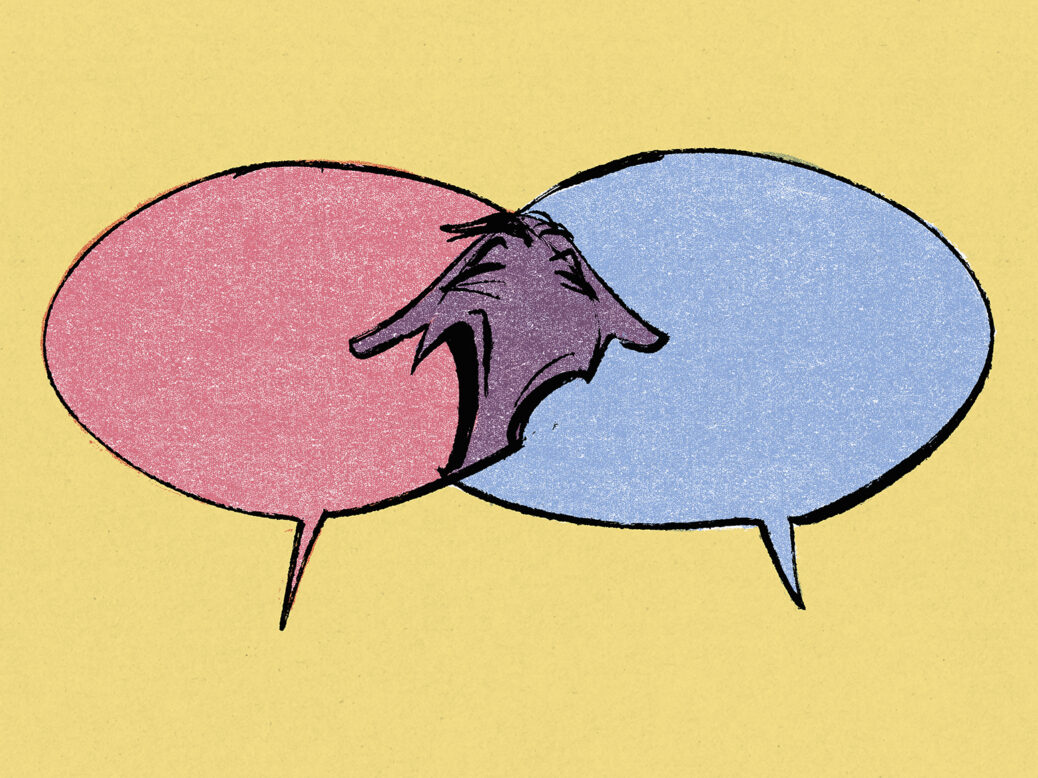
When was the last time you had a proper disagreement? And how did it make you feel afterwards?
We’re not talking about domestic arguments here, but debating the key political and social issues of our time. And according to new research by UCL and More In Common, shared exclusively with the New Statesman, it’s getting harder to do.
As party conference season gets underway, a poll of 2,000 Brits found an esteem for the art of robust disagreement, with 63 per cent thinking it’s important that any topic can be discussed, no matter how thorny. However, 58 per cent felt it was becoming harder to express disagreement, and 64 per cent noted political disagreements in Britain can easily become hostile or unpleasant, while 69 per cent admitted they were sometimes reluctant to share their views on contentious topics like immigration, gender identity and war in the Middle East. Only 6 per cent thought Britain actually disagrees well.
The report is part of UCL’s Disagreeing Well programme, which launched in 2023 and provides resources and events on this theme. It is the brainchild of UCL President & Provost Dr Michael Spence. “At a time when public debate can often feel polarised and hostile, creating opportunities for respectful dialogue has never been more important,” Spence said of the latest research. His belief is that disagreeing well is not an abstract ideal, but a skill that can be learnt and honed – if it is practised enough.

One fascinating aspect of the findings is that, on the whole, the public seem to agree. As one of the participants in the focus groups that accompanied the polling put it: “It’s a life skill. I don’t think it’s something to be taught. I think it’s something that you pick up on the way through life experience.” When asked which particular skill was the most important for productive disagreement, the clear winner was “listening” (46 per cent) – compared to 35 per cent for “using facts”. Disagreeing well is not a one-way process where the only aim is to get a point across. The opposite, in fact.
From the other side, people value feeling listened to and having a constructive debate more than they value winning the argument. What’s the most important thing when arguing about politics? The answer – especially if you spend lots of time online – might surprise you: 32 per cent said it was to understand the other person’s point of view, compared to 25 per cent who said it was to make their own point. Just 4 per cent prioritised changing the other person’s mind.
When reading that stat, I couldn’t help remember a revelation that dramatically reduced how much my husband and I argue: I was much more prepared to back down if I felt he’d properly listened to my points, even if he still didn’t agree with them. Politics is not domestic life, but it’s striking how quickly our emotional response to someone disagreeing with us can change if we believe they’re actually engaging with us, rather than just trying to win.
So if Brits value disagreeing well and understand the skills necessary to do, why are we seemingly so bad at it? The research doesn’t say, but two of its findings offer clues.
The first is our politicians – and it’s fair to say the public are not impressed. While parliament is supposed to be a model for healthy robust discussion (it’s there in the name – from the Old French parler, to speak), 57 per cent of people think that politicians tend to be rude and disrespectful when they debate each other. I don’t know which particular incidents of discourtesy respondents had in mind, but recent examples of insults hurled from one politician to others who disagree with them include “traitors”, “lunatics”, “arsonists”, “bigots”, “spiteful class warrior” and “like a Gestapo officer”, to choose a selection.
Such behaviour is not actually representative of our political class. Talk to most politicians and they will have something positive to say about a colleague from a rival party – someone they’ve worked with on an issue that mattered to them, or respect for championing a particular cause, or perhaps simply appreciation for offering them support during a difficult time. The cross-party solidarity within Westminster can at times be genuinely inspiring.
But this isn’t the face of politics the public sees. We are more likely to get to know our politicians, particularly the high-profile ones, in deliberately combative forums like PMQs or shows of the Question Time variety that pit them against each other. “You only have to watch the House of Commons… it’s always a one-upmanship where they’re trying to get one over on the other person… cheering in the background like they’re in primary school,” lamented one focus group participant. Long-form interviews have been replaced with soundbites that are clipped up to have the maximum impact on social media. Divisiveness pays off more than respectful disagreement, at least in the immediate term where success is measured in views and clicks. But the example it sets for how political debates should be carried out is not a happy one.
Which brings us to the other interesting finding: the internet is not the real world. In fact, the social media platforms that were meant to provide a democratised, globalised “town square” for public debate are seen as among the worst places to disagree well, along with parliament and – depressingly, universities. Luke Tryl, director of More In Common, points out that social media has “filled the vacuum” as physical spaces for meeting and talking to new people have been hollowed out, “and is now arguably the most prominent place where public conversations are had”. Yet the vast majority of Britons do not feel comfortable debating online… For many, social media models some of the most toxic disagreement.”
It is striking that, for all the focus on what happens online and politicians obsessing over their digital presence, 63 per cent of people say they never argue about politics on social media. There’s also a left-wing tilt to those who do (who, Tryl, adds are also disproportionately male and university-educated). But both left and right are concerned about being labelled negatives – as “racist” or “woke” – for expressing an opinion: 44 per cent worry sometimes, and 14 per cent often.
For those wary of saying what they think, the top four reasons why were: not wanting to start an argument, not wanting to be misrepresented, not wanting to make things awkward, and not wanting to be seen as prejudiced.
Social media platforms, with algorithms that prioritise (and in some cases monetise) the most provocative and divisive content, seem almost uniquely unsuited to alleviating these concerns – doubly so for the ones with character counts that discourage making nuanced points. They also combine arguing in public, where anyone can wade in, with permanence that means old comments can be dug up years later. That drives up the risk of asking questions in case they make you look stupid or trying out new ideas that could be taken out of context and mocked. Acknowledging the other side might have point risks ceding territory, so the impulse is to double down.
Contrast that to the one space people do think is suited to disagreeing well: the pub. Figures are still modest, but more people at least sometimes argue about politics in the pub (23 per cent) than on social media (22 per cent), at college, university or school (18 per cent), at a town hall or community group meeting (17 per cent), or in public with strangers (15 per cent). The research also found an even spread across left and right among people who argue in the pub. Perhaps the informal setting acts as an equaliser, encouraging a freer flow of views, or perhaps the presence of alcohol lowers the stakes, as it means exact conversations might not necessarily be remembered. Either way, the risk of an ill-judged comment causing permanent damage is greatly reduced.
Pubs are struggling, as are our other hospitality venues and spaces for low-stakes socialising. In contrast, all of us are spending more time on our phones, where we are provided non-stop opportunities to witness vicious political arguments whether we want to or not. Maybe it’s no surprise our perception of how good we are at disagreeing well leaves a lot to be desired.
One final insight from the polling might be of interest to the new Prime Minister on the eve of his first Labour Party Conference as leader: Andy Burnham fares pretty well on the disagreeing well metric. In fact, he was the only figure tested where twice as many say he disagrees well (37 per cent) as badly (14 per cent).
At a time when the public seems to want politicians who are less divisive, this is good news for Burnham. He’s been able to maintain his reputation for positivity and engaging with opposing views (rather than resorting to “point-scoring”) through the Makerfield by-election and summer recess and into the first weeks of parliament. Can he keep that up, not just through the conference but then all the challenges the autumn has to throw at him – not least a budget on 28 October that is looking increasingly tricky? Maybe if Burnham is able to lead by example, Brits will gradually start to feel more confident about speaking their minds. If they get offline and head to the pub, anyway.
[Further reading: George Galloway’s gift for Labour]
Content from our partners


Related



Join the debate
Subscribe here to commentThe broadcast of PMQ’s only serves to emphasise politicians’ inability to disagree well. One improvement would be the elimination of the unit where the opposition leader has six questions. This part of the session guarantees divisiveness and always comes down to point-scoring regardless of which party is in government.
Andy Burnham tries his best to avoid point-scoring, and so far his PMQ’s was a great improvement. Unfortunately, the structure of the session guarantees ill humour.
On the other hand, the rest of the session where individual MP’s ask questions has a much better feel, in general.
I agree with Rachel!
Perhaps the author should take her own medicine given her contributions to a debate about pedestrian and cycling safety on Bluesky recently in which she showed a total failure to understand the points other people were making while continuously gaslighting people who had a different perspective … the only reason I haven’t cancelled my NS subscription is because I haven’t worked out to do it…