
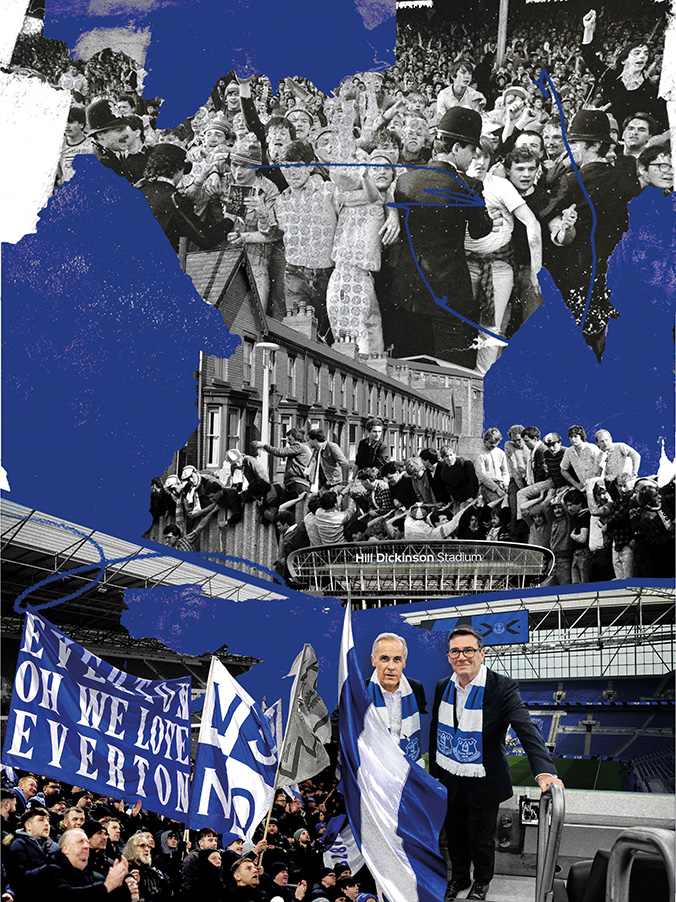
The new Prime Minister was hitting the phones. Appointing his cabinet, Andy Burnham was methodically whittling through the list prepared by his close aides, letting down those he was sending to the back benches, congratulating his new star signings. Then the PM heard the ping of a WhatsApp message. It was from one of his most cherished contacts. “Stop! Stop!” he ordered the room, and proceeded to play a video message from David Moyes, the manager of Everton Football Club, congratulating Burnham on his accession. He played it again, and again, and again, his glee increasing each time.
The Glaswegian Moyes, the once flame-haired, now grey-haired, club stalwart, recently returned to Everton as manager after a decade or so away, providing stability and hope after a succession of temporary kings. Burnham is hoping to do the same for the country. And while analogies between the worlds of football and politics can be stretched, the comparisons between Everton supporters and Labour Party members are there to be made: each back a proud team constantly looking to past glories, obsessed with the Eighties, and deeply attached their self-image: the people’s club, the people’s party. And both, of course, can look like losers even when winning.
Andy Burnham has often cited three great institutional influences on his life and politics: the Labour Party, the Catholic Church and Everton Football Club. There’s no shortage of commentary about the role of Labour in his life, and there have been some clear insights on the influence of the Church. But about Everton and his formative trips to Goodison Park? Almost nothing.
Perhaps the assumption among opinion shapers is that football is somehow frivolous. For Keir Starmer, a die-hard Arsenal fan, football was mostly a way to move conversation on when he was uncomfortable talking about politics, the subject of endless small talk at Downing Street functions.

Not so for Burnham. Everton is core, and constant. He has described himself as a cultural Catholic, distancing himself from any religious talk that sounds too earnest, and he left Westminster in 2017 to avoid the maelstrom of Labour faction-fighting and try a form of cross-party working in Manchester. Yet he has never strayed from his lifelong love of the Toffees.
When Burnham reflected on his disaffection with London in his book Head North, co-written with the Liverpool mayor, Steve Rotheram, he used a telling phrase: “I had reached a stage in my life when I wanted more Goodison and less Groucho.” Everton – solidly working-class and militantly local, the club of Dixie Dean, of Kendall, Harvey and Ball, of Southall, Reid and Sheedy – and what its heritage represented, pulled him back home.
Everton had its mid-Victorian origins in a Methodist Chapel, St Domingo’s. But with waves of immigration over the Irish Sea – among them Burnham’s ancestors from Drogheda and Donegal – it was to become the Catholic team on Merseyside, partly because of demographics but also because of Liverpool’s traditional Orange Order links. What this created was a distinct underdog mindset. While the city’s suburbs were Protestant and wealthy thanks to the booming port, its inner city was described by outsiders as an Irish slum. The football team of that slum was Everton, a source not of shame but defiant pride. As one of the club’s oldest songs goes: “We have no manners, we spend our tanners/We are respected, wherever we may go.”
Burnham says privately that he considers himself “Liverpool Irish” as well as English, and doesn’t see any contradiction between the two. He cites his great-grandfather Ned Burke, who fought on the Western Front in the First World War. Burnham recalls to the New Statesman that Burke wrote in a letter back to his family: “Don’t let them say the Irish aren’t doing their bit in this war, there’s Irish lads everywhere, it’s God help the Boche if they come across them, because these are the biggest lads you’ve ever seen.”
There was a strong correlation between religion, football and politics in Liverpool that was only fading when Burnham was born in the first month of the Seventies. Until then, the Protestant environs of the city voted Unionist/Tory and supported Liverpool FC, while the Catholic inner city was Evertonian and voted not just Labour but for explicitly Irish nationalist candidates. The Home Ruler TP O’Connor, MP for Liverpool Scotland from 1885 to 1929, is surely a great pub quiz answer: he was the only Irish nationalist MP elected to a constituency on the British mainland.
Change came with the Sixties. The city was reshaped by the combined forces of economic decline (Liverpool’s port was “on the wrong side of the country”, as a notorious Spectator leader article later put it); cultural energy (Merseybeat and the success of the Beatles made it feel briefly like the centre of the world) and the determined ecumenical efforts of Church leaders on both sides of the sectarian divide. By the end of that decade, a distinct, cross-community “Scouse” identity emerged, which more united the people than divided them. Crucially, Scousers defined themselves against outsiders: at first, the “woolybacks” who lived on the outskirts of Liverpool but were not truly Scouse, and, in time, that other great north-western city, Manchester – as well as the rest of the country.
Testament to the sea change was the transformation of Liverpool’s politics. As sectarianism withered, so too did any strong attachment to the Tory party, and from the late Sixties, this city of blue-collar working people became a loyal Labour stronghold. On the football front, while it is still true that many Liverpool Catholics are Evertonians, the only sectarian hangover is now something more cultural: an enduring link between Everton and Celtic FC. It was one Burnham played along with – growing up, he had a reversible Everton/Celtic hat and followed both teams.
In the year Burnham was born, Everton were crowned league champions, and that was coming off the back of a golden period in the Sixties. But for the rest of his childhood, they didn’t win anything. That began to change in April 1984. Burnham was 14 years old, going home and away, following his team. Howard Kendall, a former star midfielder, had come back as manager but endured a rough start. Then came a match that has a special place in Everton history: the 1984 FA Cup semi-final against Southampton, played at Arsenal’s Highbury ground in north London. After a tense match, Everton’s pint-sized striker Adrian Heath nipped in to score a header against England’s keeper Peter Shilton with just three minutes left of extra time. Cue pandemonium and a pitch invasion. After 14 miserable years, Everton were back, going on to beat Watford in the final. In the closest thing EFC has to an official history book, James Corbett’s Everton: The School of Science, the Highbury match is described as “the best afternoon of being an Evertonian”. Peter Reid, who played midfield that day and later became a friend to Burnham, told the New Statesman: “The crowd got us through. The atmosphere was amazing, the love and care for a football club.”
In the scrum of that pitch invasion was schoolboy Burnham, who had taken a coach down from Manchester. It was his first time at an away match without his father, Roy. He was wearing a bright yellow Pierre Sangan jumper which allowed his dad to identify him when the footage was played on the television. The exchange when he got back home, Burnham later recalled, was terse. “Did you have a good day?” “Brilliant.” “Did you behave yourself?” “Of course.” “So that wasn’t you I saw running across the pitch on Match of the Day then?” Caught red-handed – or yellow-jerseyed – it was Burnham’s first TV appearance and his first victorious foray south. Forty-two years later, news cameras on helicopters filmed his most recent successful assault on the capital as he took the train to London to seize No 10 Downing Street.
When Burnham stands up in Prime Minister’s Questions and bemoans the legacy of Margaret Thatcher’s governments, his opponents are bemused. Isn’t he living in the past? Wasn’t he just a kid at the time anyway? Back then, Liverpool was a harsh urban environment – and Burnham was shielded from it in the Cheshire suburb of Culcheth, where his family moved to when he was a toddler. The Burnhams were also the only match-going Evertonians in the town, and every second weekend they would venture into the heart of north Liverpool’s urban decay to see their team play in the rapidly deteriorating surroundings of the County Road area. At the time, the city was a place of violent riots that made national news, infamously high unemployment (Alan Bleasdale’s brilliant TV drama Boys from the Blackstuff made Yosser Hughes’s “Gizza job! I can do that!” a heartbreaking national catchphrase), rapid population decline (around 10 per cent each decade from 1971 to 1991) and an explosion of heroin use.
But as a True Blue, Burnham was also travelling to away matches across England for much of Thatcher’s Eighties. As a child, he saw up close the misery of others, as well as the riches and arrogance of those who were doing better. “Feed the Scousers”, a perversion of the Band Aid single to fund-raise for starving Ethiopia, was one of a range of hateful chants deployed by opposing fans about Liverpudlian poverty. Burnham’s sense that Liverpool – and the north – was belittled by those with more money and power was becoming well established.
“It felt like the city of Liverpool was under siege for most of the decade,” wrote Burnham in Head North, “as I travelled the country watching Everton away games, I began to feel that England was in fact two different countries.” Peter Reid puts it like this: “Andy’s upbringing has an imprint on him. Liverpool at that time was a difficult place. But his dad instilled in him the Everton spirit, that fervent belief in the football club and whatever it takes to get behind them.’’
On the day of the Hillsborough tragedy in 1989, Burnham – who was still following Everton but had gone up to Cambridge to study English – was at Villa Park watching the other FA Cup semi-final, where Everton beat Norwich. Before the final whistle, news had started to come through of deaths at the Liverpool vs Nottingham Forest match and the true scale of the disaster was beginning to unfold. Yet when Burnham got back to Cambridge, it was as though nothing had happened. His sense of being an outsider in that place, and in the world into which its cosseted students graduated, was not the product of some unreasonable northern chippiness that left Burnham unable to adapt. It was more that a decade of misery culminating in Hillsborough had proved it was a different world, and one that didn’t really care about the world he came from. In these ways, Burnham the Evertonian helps explain Burnham the politician.
Amid all that misery, there was at least Everton’s rise under Kendall. They were a fantastic side in the mid-Eighties, winning league championships, the FA Cup and the UEFA Cup Winners’ Cup. They were finally going toe-to-toe with their Liverpool neighbours. “Ev-er-ton, we never shone so brightly,” as the Hi-NRG Eighties club anthem “Spirit of the Blues” put it, summing up the feeling of that time. But that, too, was to be snatched from them with English clubs’ enforced exile from Europe for five years after the 1985 Heysel disaster. Burnham, like most Evertonians of his generation, is convinced his team would have won the 1986 European Cup, ushering in an era of supremacy. Bar the brief high spot of an FA Cup win in 1995, they instead sank back into the middle of the table and shrank in the shadow of their neighbours. That Liverpool fans had been key to the European ban, and that Margaret Thatcher played a vital role in it, only exacerbates the deep grievance over a golden age lost.
Everton haven’t won a trophy in 31 years. Sunder Katwala, a fellow Evertonian and founder of the British Future think tank, says of his and Burnham’s generation of Evertonians: “To an extent we’re local civic patriots and also great-power nostalgics, waiting to be restored to our former glory and unwilling to accept we’re now a middle power.” But there is some optimism that perhaps good times may be returning.
Last year, Everton’s men’s team said goodbye to Goodison, its home for well over a century. The warren of narrow terraced streets sprawling out from the ground, into which tens of thousands of fans would flow after a match and into the pubs on the street corners, was where Burnham felt most connected to the world of his father and where his roots were. He even contributed a chapter to The Leaving of Goodison Park: 100 Memories of the Grand Old Lady, a farewell book organised by fans. A friend of mine met Burnham long before I ever did as a political correspondent, when he spotted the then mayor of Manchester swigging Guinness outside the Winslow, one of those fine pubs that has now closed down because of a lack of match-day business.
There was nothing like Goodison left in English top-flight football and it was the great credential of Everton’s claim to be the “people’s club”. “Goodison was a shithole, but it was our shithole,” one season-ticket holder told me at last week’s game against Ipswich Town, lamenting the fancy-pants nature of the team’s new state-of-the-art Hill Dickinson Stadium on the River Mersey, with its automated-card-only bars. At least the women’s team still play at Goodison.
Burnham – who had tried to keep his season ticket among the fans until security overruled him – took his seat in the executive box area of Everton’s new ground for the game against Wolves on 16 September. Suited and booted, he stood alongside unlikely fellow Evertonian Mark Carney, the PM of Canada, moved as a tribute was paid to his dad before kick-off. A message on the big screen read: “RIP Roy Burnham, lifelong die-hard Blue. Much loved by Eileen, Nick, Andy, John and all the family.”
Burnham both considers himself the inheritor of that world that has largely gone, and the one who can remain true to those values and bear it safely deep into the 21st century. The changes at Everton could be taken as an example of Burnham’s “Manchesterism” ideas in practice, for good and ill – the old club is now burdened with debt, leveraged to the hilt, reliant on foreign investment and hoping a new model based on tourism and big spending will see its fortunes turned around. Everything moves on, but can the old ideals still play a role?
Everton is trying to become a modern football club with European ambitions while also being the “people’s club”. There are, of course, loud echoes of what Burnham is trying to do as PM: finding modern solutions to fearsome new challenges while staying true to the principles of the past.
It is too glib to say Burnham was forged at Goodison, but cut him and he will bleed blue. And Everton’s heritage as the outsider, its sense of community, evinced in its impressive charity work, its sense of grievances from the Eighties, fuels him too.
Not that this makes him a starry-eyed optimist. He maintains that self-deprecating pessimism of the lifelong Evertonian. As he prepared to watch the match with Carney, he said: “It’s just so good for me to think that I will have somebody to talk to and commiserate about Everton at a G7 meeting.”
What he failed to imagine was that Everton might actually beat Wolves (as they did, 1-0). Could it be they are both on the cusp of happier times?
[Further reading: Andy Burnham seizes control]
Content from our partners



Related
This article appears in the 24 Sep 2026 issue of the New Statesman, A Sense of Power
Join the debate
Subscribe here to commentI’m Luton Irish and went to university from a lower working class background in 1975. I have supported Luton Town FC through thick and thin…….it’s a bit thin at the moment but nowehere near the nadir of being booted out of the Football League in 2009! In addition I support Celtic. I’m also a Labour Party member but we must not get carried away with footy and fond memories of the old country(Ireland). What I learned coming up from the lower orders is you must play the English card all the way and keep the Irish background as an exotic twist when people of a certain age start making Irish jokes……they still do from time to time! You can also use it if it if you can get an advantage. When I went to the USA I was able to win a green card in the lottery because a certain percentage of winners had to be Irish. Of course Brexit was a massive migraine for Ireland and both traditions but at least by accident of birth I had an Irish passport in addition to the UK one (since 1990) which salved the pain ever so slightly. Having said all that success for Labour politicians in national elections means getting the English to vote for you so don’t give the opposition any ammunition to crucify you. Of course be proud of your backgund but wear it lightly. If I can put it simply it’s Coronation Street and Eastenders but not Father Ted. Even though Father Ted is the greatest comedy ever!