
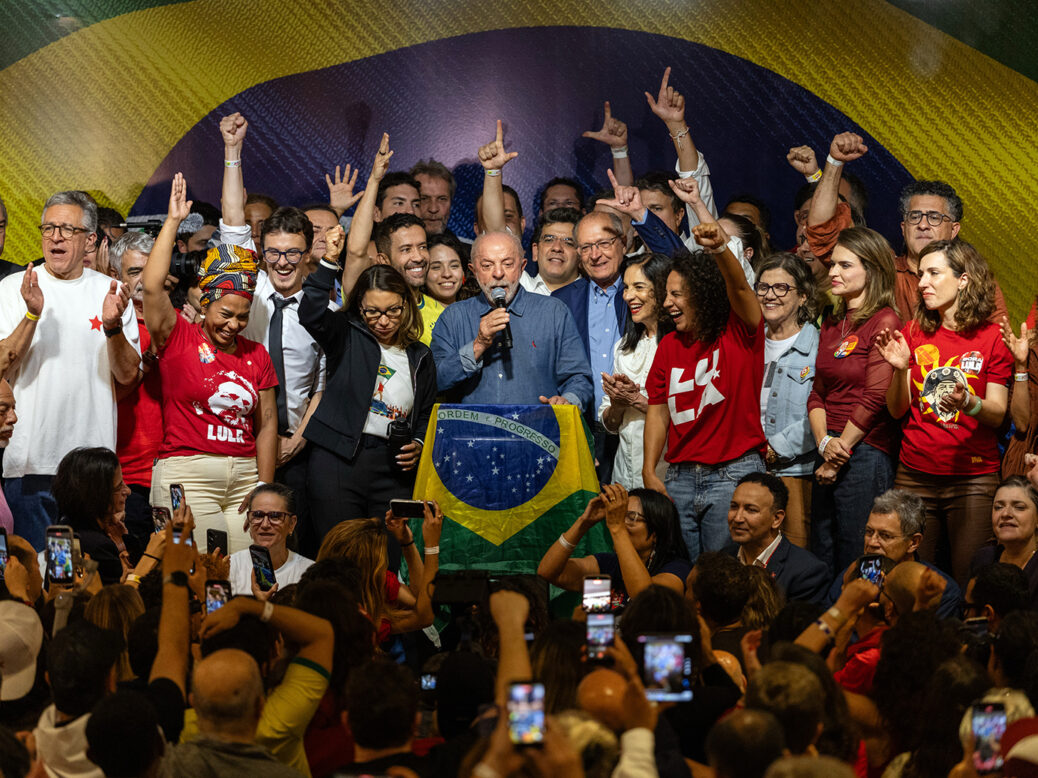
With his country’s constitution in one hand and a Brazilian flag in the other, Luiz Inácio Lula da Silva stood on top on a truck on São Paulo’s main thoroughfare as a mile-long crowd roared around him. “Even the oldest campaigners have never seen a mobilisation like this,” Lula, an octogenarian who has spent much of his life in politics, shouted to his supporters.
The next day, on 25 October, that mobilised support propelled the storied sitting president to another electoral victory, marking a striking political turnaround. After Brazil’s first round of voting on 4 October, it seemed as though the left had lost the election. Not only had Lula trailed his opponent, the far-right Flávio Bolsonaro, by more than two million votes in the first round, but the left had just been routed in congressional and state elections throughout Brazil. In democracies across the world, it seemed as though the far right was surging.
Yet Lula achieved a decisive run-off victory, by 4.4 million votes. It would be easy to attribute Lula’s fourth presidential term just to his political stardust or to the political machine he has built since co-founding the Workers’ Party (PT) in 1980 as a militant metalworker during the country’s dictatorship. But those close to the campaign say Lula’s victory over a candidate he called a “traitor to the fatherland” was not due to his – or his party’s – efforts in the second round alone, but to an uprising across swathes of Brazilian society against the Bolsonaros.
Flávio had promised to pardon his father, the former president Jair Bolsonaro, from a 27-year prison sentence for a coup plot he led in 2022-23. He also could have nominated up to four judges to the Supreme Court, which he had accused of exacting “revenge” when it convicted his father.

In the first round, Lula’s PT “lost the pulse of the streets”, Thomas Traumann, a political analyst and former presidential spokesman, told me. As the campaign focused on television ads aimed at burnishing Lula’s legacy, “people were discussing how prices were high in supermarkets”. As a result, Flávio won 47 per cent of the early October vote, to Lula’s 45.2 per cent – a reversal of what polls had predicted.
What followed was a retooling of Lula’s campaign. Two electorally successful politicians from the PT’s north-eastern stronghold took over the campaign’s leadership and they brought in a group of young leftist legislators who had previously found success with digital strategies.
That led to the creation of a WhatsApp broadcast channel called Lula’s Army, which offered daily voter engagement with its 10 million recipients. But more importantly, that new strategy dovetailed with the organic activism bubbling up across Brazil. As election day neared, a groundswell of self-organisation from students, activists and citizens formed what Traumann called the largest left-wing mobilisation in Brazilian history. Other political analysts and experts agree that the first-round vote – and the prospect of Flávio winning the presidency – spurred cooperation across civil society. “The defeat… mobilised people – on the streets, on social media,” Mauricio Santoro, a political scientist at Rio de Janeiro State University, told me. “They were just reacting to what they saw as a very serious situation.”
“All those people understood what was at stake,” agreed Sabrina Fernandes, a sociologist and author, who noted that even prominent figures from the centre right backed Lula.
By the day of the vote, PT’s supporters were still bracing for defeat: a first-round winner had not lost a run-off in Brazil since the country’s return to civilian rule in 1985. But even alleged dirty tricks that paralysed bus networks in two major cities and led to an extension of voting by two hours could not stop a clear Lula victory, as he took 51.8 per cent of the vote. Turnout even rose by three million, and the share of blank and spoilt ballots hit a record low.
Flávio initially said he would challenge the result over the 34,330 votes cast after 5pm, when voting was originally scheduled to close. Yet his party conceded the result, even as Donald Trump announced on 26 October that the election looked “rigged” – but did not indicate he would intervene. At the time of writing, the Brazilian press was reporting that Flávio had fled Brazil on foot across the border to Argentina, from where he intends to fly to the US.
Since Trump’s return to the White House in January 2025, the right has won seven straight elections in Latin America – in Colombia, Chile, Honduras, Bolivia, Peru, Ecuador and Costa Rica – as well as Javier Milei’s government in Argentina, which was elected in 2023. Lula’s win halts that run. He told his victory rally: “This country will not accept being anyone’s backyard.”
Yet while this was a decisive victory for the left in Brazil, complacency would be a mistake. Four years from now, Lula will be ineligible to run again. “The Brazilian left needs to understand that this was a Hail Mary,” said Fernandes. In addition to him being a savvy politician, “Lula, the idea, is powerful”. This is a man who rose up from the working class, organised mass strikes, fought a military dictatorship – and cancer – and could still connect with Brazilian society. The urgent task for the left will be to find fresh leaders who can fill that role, while also heading off the populist right and grappling with the country’s economic plight.
[Further reading: Latin America will not go the way of Venezuela]
Content from our partners



Related

This article appears in the 28 Oct 2026 issue of the New Statesman, Bin the Budget
Join the debate
Subscribe here to comment