
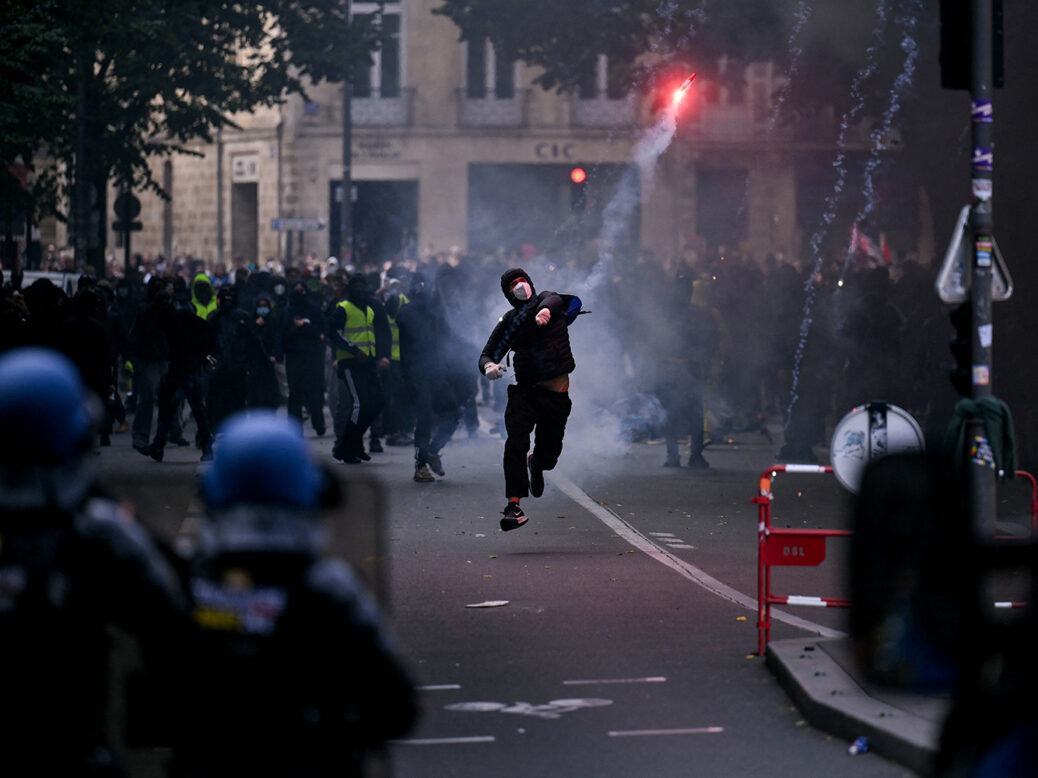
Watching Paris gendarmes set on fire by Molotov cocktails at the end of a 31 October march to the Porte de Vincennes, in the east of the French capital, was shocking, but hardly surprising. As flames leaped around the panicking officers, agitators skilled in the art of insurrection shouted “let them burn”.
Masked and ruthless, the rioters have latched on to an anti-government protest that Laurent Nuñez, France’s interior minister, diverted away from the city centre to this outer boundary. The Porte de Vincennes is also adjacent to the historic Red Belt of working-class industrial suburbs, dominated for decades by French Communist Party politicians who linked everything to the class struggle. Nuñez played up to this legacy after the disturbances, blaming “the ultra-left movement” for the worst of the trouble, including the “attempted murder” of his officers. (All escaped serious injury, thanks to flame-resistant undergarments beneath protective armour.)
The marchers I spoke to rejected Nuñez’s accusations, saying riot police had acted recklessly with tear gas, savage baton charges and munitions. The majority of protesters reject fringe violence and reference the sacred grève générale, the general strike, as the cornerstone of a struggle for social justice and economic redistribution. The right to strike is enshrined in the French constitution, and sanctions against those who take part are all but non-existent. This contrasts sharply with Britain, where strict anti-union measures and historical trauma after failed attempts at mass walkouts mean there has not been a general strike since 1926.
Beyond the rallies, workers in France from many sectors have joined rolling pickets making various demands, including a 10 per cent increase in the minimum wage and a reversal of austerity budgets. At the time of writing, another general strike has been scheduled for 5 November – of the kind the French political philosopher Georges Sorel called the supreme “social myth”, one with as much power to rally the French as their national anthem, La Marseillaise, which includes the words, “To arms, citizens!”

Sorel’s ideas about this particularly Gallic form of militancy are contained in his 1908 book Reflections on Violence, and – almost 120 years on – they are still revered. He noted an “aversion felt by England for the general strike”, mainly because of its overall rejection of leftist ideology and inclination to protect capitalism rather than threaten it, as powerful French groups such as the Communist Party, the Socialist Party and France Unbowed have done in the postwar period.
The General Confederation of Labour (CGT), one of France’s largest unions, has been organising general strikes for decades, including the fabled May 1968 one, when around 10 million workers launched wildcat actions in solidarity with protesting students. Fatima Guetatilia, a CGT branch treasurer, told me at the 31 October protest: “Nationwide, coordinated strikes are an essential part of our work. In recent years they have brought down those in power, or ensured an end to their proposed laws.”
Last year’s Bloquons tout (Block Everything) initiative hastened the dissolution of the François Bayrou government, while President Emmanuel Macron’s much-vaunted pensions reform raising the retirement age from 62 to 64 is currently suspended, thanks in part to the “inter-professional strike days” of early 2023.
The current uprising started with students blockading their lycées to protest the underfunding of the education system; other bodies, including the unions and the gilets jaunes movement, joined in. There have been plenty of very ugly confrontations but concessions have already been won, including €5bn (£4.2bn) in government loans for the renovation of decaying school buildings, hiring more teachers and class size caps.
Such muscular solidarity was once attempted in Britain, but failed miserably. In May 1926, the Trades Union Congress (TUC) led mass walkouts on behalf of the nation’s coal miners, who were facing wage cuts and longer shifts. Everything from public transport and factories to shops and newspapers briefly shut down, but Stanley Baldwin’s Conservative government soon portrayed it as a French-style revolution.
In line with Sorel’s theorising, the threat was met with troops, armoured cars and Royal Navy warships protecting river supply lines. After just nine days, the TUC surrendered. It was a dismal defeat for the labour movement and, to make sure there were no repeats, new legislation outlawed mass picketing and sympathy strikes.
When Margaret Thatcher crushed striking miners in the Eighties, loud calls for another general strike got nowhere. During the Battle of Orgreave in 1984, 6,000 truncheon-wielding police, including mounted units, clashed with 8,000 miners as they tried to block lorries entering a coking plant near Rotherham, South Yorkshire.
As was made clear around the Porte de Vincennes and elsewhere, the French are well used to such violent combat. There have been at least 4,000 arrests associated with the disorder over the past month alone. Protests are viewed as a legitimate outlet for dissent in a democracy built on the 1789 revolution. Stoppages and uprisings combine to devastating effect in the ever-turbulent French Republic, where the general strike is viewed by patriots not just as a right, but as a highly dependable weapon.
[Further reading: Machado’s return won’t fix Venezuela]
Content from our partners



Related

This article appears in the 05 Nov 2026 issue of the New Statesman, Nigel Farage's bastards
Join the debate
Subscribe here to comment