
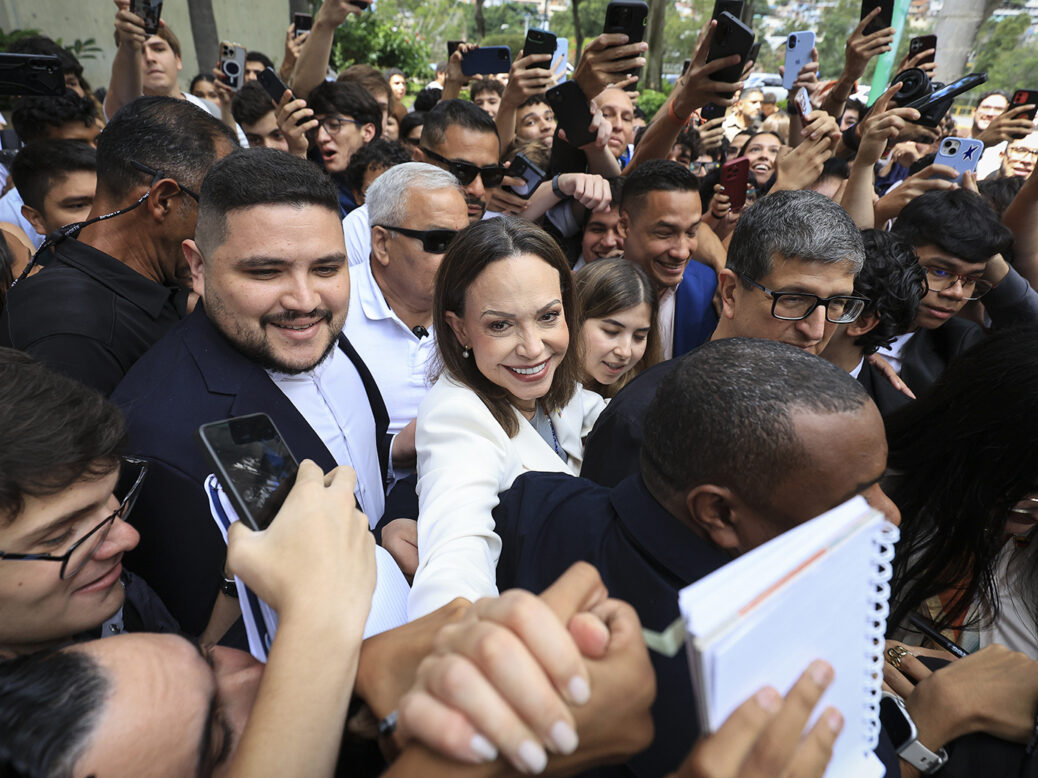
What is an apt way for the leader of the opposition to announce their homecoming after ten months in exile? According to María Corina Machado, the leader of the Vente Venezuela party, it’s with a tweet. “Estoy aquí . Con ustedes” – “I am here. With you” – she wrote on X.
Thousands reportedly lined up to watch Machado make her way to Caracas; some of them crying as they saw her motorcade. As one of Venezuela’s most popular opposition figures, Machado is a beacon of hope to her followers.
In the months leading up to Venezuelans casting their votes, Machado was disqualified from running for the presidency by Venezuela’s Supreme Tribunal of Justice, and Edmundo González became the opposition candidate instead. Following the heavily contested results which indicated González as the real winner in place of Nicolás Maduro who claimed the victory, Machado spent nearly 16 months in hiding, fearing political persecution. She undertook the perilous and secret journey from Venezuela on 9 December 2025 to receive the Nobel Peace Prize. Since then, she has been barred from returning by Maduro’s government, even after the US’s intervention and the appointment of Delcy Rodríguez, Maduro’s vice president, as the interim head of the state.
Machado has been pushing for an election as early as July 2027. She is backed by the US, although the Trump administration is reluctant to set a date for the vote to take place. But even if she won, could she rebuild Venezuela as she promised in the run-up to the election? The country’s structural problems make transforming the country far more difficult than the optimism surrounding her suggests.

The dust following the deadly earthquake in June has barely settled. In a country where the majority of the population lives below the poverty line, and where more than 70 per cent of hospitals have no regular access to water, an IMF fund of $346 million will do little to help. Venezuela’s ongoing crisis is rooted in decades of corruption, financial mismanagement and institutional decline. The heyday of the 1970s, Venezuela’s most lucrative decade, ultimately led to the 1980s economic crisis. Caracas, previously referred to as the Paris of Latin America, never recovered. In fact, the dire financial standing of the country snowballed further leading to another, larger economic crisis in 2014.
Venezuela’s economic collapse has left the country unable to secure international financial aid, while a failing healthcare system and a deeply compromised judiciary underscore the scale of the challenge any new leadership would face, whether that is Machado or not. Solving Venezuela’s deep-rooted issues will require institutional reform and a realistic strategy towards economic recovery – something that the country has consistently failed to do, focusing solely on the export of its most lucrative source: crude oil. Venezuela remains dependent on oil exports. In 2024 oil accounted for 95 per cent of the country’s exports to the US, and it has historically made up the majority of the country’s total exports.
Meanwhile, with US interests increasingly shaping Venezuela’s future, questions about its economic independence are becoming harder to ignore. Following an oil trade deal between the two nations, Donald Trump went so far as to suggest making Venezuela America’s 51st state. Now that the annexation of Canada has become a distant dream, Venezuela has become the US president’s next target, raising serious questions about whether Washington’s priorities lie in “rebuilding” the country or simply in access to its oil. Machado’s relationship with Trump, including her highly publicised gestures towards the US president – the flattery, the dedication and gifting of her Nobel Peace Prize medal – add another layer of complexity to the question of what her leadership would deliver for Venezuelans.
Since the 2010s, some Venezuelans have been wary if not outright hostile towards the US. Graffiti and murals demanding “Obama go home” lined the walls of Caracas during the former president’s tenure between 2009 and 2017. In their place are new slogans, damning Trump. Machado’s homecoming may have sparked hope in the hearts of some Venezuelans, but it is by no means a sign of change to come.
[Further reading: Trump is no longer the centre of American politics]
Content from our partners



Related
Join the debate
Subscribe here to comment