
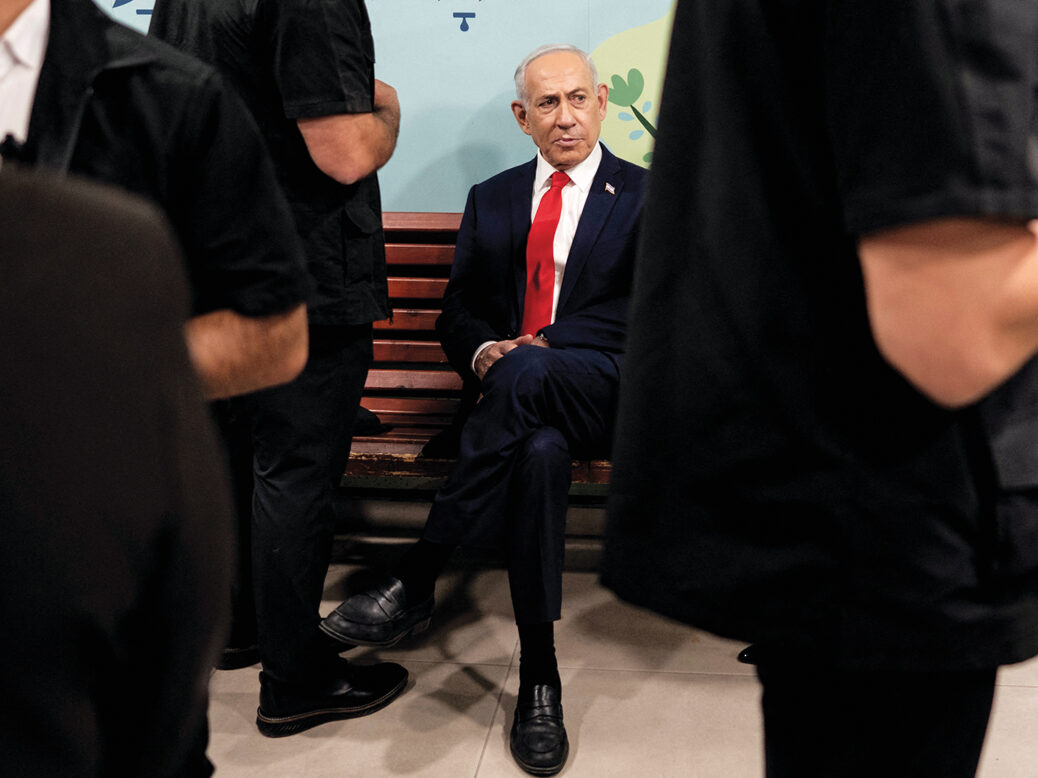
The results of the elections for the 26th Knesset in Israel are full of contradictions. Even Israelis struggle to understand them. In Israel, the left supports universal military conscription, while the right opposes it. This is hard to understand. Meanwhile, almost the entire “change” opposition objects to the inclusion of representatives from Arab parties in the government – one of the most important changes Israel needs right now, and without which there will no longer be any opposition to the right in Israel. In Israel, one camp can secure a clear majority – 67 out of 120 Knesset seats – yet either chooses not to form a government or finds itself unable to do so. The other camp, led by Benjamin Netanyahu’s Likud – the party that won the most votes by a wide margin but not a majority – is also currently unable to form a government. And there is another, truly unbelievable, aspect: in the first elections following 7 October and the genocide in Gaza, these two critical issues were not discussed at all during the campaign. Israel: a land of endless absurdities.
The first phenomenon that stood out immediately upon the announcement of the election results was the strengthening of the two Arab parties. The Joint List and Ra’am together won 19 seats, an unprecedented figure in Israel. Nevertheless, it appears that both Netanyahu’s camp and, quite astonishingly, the so-called change camp continue to subject them to a total boycott. For Netanyahu’s camp, this stems from an overtly racist ideology. For the other camp, it stems from veiled racism and cowardice – a fear of how it might be perceived by the right, the media and even some of its own supporters. The change camp is composed of diverse and even contradictory elements: a Zionist left (the Democrats party), a militaristic centre (the parties of Gadi Eisenkot and Naftali Bennett), and the nationalist right. Except for the Democrats, all other components of the camp have vowed not to sit in a government alongside Arab parties, nor would they even discuss the possibility. In other words, the change camp excludes the Arab voice just as the right does.
Whether driven by cowardice or racism, this demonstrates that the most potent sentiment in Israeli public life is hatred towards Arabs. It even outweighs the hatred for Netanyahu within the change camp, given that working with them is the only way to oust Netanyahu. After the Palestinian citizens of Israel decided to participate in the elections in impressive and unprecedented numbers – with nearly 80 per cent heading to the polls, a decision reflecting a desire to integrate and exert influence rather than to isolate themselves – and after Palestinian society in Israel conducted itself in an exemplary manner while their brethren were being massacred in Gaza and enduring daily pogroms in the West Bank, Israeli society has responded by slapping them in the face. “We don’t want you. You are lepers,” is a sentiment echoed, quite literally, from one end of the political spectrum to the other.
This will have long-term consequences. Just as the historic inclusion of Arabs in the government would have had an impact on Israeli society and on Israel’s international standing, so too will their exclusion shape the future of relations between Jews and Arabs in Israel. One in every five citizens in Israel is an Arab. Unlike their counterparts in the occupied territories, they possess full citizenship and formal civil rights; yet they face discrimination in virtually every sphere of life. Nevertheless, they have managed to carve out a path for themselves – Israel’s healthcare system, for instance, relies heavily on Arab doctors, pharmacists and nurses. The road towards their full and equal integration remains long, and the decision not to include them in the government will set the situation back.

A second prominent feature of these elections is that Israeli politics has once again revealed itself to be a politics of identity – perhaps more so than ever before. Policy, leadership and party platforms are secondary; ultimately, most Israelis cast their votes based on ethnic identity and class affiliation. Consequently, voting behaviour remains largely unaffected by unfolding events.
This is, of course, particularly evident in the support for Netanyahu. Following the fiasco of 7 October 2023 – an event that should have immediately ended his career – and the subsequent multi-front war that yielded almost no significant achievements for Israel, his party remains the largest, solely thanks to him. In Kiryat Shmona, in the north near the Lebanese border, and in Sderot, near the Gaza Strip – the two Israeli cities that have suffered the most in recent conflicts – Likud secured a majority, with a result double the party’s national average. This can only be explained through identity politics and the fact that, in the eyes of his supporters and admirers, Netanyahu is a statesman beyond reproach; no matter what he does, or fails to do, his camp stands firmly behind him. Even the clear prospect that Netanyahu’s re-election would trigger a wave of international economic sanctions against Israel has changed nothing. Likewise, the revelation – published in the newspaper Haaretz – that Netanyahu was warned about 7 October in advance yet failed to act has had no impact on his supporters.
Those who hoped that, following the election results in Brazil and Serbia, it would be Israel’s turn to break free from right-wing rule have been bitterly disappointed. The right has not won, but the left is neither determined nor capable of forming a government without the Arab parties; consequently, the State of Israel faces a political deadlock. Such a deadlock would mean that the current administration – Netanyahu’s government – would continue to serve as a transitional government until the next elections, the date of which would be determined later. This would be a government possessing full executive authority. Donald Trump has already declared that only with Netanyahu can he rely on Israel to join him in another war against Iran. In other words, a transitional government led by Netanyahu implies another round of conflict with Iran – following previous rounds that achieved nothing and served only to sow unnecessary death and destruction. A transitional government under Netanyahu also signifies the continuation of the inhumane status quo in Gaza, as well as the ongoing pogroms carried out by settlers in the West Bank.
This is the best-case scenario for Netanyahu, and he will likely cling to it. Another round of elections would likely secure a victory for Netanyahu, as it is reasonable to assume that Arab voters will not flock to the polls in the same numbers as they did this time, and the tens of thousands of Israelis living abroad who returned to vote for change are unlikely to do so again.
The other possibility is a national unity government, led by Netanyahu and Eisenkot. This is perhaps the most plausible scenario. Before the elections, all the leaders of the change camp declared that they would not sit with Netanyahu under any circumstances; now, they face their true test. In the past, anyone from the centre left who joined a Netanyahu-led government effectively destroyed their own career. Have the leaders of this camp learned that lesson? It is highly doubtful. They will likely convince themselves that a unity government is preferable to yet another round of elections, which they would almost certainly lose.
Politics is the art of choosing between various options – some bad, others less so. The leaders of the change camp will have to choose among the following: leading a majority government that includes Arab parties; leading a minority government supported from the outside by Arab parties; forming a national unity government with Netanyahu; or another round of elections.
The first option – forming a government based on the 67 seats currently held by the entire opposition in the Knesset – has not even been seriously considered. A minority government has no real chance of survival, especially given that Likud is the largest party. A unity government means reneging on the explicit election promise not to sit with Netanyahu – and, as it stands, new elections look like the finest gift Netanyahu could wish for.
The skies are darkening in Israel – and not just because winter is on the horizon.
[Further reading: Machado’s return won’t fix Venezuela]
Content from our partners



Related

This article appears in the 05 Nov 2026 issue of the New Statesman, Nigel Farage's bastards
Join the debate
Subscribe here to comment