
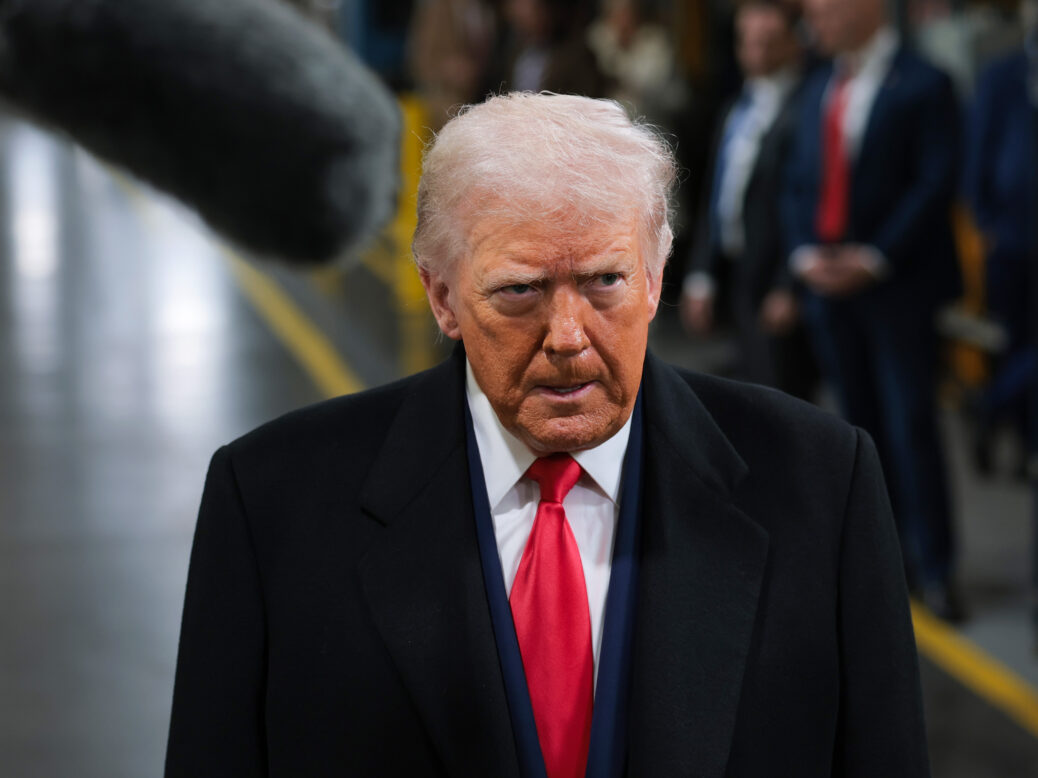
The end of the Donald Trump era has been predicted, wrongly, for many years. There was his handling of the Covid-19 pandemic – injecting bleach into your veins, anyone? – then his refusal to accept defeat in the 2020 presidential election, the storming of the US Capitol by his supporters, and his multiple criminal indictments. Yet his grip on his base, and his hold over the Republican Party, always endured.
Now, after dominating American politics for a decade, Trump is officially and emphatically a lame duck. His name was not on the ballot during these midterm elections, but he campaigned around the country asking voters to pretend that it was, seemingly convinced that his abysmal approval ratings were just a mirage and his charisma would cancel out the eye-watering price of petrol and diesel, the ever-increasing cost of living and his decision to launch an ill-conceived war against Iran. He closed out his campaign with a long, rambling sermon at the Reflecting Pool in Washington, insisting that he had finally tamed the capital’s algae and apparently utterly indifferent to voters’ concerns. The midterms results were an unmistakable repudiation of his leadership, as Democrats flipped both the House and the Senate, turning Texas blue and winning seats in long-standing Republican strongholds.
To his credit, Trump has said he will accept the result of these elections. He doesn’t have much choice. It is hard to hide an electoral landslide. The result was “too big to rig”, as one of his favourite slogans used to go. But the US president does not have a history of graciously accepting defeat, much less perceived humiliation, and he still has more than two years left in power. Confronted by a Democratic-controlled Congress, which will surely launch numerous investigations into his administration and perhaps a new impeachment campaign, it would be wise to expect Trump to lash out in the arena where he does still have significant power and wide latitude – foreign policy.
In the short term, this is likely to be good news for Vladimir Putin and Xi Jinping. The prospect of a trilateral summit between the three leaders in China later this month is presumably now even more enticing for Trump, who may hope to compensate for power leaching away from him at home by convening a meeting of what he will surely call the “G3” alongside the autocrats he so admires. Trump has already invited Putin to the G20 leaders’ summit in Florida in December, which he will, naturally, host at one of his golf clubs and presumably be determined to turn into even more of a spectacle.

There has been some speculation that Trump will renew his trade war with China, but Beijing has already demonstrated a formidable ability to stand its ground and push back hard with restrictions on rare earths. It seems less likely that Trump will have the appetite for a fight in which he has little hope of winning and risks spooking his cherished stock markets. If past form is any guide, it is more likely he will seek to preserve the current trade truce and continue to fete Xi and bask in the reflected strongman glare.
There is less good news for Ukraine. Trump has held a grudge against Volodymyr Zelensky since his first term, when the Ukrainian leader was unfortunately entangled in the US president’s first impeachment scandal. Those tensions erupted into public during their Oval Office showdown in February 2025 and have resurfaced at regular intervals as Trump rails against Zelensky’s unwillingness to capitulate, apparently blaming Kyiv, not Moscow, for his inability to deliver on his campaign promise to end the war. A Democratic Congress might be more sympathetic to Ukraine and more inclined to restore military aid, but a lame-duck Trump will only be more liable to nurture his grievances and attempt to punish his perceived adversaries.
The same logic applies to Europe, Canada and large swathes of Latin America, where Trump may well return to his threats of tariffs, trade wars and fantasies of territorial conquest. Faced with domestic political defeat, he is likely to punch down against countries he perceives as weaker powers, rather than up. It would also be a mistake to view this election as a wholesale rejection of Trump’s “America First” politics and a desire to return to the status quo ante for US foreign policy before 2016. The push for Europe – and American allies in East Asia – to take more responsibility for their own security is likely to prevail, whoever succeeds Trump in 2029.
Yet it is just as likely the US president, who has surrounded himself with sycophants and yes-men – and -women – will instead interpret the outcome as a reflection of the fact that his name was not actually on the ballot. He may choose to believe that the electorate has not, in fact, comprehensively rejected his war and its domestic economic consequences, and that victory is still possible if only he escalates the conflict and exercises his enduring power as commander-in-chief of the US military.
[Further reading: Nigel Farage’s bastards]
Content from our partners



Related

Join the debate
Subscribe here to comment