
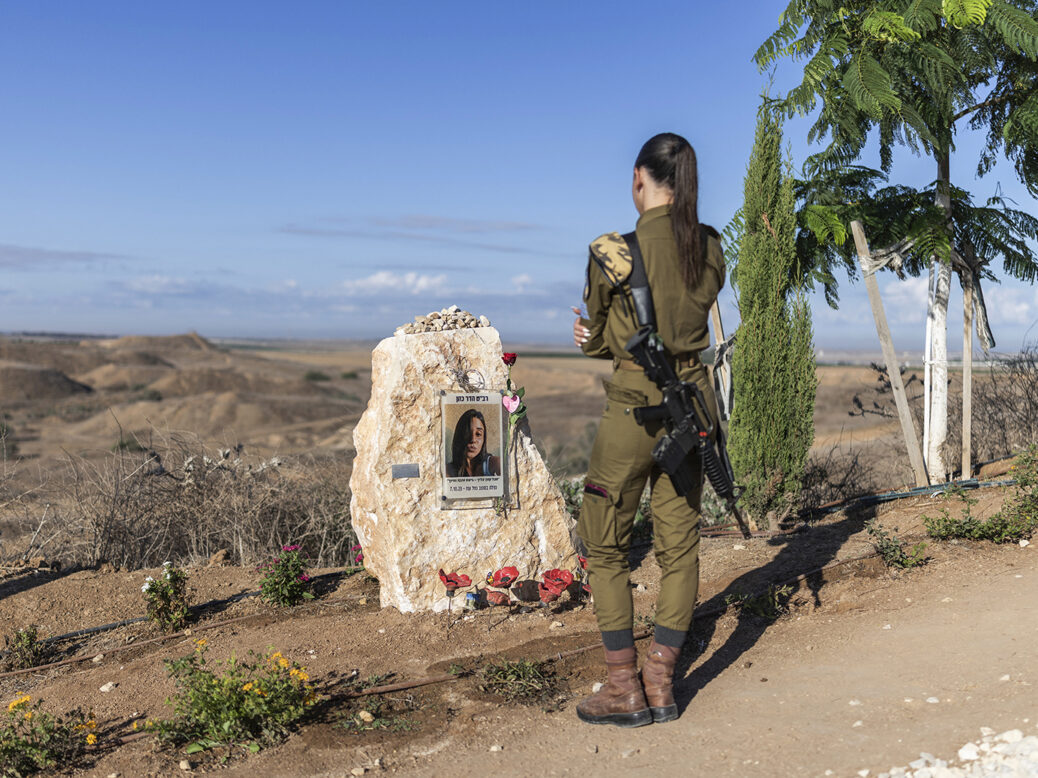
I have just spent a week in Israel and Palestine. The British-Israeli non-profit Amplify, which organises delegations to the region, invited an international group of journalists to visit the sites of massacres and refugee camps, to interview politicians and to speak with and look into the eyes of survivors.
Israelis vote for their government on 27 October. The splintered nature of Israel’s politics means the parties can be crudely split into two blocs – those prepared to form a coalition with Benjamin Netanyahu and those that aren’t, centred around the retired lieutenant general Gadi Eisenkot. Both groups sit comfortably on the right, and polls indicate that neither will win the 61 Knesset seats necessary for a majority. So speculation is rife about deal-making. The Arab parties, including the socially conservative Ra’am, are projected to win around 13 seats. In some ways Ra’am would make ideal kingmakers for the anti-Netanyahu bloc, but Eisenkot has so far ruled out forming a government with Arab parties.
Some Israeli elites believe what they describe as a “unity government” is a likely outcome, with the office of prime minister rotating between parties. One political analyst speculated that if the handover conveniently took place in two years’ time, it would allow Netanyahu to run in the next presidential election. Many of those same elites wish for the electoral isolation of the far right – particularly ministers like Itamar Ben-Gvir and Bezalel Smotrich. Yet the far right are expected to make gains and surpass the left-leaning Democrats, formed from the merger of two parties, including the once powerful Labor Party of Golda Meir and Yitzhak Rabin.
I met President Isaac Herzog at his residence in Jerusalem. Constitutionally responsible for choosing which Knesset member can try to form a government, he seemed relaxed as we drank coffee and ate chocolate marked with the seal of his office. But there was a distinct glint in his eye when talking about coalition arithmetic. Israel’s head of state has no executive power (that resides with the prime minister) but he can bestow pardons if the offender admits their guilt and asks forgiveness. (Netanyahu has long been battling a corruption case.)

Earlier that day we’d been in the West Bank, where illegal settlements are next to the refugee camps and the Palestinians, whose land has been stolen, who live in them. In the camps, DIY power lines and sewage pipes crowd alleyways less than a metre wide. The plastic tubes are covered with patch-ups and sealant. The summer heat cracks their plastic and causes human waste to spurt out with every toilet flush.
In al-Am’ari refugee camp, our guide informed us that, where we stood, an IDF soldier, Ronen Lubarsky, was crushed in 2018. A stone slab was dropped on him from one of the houses above us. The man responsible was sentenced to life imprisonment and his family home razed to the ground, as is Israeli policy. A year later, the IDF noticed the family’s house had been rebuilt, and so demolished it again. Riots and arrests followed. So it goes, so it goes.
On to Ramallah and an audience with Mohammad Shtayyeh, the former prime minister of the Palestinian Authority (PA) and a member of Fatah’s Central Committee, its highest decision-making body. Before the meeting, we learned that, once again, Palestine’s elections had been postponed by the PA’s president, Mahmoud Abbas. Babies have been born and reached voting age since the Palestinians last voted, in 2005 (presidential) and 2006 (legislative).
Shtayyeh told us conditions in Palestine make a free and fair election impossible, that at least 74,000 Palestinians have been killed since 7 October 2023, 170,000 injured and two million displaced. He said the Israelis are committing genocide, a view shared by many leading genocide scholars. He also said Israel was “vetoing our democracy”. Shtayyeh had recently been in Cairo negotiating with Hamas as part of a Palestinian national dialogue, and told us that the militants have verbally agreed to disarmament and are committed to a two-state solution. But the national dialogue has been ongoing for nearly 20 years; Shtayyeh didn’t seem to believe Hamas himself.
The next day we headed to Kfar Aza, a kibbutz where at least 60 people were murdered by Hamas on 7 October. Doron Steinbrecher, one of the 19 people taken hostage here, stood outside her old house. She survived 471 days in captivity. She told me: “I really lost all hope that I was coming back home.” While the rest of the kibbutz is being rebuilt, her neighbourhood has been left as it was after the attack, save for the spray-paint markings of bomb disposal units and archaeologists from the Israel Antiquities Authority. Their expertise was enlisted to distinguish human remains otherwise unidentifiable in the wreckage.
Gaza was visible across the fields. I recognised the grey of concrete but not the discernible outline of buildings. A drone hummed above us. We could get no closer: the IDF does not permit independent foreign media to enter. The International Federation of Journalists has documented the killing of at least 203 Palestinian journalists and media workers in Gaza since the horror started. Both countries – and this election – are soaked in trauma. The outcome is unlikely to be liberal.
[Further reading: This is censorship by other means]
Content from our partners


Related
This article appears in the 21 Oct 2026 issue of the New Statesman, Sally Rooney is a writer, not a terrorist
Join the debate
Subscribe here to commentIt would be good to have more thoughts on why genocide and not crime against humanity in this context. Has crime against humanity been superceded for Israel – Palestine?
The intro for Shtayyeh seems to be missing.