
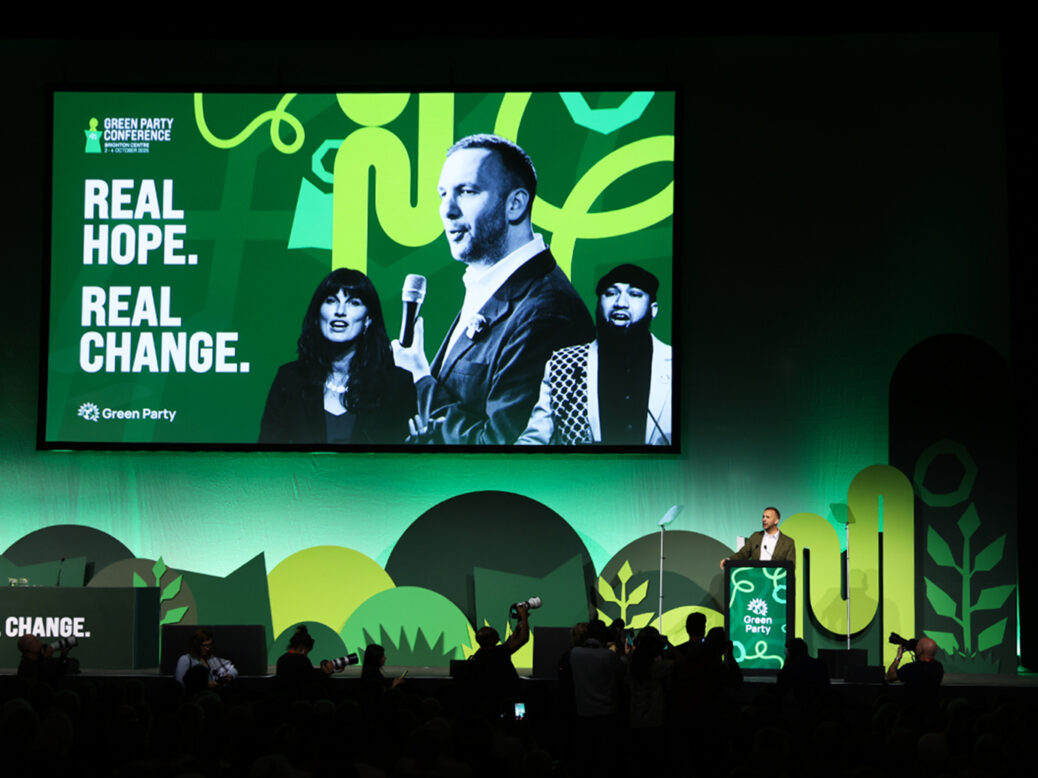
Rarely do Jews, a people famous for disagreeing with one another, seem as aligned as they do over the Green Party motion equating Zionism with racism. From the Orthodox chief rabbi, Ephraim Mirvis, to anti-Zionists, there is a broad consensus that this was a truly offensive move. Rather than urgently addressing the dystopia that the Israel-Palestine conflict has become, the motion will achieve little beyond amplifying prejudice and entrenching division.
The Greens had already made clear their opposition to Israeli violations of Palestinian rights. Two years ago, members voted to recognise Israel as an apartheid state and the Gaza war as a genocide. The party has long supported the Boycott, Divestment and Sanctions movement. When Israel banned 11 MPs from the country in response to Ed Miliband’s sanctions on settlements, all five Green MPs were on the list.
The “Zionism is racism” vote, proposed by Greens for Palestine, goes much further. It states that Zionism “is a political ideology which called for the creation – and, now it exists, the continuity – of an ethno-nationalist Jewish state in historic Palestine to the exclusion and/or domination of the non-Jewish population”. The motion caveats that whatever Zionism as an ideology may have intended is immaterial, as its manifestation “has been the historic and ongoing dehumanisation, displacement, dispossession, disenfranchisement and destruction of Palestinians”. It passed by 1,022 votes to 813 on 4 October. The party’s official position is now that “Zionism… will be treated as any other form of racism”.
Amendments to address concerns that the motion may discriminate against British Jews – the majority of whom, polling suggests, support Zionism in some form, and are likely to attend a synagogue or other organisation connected with Zionism – were rejected. Zack Polanski, the party’s Jewish anti-Zionist leader, backed two failed amendments. Opposition to the motion at the conference was reportedly heckled.

This saga says much about the state of discourse on the left. But it also says much about the difficult position of British Jews vis-Ã -vis the Jewish state, and at a time of rising antisemitism. It is a reminder, too, that, three years on from Hamas’s 7 October attack and the start of the Israeli onslaught on Gaza, we are still no nearer to changing the material reality for anyone living between the river and the sea.
Zionism is a term over which few agree. For Palestinians it has become a byword for occupation and violence, while many Jews – though not all – associate it with liberation. Polling from last year shows that nearly a quarter of young British Jews identify as anti-Zionist, while a further 20 per cent identify as “non-Zionists”. Indeed, Jews have fiercely debated what Zionism should be since its inception as a modern political movement in the late 19th century. When the State of Israel was established in 1948, amid war and the dispossession of 700,000 Palestinians, the socialist Zionist stream dominated. Israel’s Declaration of Independence sought to “ensure complete equality of social and political rights to all its inhabitants irrespective of religion, race or sex”. Kahanism, the racist, far-right ideology in Israel, was not inevitable.
Jews prayed in the direction of Jerusalem and spoke of Zion long before modern Zionism’s founder, the journalist Theodor Herzl, adopted these tenets of the Jewish faith in his answer to European antisemitism. They did so long before Israel passed the 2018 Nation State Law, which recognised only the Jewish right to exercise self-determination in Palestine. And they did so long before the occupation of the West Bank, Gaza and East Jerusalem after the 1967 Six Day War. In the meantime, belief in Jewish peoplehood has remained a core part of Jewish identity in the diaspora.
The Greens’ motion supports “a single democratic Palestinian State in all of historic Palestine”. What would that mean in practice for Gaza, the West Bank or Israel? Rula Hardal, a Palestinian citizen of Israel and co-director of A Land for All, the project dedicated to reimagining the moribund two-state solution, told me last year she had abandoned advocating a one-state solution as the theory wasn’t realistic. In the name of anti-racism, the Greens presume to decide, on behalf of everyone between the Jordan River and Mediterranean Sea, what is best for them. If politics is the art of the possible, we might ask: what does this motion make possible? Will it convince British Jews to see clearly what is happening in the Jewish homeland they grew up idolising, and to push for change? Will it move Israelis to demand an end to occupation or to what many experts consider genocide? Expending energy on winning this debate seems comparable with Israel advocates insisting that people state their belief in Israel’s right to exist. You might win a rhetorical point. Then what?
If change were the point, those behind the motion might have listened to colleagues concerned about the chaos that would ensue, the opportunity cost of lost votes. A Green insider tells me local parties have been left to deal with the fallout, with little support from the centre. If this was a moment for Polanski to show leadership, he has failed.
The motion seems to me typical of his brand of social-media-first politics. It has the logic of a meme, the hollow signalling of a position. Crude and shallow, it is hardly the instrument with which to address the intractable horrors of what has become of Israel and Palestine.
[Further reading: The Green Party’s Zionism reckoning]
Content from our partners

Related
This article appears in the 07 Oct 2026 issue of the New Statesman, The Suspicious Relationship
Join the debate
Subscribe here to commentI recall that in the 1960s/1970s and into the Thatcher era, the media were full of people claiming to be anti-apartheid but nonetheless backing trade with South Africa, sporting tours, etc, etc, always with some semi-plausible reason which varied from commentator to commentator. The unanimity of their hostility to Peter Hain, the Anti-Apartheid movement, the noisier Labour people who demanded sanctions, and so on, were impressive and even though I was tending to agree with the criticism, the difference in the reasons always struck me as fishy, like 30 children claiming 30 different reasons why the overrunning of the sports period had made them 20 minutes late for maths when in reality there was one reason – they preferred to chat and indulge in horseplay and mucking around in the changing room rather than rush to maths. It’s the same with the almost universal criticism of the Green party’s vote that Zionism is racism. The founding of the State of Israel on what has been Palestinian land for 1000 years is not to be criticised, despite its displacement of those Palestinians by stratagems such as their massacre at Deir Yassin, any more than criticism of “our kith and kin” in South Africa was allowed in those days.
A pointless motion at a party conference which will damage the Greens’ popularity and electoral chances. But the fall out reminds me of the shock-horror reaction to Diane Abbott’s contribution to the debate on race