
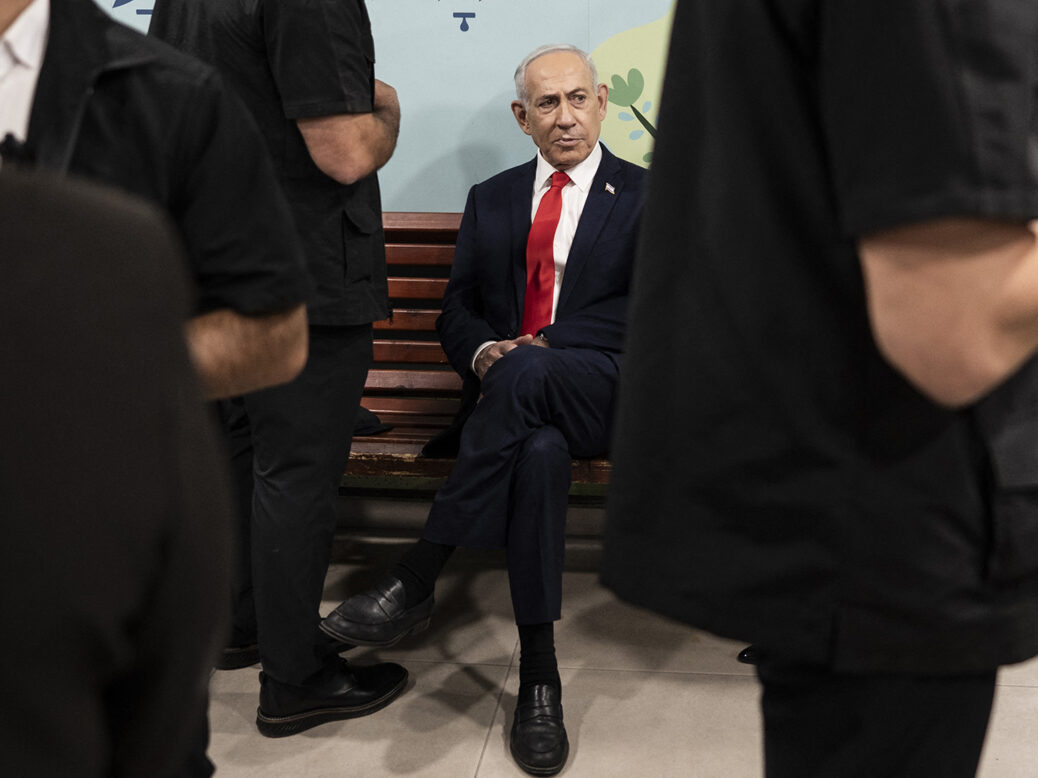
Israel may have just had one of the most consequential elections in its history, but exactly what the consequences will be is still far from clear.
On Tuesday, amid thunderstorms in Jerusalem and last-minute campaigning by politicians, Israelis turned out to vote in record numbers in the first election since Hamas’s attacks on 7 October. Against a backdrop of the country’s devastating war in Gaza – as well as ongoing fighting on the Lebanon border and a surge of extremist settler violence against Palestinians on the West Bank – the stakes of this election are high. The results will be viewed, variously, as a verdict on Benjamin Netanyahu’s political future, as a test for the country’s security and as an attempt to safeguard Israel’s democracy.
Netanyahu’s far-right coalition was in power when Hamas launched its attack on Israel three years ago – a stunning breach of security that resulted in the single biggest loss of Israeli life since the Holocaust. Numerous credible reports have since emerged that Netanyahu was warned about a potential attack ahead of 7 October and failed to act. Many Israelis want to see Netanyahu and his coalition partners held accountable for the security lapse; many are also angry at the way the government has waged the war on Gaza, feeling Netanyahu prioritised his political survival over a dedicated attempt to rescue the hostages kidnapped by Hamas.
Yet Netanyahu – Israel’s longest serving prime minister – has form for defying the political odds. He leads a bloc of far-right nationalist and ultra-Orthodox parties, whose vision for the country includes, among other things, ever-expanding settlements in the West Bank and full annexation of Gaza. His main opponent, Gadi Eisenkot – a former general who once served in the prime minister’s cabinet but resigned over how the war in Gaza was being fought – leads a bloc of loosely associated parties whose defining feature, perhaps, is that they oppose the prime minister.

Even as exit polls were released at 10pm local time on Tuesday it was still uncertain which bloc had managed to sway the Israeli public. Both Netanyahu and Eisenkot’s bloc won the same number of seats – though, crucially, not enough to form a majority government (61 seats are needed to win a majority and each bloc won 51).
That didn’t stop Eisenkot from releasing a statement shortly after the polls closed saying, “If these are the final results, they would mark a victory”. Meanwhile, Netanyahu is working overtime to spin the results as a victory for his Likud party, which won more votes than any other single party (although it seems to be a pyrrhic victory as his party appears to have taken seats from his coalition allies, rather than his rivals). What’s more, Israel’s exit polls can be inaccurate – and even the earliest results were revised hours later – and they can be especially inaccurate in tight races like this one; the full picture won’t appear until all the ballots are counted, by hand, by party representatives as election observers equipped with body cameras watch over. At the time of publication, more than half of votes had been counted with neither bloc on track for a majority. We won’t know the full results until later this week.
And then comes messy part: weeks, if not months, of negotiations between parties as each bloc jockeys to form a robust-enough coalition. The challenge for either bloc is immense. Netanyahu and his allies don’t appear to have enough seats between them to form a government, unless they are joined by one of the parties that has actively campaigned for change (ie ousting Netanyahu). Yet Eisenkot’s bloc won’t be able to cobble together enough seats either, unless they are joined by an Arab-majority party – something he and his allies have vowed not to do. It’s not clear if that vow holds firm once party’s begin reckoning with the electoral maths – the exit poll indicates that Israel’s Arab parties have won a record number of seats and could certainly act as kingmakers if either bloc was willing to work with them.
Yet if the commitment to reject Arab parties does stand, it could offer the seemingly out-of-luck Netanyahu a fresh opportunity. As Dimi Reider wrote in this magazine earlier this year, “Netanyahu might yet be able to capitalise on the desire to lock out Israel’s most significant and maligned minorities – the Palestinians and the ultra-Orthodox – by spearheading a coalition made up of all secular Zionist parties” – which could include those who actively campaigned on ending his reign. After the exit polls were announced there was much speculation that Eisenkot himself could entertain an alliance with Netanyahu – a man he previously declared unfit to lead – in order to form a so-called unity government.
Much could change in the weeks and months ahead as parties weigh up which compromises they’re willing to make and which campaign pledges they’re prepared to break. If no stable government can be formed, another election could be on the horizon. But for now, as the far-right national security minister and Netanyahu ally, Itamar Ben-Gvir, put it in the hours after the polls closed: “The night is still young.”
[Further reading: After Iran, America may turn on Israel]
Content from our partners



Related

Join the debate
Subscribe here to comment