
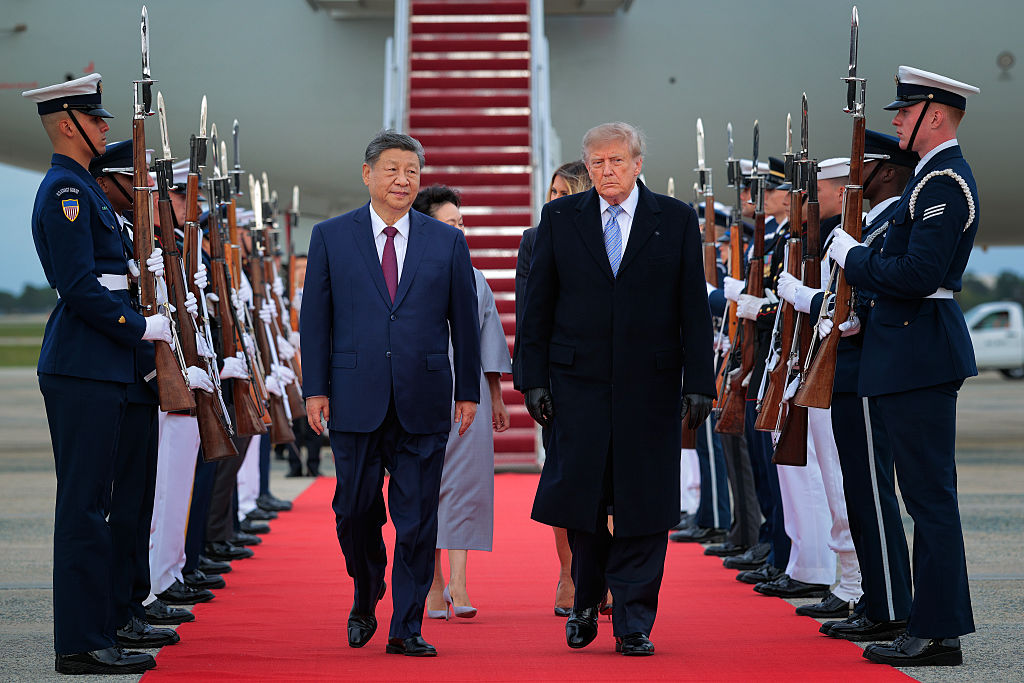
To watch Donald Trump welcome Xi Jinping to Washington this week, you would think the People’s Republic of China was one of the United States’ closest allies. As Xi descended the steps from his plane at Joint Base Andrews on 23 September, Trump was waiting to greet him on the tarmac. The US president escorted him along a red carpet to observe a 21-gun salute and a military flypast, wincing mightily as two US Air Force B-1 bombers roared overhead. Xi, for his part, barely moved.
Barack Obama made the trip to Andrews to welcome Pope Francis to the US in 2015. But other than the late pope, the last foreign leader to receive such a welcome at the air force base was the British prime minister Harold Macmillan, who was greeted by then US president John F. Kennedy in 1962. Xi did not deign to travel to the airport to meet Trump when he visited Beijing earlier this year. Yet, the current US president does have form for staging elaborate welcome ceremonies for leaders he admires. Last year, he greeted Vladimir Putin at a US air force base in Alaska, smiling and clapping as the Russian president walked towards him on the red carpet and told him, as a formation of US military aircraft streaked overhead, “this is for you.”
Perhaps Trump imagines that such effusive gestures are merely a low-cost way to get their talks off to a good start. Perhaps he simply enjoys the spectacle and the prospect of how it will all look on TV. (This aspect of the visit was complicated when the major US networks suspended their usual pooled video coverage after Trump banned three US news organisations from the White House.) The following morning, Trump was still showering Xi with inexplicable compliments. “I met President Xi at the plane (Airport!) yesterday and he looks strong, vibrant, and fit – Better than ever,” Trump reported on Truth Social on 24 September. “Madam Xi, of course, BEAUTIFUL!” Never mind that her actual name is Madam Peng.
The two leaders toured the new ballroom construction project Trump is overseeing and a new supersized helipad, ignoring the assembled reporters who shouted questions about Iran, Taiwan and the imprisoned Hong Kong media tycoon Jimmy Lai. “He is an expert on stone, among many other things, and loves good granite,” Trump enthused, insisting they were having a “very good meeting.” Xi said nothing in response.

Xi does not do public displays of emotion. During his nearly 14 years as general secretary of the Chinese Communist Party (CCP), he has perfected a scrupulously impassive facial expression that he maintains during public events. Still, the lack of reciprocity was notable. While Trump praised their “truly great friendship” and the “spectacular and very beautiful hospitality” Xi had displayed during his visit to Beijing, Xi merely noted their “respect” for one other. “We have built a personal rapport and stayed in touch,” he said. (By contrast, Xi has previously referred to Vladimir Putin as his “best and bosom friend.”)
Expectations were low for any real breakthroughs during this summit. Both sides seem content to muddle along for now under the rubric of “constructive strategic stability” that they adopted last year, which seems to translate to not picking any major new fights and maintaining their current trade truce as both Trump and Xi confront their own economic challenges at home. After talks with China’s vice-premier He Lifeng on 23 September, the US treasury secretary Scott Bessent duly announced that they had agreed to a two-month extension of the trade truce they agreed in Busan last year, which will now run until 10 January. Private talks between the two leaders in the Oval Office were scheduled to last just 30 minutes, including translation time.
There was also little sign of progress towards establishing safety guidelines between the two powers on artificial intelligence, which Trump is attempting to rebrand “Super Intelligence” or SI. “A big day with President Xi of China,” Trump posted on social media during the summit. “Super Intelligence (SI) will be a big topic of discussion, but I want to leave it exactly where it is. That is China’s position also.” Xi appeared to go slightly further, noting the importance of ensuring that the “development of AI is always under human control.”
At the time of writing, the most tangible result of the visit seemed to be an announcement by Xi that China would send two more pandas to the US. Referring to the animals as “envoys of friendship”, Xi confirmed that a male and a female panda would soon be dispatched on loan to a zoo in Atlanta, Georgia, in keeping with Beijing’s long-running practice of panda diplomacy. This was not quite as meaningful as a major trade deal or an agreement to work together to ensure that AI does not kill us all, yet it was perhaps a fitting outcome for a summit that delivered plenty of pageantry but little apparent substance. That will have suited both leaders just fine.
[Further reading: Donald Trump’s last hurrah]
Content from our partners



Related
Join the debate
Subscribe here to comment