
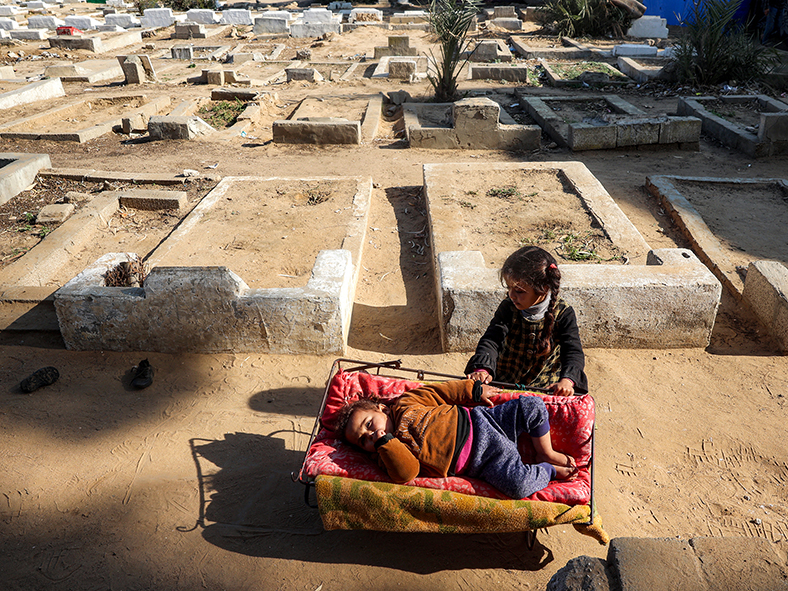
Amid the ruins and the rubble, there is a flicker of hope. The first 1,000 Palestinian children under five are now attending, or are about to attend, early-learning classes in makeshift centres across Gaza – giving the youngest victims of nearly three years of conflict the opportunity to play, to learn, to escape the trauma of recent times, and to smile and laugh again.
In bombed-out areas, where there is barely skeletal provision for newborns, toddlers and infants, centres called “pop-up Sure Starts”– in a nod to the UK scheme established during the Labour government of 1997-2010 – are being established. These centres deliver a programme combining education, healthcare, childcare and essential mental health support for children who have been born into conflict and are, even now, living on the edge of subsistence.
The Swedish government and independent charity the Akelius Foundation have invested a combined $120m in Unicef’s provision. There are to be 400 schools for children aged between four and 16. The plan, initiated by the charity Theirworld and delivered by the local Palestinian Early Childhood Education Program (PECEP), is to match those schools with 400 permanent Sure Start-style centres for under-fives. With Theirworld’s support, PECEP is providing 12 temporary early-learning centres for children aged three to five, giving young children opportunities to return to learning and play.
The charity has brought together some of the stories of those now attending these centres. Haneen Hijazi, whose five-year-old daughter Kawthar has been attending the pop-up tent for just over a month, is traumatised by the impact of repeated displacement on her child. Kawthar weighs just 11kg, and suffers from malnutrition from the effects of famine. Hijazi movingly reports the change she has seen since Kawthar began attending the centre: “She was always afraid and terrified of the bombing and attacks and death. She was afraid we would die or be harmed and something terrible would happen to us,” she says. “Kawthar struggled to get through each day. I used to wait for night to come, hoping that she would be tired enough to fall asleep because I did not know how to help her get through the day. There were no toys, no centres, parks or play areas. She would play in the sand. Sometimes we would tell her a story that we made up ourselves because there were no books.”

Since Kawthar has been attending the Khan Younis children’s centre, her mother says, “her personality changed significantly”. “Kawthar had become extremely attached to me and I wanted her to go out into the wider world and move away from the terror of war and the fear she had been living with. So I was very, very happy – perhaps even happier than she was.”
The pop-up play centre offers painting, colouring, drawing, storytelling and singing. “Kawthar has become more confident and has started doing things more independently and has started drawing and writing. She comes home now extremely happy and excited by the things she has done.”
Children do not start wars or plan acts of terrorism, but too often they are the greatest casualties of conflict and terror – their schools are the first facilities to close and often among the last to reopen. Because the Gaza war has been fought in heavily populated urban areas, where bombing has little distinction between civilians and military targets, the trauma experienced by children has been far more profound than in many of the wars of the past century.
According to a recent UN Commission report, 20,179 Palestinian children have been killed and 44,143 children injured since October 2023 – suffering what Unicef has called “unimaginable horrors”. Even in the year since the conflict was supposed to have ended, 300 children have been killed. “A ceasefire that leaves an average of one child dead each and every day,” Edouard Beigbeder, Unicef’s regional director, says, “is failing children.”
In total, one Palestinian child in every 17 has been killed or injured, and almost all schools and many kindergartens have been severely damaged or destroyed. As satellite images captured by the Global Education Cluster revealed, 93 per cent of schools have sustained some level of damage, and 85 per cent will need to be reconstructed. The Palestinian education ministry’s June 2026 figures state that 179 public schools have been razed to the ground, 105 UNRWA schools have been struck or vandalised, and 63 university buildings destroyed. Reconstruction cost estimates are roughly $870m in the short term and $3.8bn over five years.
This summer, 250,000 pre-school and school-age children took part in learning activities, with more than 600 pallets of educational materials delivered. But the new school year has begun with only some of the learning spaces that are needed, and most are temporary. Unicef’s “Back to Learning” programme hosts more than 100 centres in Gaza which currently support 135,400 children. But, as the European Training Foundation has reported, “structured and comprehensive schooling has not yet resumed” in the region, and learning is still temporary and fragmented.
Because of the pandemic and now the war, pupils in Gaza have lost at least four academic years of schooling. Even this sorry outcome does not account for the effects of trauma, disability and displacement.
The children who have survived account for half the population of Gaza. More than 58,000 children have lost one or both parents, and at one point more than 40 per cent of families in Gaza were caring for children not their own. The wounds run deep. Many who have suffered war-related injuries and amputations need not just emergency medical and surgical care, but mental health services. Early in the war, speech therapists reported that, in some camps, six out of ten children had developed speech problems.
As it awaits the first projects from the Board of Peace, Gaza is today short of everything. Eighty-five per cent of parents report their children have gone at least one whole day without any food. One in every four children aged six months to two years was found to have a minimally acceptable diet. Many more – 37 per cent – had suffered diarrhoea over the preceding fortnight. While Unicef have reported some improvement, this is fragile and could reverse rapidly without more permanent measures to support children.
The urgent need is for food, shelter, electricity and healthcare, but it is the return of schools that will mean families can begin to prepare and plan for a better future. And education is nowhere more valued than among Palestinians. In normal times, a child who started school in Gaza or the West Bank would complete 12 years of school. Because investment in education until now has been higher than elsewhere in the Arab world and higher than in most low-income countries, Palestinian children have achieved impressive results.
Back to Learning is Unicef’s flagship Gaza operation, which is a deliberately integrated network of multi-service, non-formal learning centres delivering education alongside mental health and psychological support. Unicef aims to reach 336,000 school-age children by the end of 2026, at a cost of $86m – about $280 per child per year. Education Cannot Wait, the global fund for education emergencies, which I used to chair, is focusing its effort on the most vulnerable children: those with disabilities, especially who suffered life-altering amputations.
But there are still 335,000 children under five at risk of severe developmental delay, who need caregivers, teachers, psychologists and special provision for those with disabilities – the provision that has been missing from every recent programme of reconstruction.
Research shows that the first 48 months of a child’s life are more critical for development than the 48 years that follow, and 90 per cent of brain development happens in their first five years. In many parts of the world, early learning is seen not as a luxury but a right that every child should enjoy. But early-childhood development, which spans many sectors – from health to education and play – has no single agency focused on the needs of the world’s youngest and most deprived boys and girls. If we do nothing, children suffering from trauma will face a future as hopeless as the past.
Theirworld has learned from its members’ experiences in Ukraine, Lebanon and beyond about how to implement early-years programmes in emergencies. We can also learn from one of the world’s biggest and most ambitious early-years programmes, which I supported during my time in government: the Sure Start programme in Britain. This initiative has been given high marks for its effectiveness. As its first entrants have now taken their final school-leaving examinations, the results are showing performance across the curriculum has increased by three grades. Children who lived near a Sure Start centre were less likely to be hospitalised, suffer mental illness or experience youth crime. Children with quality early-childhood care and education have been four times likelier in Britain and elsewhere to graduate from college. What works in the peaceful environment the UK has been fortunate enough to enjoy can yield even more dramatic results in zones recovering from conflict.
The next step is to listen to the voices of the Palestinian population. As I reported to the UN secretary-general, António Guterres, we need to build a coalition of international agencies – including Unicef, UNRWA, Education Cannot Wait, the World Food Programme and the World Health Organisation – to turn around the life chances of Gaza’s children. With evidence that pop-up Sure Starts are working, there is now a case for a global initiative and for a special children’s emergency fund, inviting governments, companies and the public around the world to donate.
We have an opportunity to show the difference that investment in the early years can make and, instead of despair and desolation, to offer young children hope that the future will be better than the past.
Gordon Brown is UN special envoy for global education. His latest book, The Future Starts with Us, is published by Simon & Schuster; all royalties go to children’s charities
[Further reading: How long can Germany resist the far right?]
Content from our partners


Related
This article appears in the 10 Sep 2026 issue of the New Statesman, The World According To Ed
Join the debate
Subscribe here to commentI’m glad I read this article – deeply disturbing but with flashes of optimism about a desperate man-made crisis.