
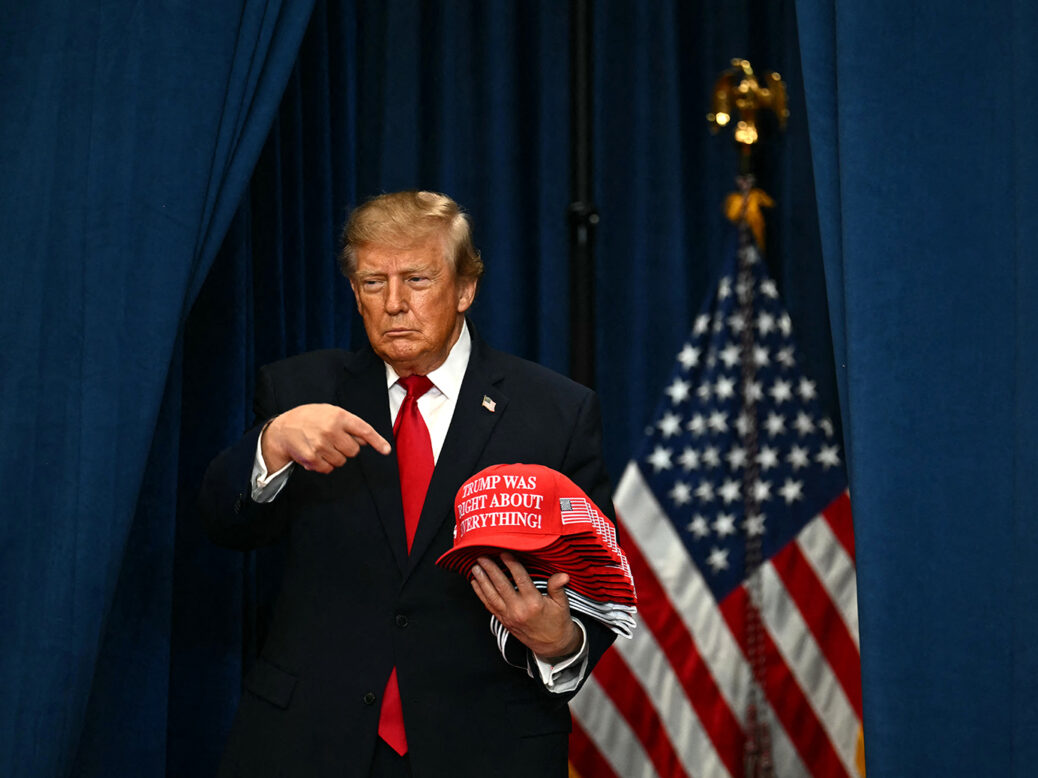
It is tempting to look back and think it was the slogan wot won it. An adroit four-worder can pierce national consciousness and define a moment. A good slogan should be as relevant to historians as it was during a campaign. “Make America great again” seemed to resolve the paradox Americans believed that the US was the greatest country on Earth and yet were anxious about what they saw as its endemic decline.
“Take back control” brought together the ineffable threads of despair that voters felt after being ignored over migration, declining wages and all the rest. Or to see the opposite: think of David Cameron’s call for the nation to stick to the “long-term economic plan” in 2015. He salvaged a small Conservative majority and then called the Brexit referendum, bringing about the largest economic rupture since the financial crash.
The Democrats did not have a slogan for the 3 November midterm elections. Its campaign was too diffuse. The party itself is split between the establishment and the insurgent progressive left. Its strategy was to run campaigns that focused on local issues run by local candidates instead of an overarching national theme. If they had chosen one though, they could not have done better than adapting the Republicans’ slogan from the 1946 midterms: “Had enough?”
That year, the Republicans took back Congress for the first time in almost 20 years by tapping into voters’ frustration at the long reign of the New Deal, inflation in the double digits and a president in Harry Truman who seemed to lack the aplomb of his predecessor, Franklin D Roosevelt. As much as he might have liked, Donald Trump could not match Roosevelt’s 12 years in office. But that has not stopped the Democrats from essentially running on the question: have you had enough of Trump yet?

Even though they have inevitably framed the midterms as a referendum on the president, Democrats have slackened their apocalyptic predictions about the potential end of democracy, a defining feature of the 2024 presidential campaign. That diagnosis has receded as we have progressed through the Trumpian age, partly because democracy has staggered on, increasingly deformed and ugly, but also perhaps because the Democrats seem to have belatedly realised that those who support Trump – or, in other words, those they need to win over – don’t see him as a threat to democracy; they see him as its embodiment.
It is always the case that politicians tell voters that the current election is the most important of their lifetimes. Following the midterms in 1958, the New Yorker declared that the “next two years promise to be unlike anything known in recent history”. It is a constant and often irresistible message about the urgency of our times. But most things in politics have some form of precedent. What counts as the most important election in your lifetime depends on the scope of your reference.
Trump’s oblivious plea to voters that they should imagine that his name was on the ballot is one of many examples of presidents being out of touch with voters, convinced that the public cannot see what their leaders are doing to improve their lives. After his party’s mauling in the 1958 midterms, Eisenhower said, “I do not see where there is anything that these people [who voted for Democrats] consciously want the administration to do differently. And if I am wrong, I’d like to know what it is.”
It would be a mistake to read predictions into these midterms about what will happen in the presidential election two years from now. The Democrats did better than expected in 2022, only for Kamala Harris to suffer an ignominious defeat to Trump. In 1946, the electorate agreed that they had had enough of the Democrats and handed Congress to the Republicans, only for President Truman to go on to beat his opponent, Thomas Dewey, two years later.
There will be new fault lines that define the presidential election in the years to come that we cannot see right now. Rumours are rife in Washington that Trump will relaunch the war on Iran once he has got through his final election. Questions swirl about who the Democrats might impeach – and when. We might learn about new acts of corruption. Era-defining advancements in artificial intelligence could radically change debates about what the economy will look like ten – or even five – years from now. On top of what the White House and Congress might do in 2027, there is the larger question of who actually stands for each party.
In this context, midterms are little more than a national poll on a specific day in November – a hiccup in the transition of real power, which lies with the imperial presidency. Trump has long lost interest in passing legislation. His mind is preoccupied with foreign affairs and winning the AI race. Reports already suggest that the White House is preparing to govern by executive order. In a country with a habitually supine Congress, the real race is for the throne – but for the next two years, that throne already has an occupant.
The country might have had enough of Trump – but he won’t care too much. For now, he is not going anywhere.
[Further reading: Trump is no longer the centre of American politics]
Content from our partners


Related


This article appears in the 05 Nov 2026 issue of the New Statesman, Nigel Farage's bastards
Join the debate
Subscribe here to comment