
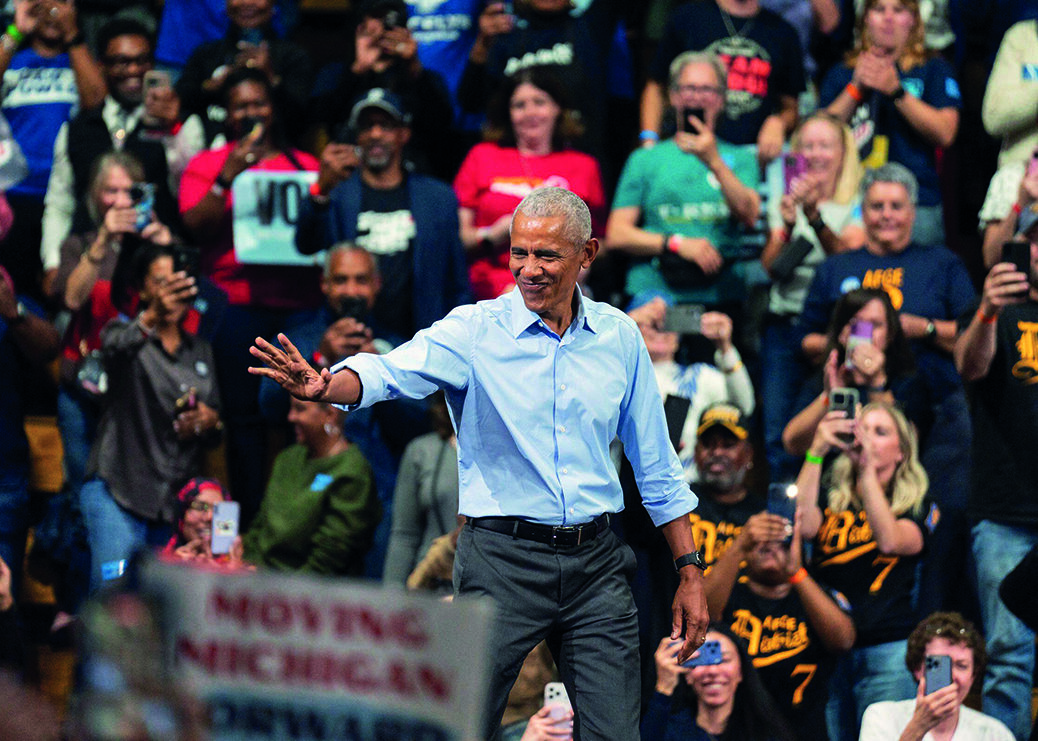
Barack Obama looked out at the crowd and did not like the country that looked back. He stood in a high-school gymnasium in Detroit, with skinny arms and a helmet of silver hair, at a recent campaign event for Michigan’s Democratic slate. He was remembering that politics was more dignified when he was president: a time when politicians dealt with their disagreements with reluctant professionalism and a begrudging mutual respect as opposed to the farcical insults thrown around today. America, he said, had lost its way and needed to return to the “old-fashioned virtues of honesty and integrity and kindness and compassion”. It was a plaintive plea. He wanted those at the rally to recognise that the midterm elections on 3 November presented an opportunity to rein in the excesses of Donald Trump’s corruption and demagoguery. But he seemed to want more than just a check on Trump’s marauding will to power. He wanted to rekindle a sense of American decency.
That evening, people in the US were offered two visions of their country. One was from a more dignified time that is hard to remember now, espoused from the stage in that sweaty Detroit sports hall. The other vision was from the present. At the same time that Obama was speaking, Trump was delivering a speech of his own in Georgia in which he asked why America could not accept migrants from places such as Sweden and Denmark as opposed to “shithouse” countries in Africa. Both men were pushing their audiences towards an idealised future, by harking back to a past that never quite existed. The key difference is that only one of these men is still the president.
Obama is the only Democratic president who still has star power. Joe Biden and Bill Clinton are both blemished, one by his senility, and the other through his association with Jeffrey Epstein. In that gym, one man shouted out as Obama was being introduced, “And he’s not in the Epstein files!” Obama also has that most important gift in Trumpland: a preternatural talent for bullying the bully. I remember him gesturing with his hands to imply that Trump had a small endowment at the Democratic National Convention in 2024. Most Democratic politicians would have looked desperate trying to pull off such an audacious gag. Those around me were literally crying with excitement about the prospect of Kamala Harris becoming president, so perhaps their judgement was slightly off. But it was received with giddy excitement.
It is not his folksy wisdom that explains Obama’s enduring appeal today, but his rare capacity to break the tension that Trump’s hegemony has cast over American politics for much of the past decade. He can drill into the Trump psyche with mock amazement without sounding too condescending to Trump’s supporters. What’s with all the gold, he asked the crowd. With all these White House renovations, he said, Trump should be presenting a show on the Home and Garden TV channel. Then there was his jibe about the flamboyantly masculine secretary of war, Pete Hegseth: “How much time do you think this man spends in front of the mirror each day,” he said, while impersonating Hegseth rearranging his stiffly gelled hair. Obama’s stature means he can treat the administration with a satirical lightness that few other politicians can muster.

That mockery all served a purpose. Obama was clearly hoping – almost pleading it to be true – that, over the past ten years, the US had gone through a purge of the national id and exhausted its dark urges. He spoke as if the Trumpian age was merely the latest period in which the country had been gripped by a thirst for carnage, and now, with that instinct cleansed, America could raise its standards and become decent again. He was asking for a moral reset.
The nation is indeed tired of Trump’s corruption, amorality and venal egotism. Even his casual racism no longer has the political benefit of transgressing politically correct norms, for there are few norms left to transgress. He has long been outgunned as the most racist person in Maga by parts of the online right. The political content of his blasé hostility to other ethnicities feels redundant. It has always been nasty; but it now feels lame, too.
Despite Obama’s urging, the school’s hall was not particularly interested in a political peace treaty. It was hot and restless and fervent. At one point, someone fainted near the stage and Obama halted his speech as a stretcher was trundled forward. He continued, and fought, through heckles, which screeched out from the room every 30 seconds or so. They seemed to knock him off his stride. His face creased, as if he realised that the crowd was not ready or willing to give up tribalism. “If you’ve been to my rallies, then you know we don’t boo, we vote,” he said, trying to remind them how they used to behave. It didn’t matter that the heckles were supportive. Obama was asking the crowd to adopt a politics that was kinder and gentler. And yet, when he criticised Trump, “Lock him up!” came the response.
American rallies have long been occasions for spectacle. Trump took that sense of theatre and turned it into pure pantomime. Democratic rallies increasingly feel like the mirror image. They have swapped the haughty disdain of Trump’s supporters that we saw from Hillary Clinton, passed through Joe Biden’s earnest, schoolyard attempt to “stand up to Trump” and come out the other side with their own version of vulgar tribalism. Right or left, Trump has seeped into the political culture like an immutable stain.
It would be a mistake, though, to characterise most Democratic candidates as imitators of the Trumpian mode of politics. Obama was in Detroit to support Abdul el-Sayed, a doctor who is running to be Michigan’s junior senator. El-Sayed spoke before Obama and his rhetorical power was only emphasised by the former president’s occasional disharmony with the crowd. He sounded like a younger Obama, just as he surely intended. Like his role model, he hangs on his vowels and speaks into the microphone through the applause with the effect that the audience is pushed even deeper into a state of enthusiasm. El-Sayed is making a play to be Obama’s heir. He himself drew the parallel in big, stark strokes. Funny name. African immigrant parents. Raised in an ethnically mixed family. “When they tell me, [voters say] ‘his name’s Abdul, though’,” El-Sayed said, “I remind them, ‘His name was Barack, though.’”
Assuming for a moment that El-Sayed is some sort of heir to Obama – and more than any other Democratic politician today he seems to have a right to that claim, not least because of the former president’s explicit endorsement – it becomes apparent how much the American left has changed. El-Sayed is a pro-Palestine progressive whose pitch is getting money out of politics and Medicare for all. He fought against the Democratic establishment in the primary and won. If elected, he would be the US’s first Muslim senator. He embraces America First, and as such wants to cut off all aid to Israel. He is a charismatic, cocky and intelligent man, who speaks with an unvarnished fluency. He has a moral conviction that separates him from the factory-produced politicians that have long haunted the party. You could say he was factory-produced for a left populist moment.
It is in politicians like El-Sayed that Obama is now putting his trust for a return to his cherished old-fashioned values. He gestured towards the reasons that the tone of American politics had slid into the sewer: money in politics, gerrymandering and a national belief that “if you’re not rich, you don’t count”. He knows that Trump alone does not explain the rise of nationalist populism across the West. Social media has become a digital carousel designed to entertain our most base urges. Billionaires are so wealthy that they can exchange their economic tokens for political power as easily as if they were at the county fair trading tokens for a fluffy teddy. On top of all that, the political elite across the West is belatedly realising the danger in permitting large migratory inflows in the face of voters’ consistent democratic protests and then act surprised when they look to the populist right.
Obama did acknowledge the need for border control but drew the line at the way Trump’s militia revels in cruelty. Only those titillated by the pornographic imagery of enforcement agents hunting migrants, pumped out by the administration, would support Ice’s tactics, which makes it unremarkable for Obama to condemn. And so, it was his acknowledgement that the US’s borders needed tightening that tells us something. Implicit was a criticism of Biden’s open-border policies, which let in more than eight million undocumented migrants. If Trump is a backlash that America needs to get over, then Obama seemed to gesture towards what his side did to produce that backlash. “These are not serious people,” Obama said of the administration, but “these are serious times”. Too serious, in fact, for politicians to act as if they were starring in “reality TV”.
Donald Trump is an unserious person with a lot of power, while Barack Obama is a serious person without much power. Yet both men’s visions of America felt out of kilter with the moment. A Democratic victory in November would undermine Trump’s hold on the country’s imagination. It would hinder his power to set the terms of what the rest of us spend our days debating. Congress would no longer cower in the shadow cast by the White House. That is, of course, if the polls are correct in putting the Democrats ahead.
But even if they are, it does not mean that when Obama next stands on a stage and looks out at a crowd, he will see a country that is honest and compassionate and treats its political opponents with respect. That seems like a much greater and altogether different task – one I got the impression very few in the over-heated gymnasium were willing to fulfil.
[Further reading: Abolish the Budget]
Content from our partners



Related
This article appears in the 28 Oct 2026 issue of the New Statesman, Bin the Budget
Join the debate
Subscribe here to commentIt is always difficult to be out of power when you once held it in the palm of your hands. Blair and Brown still try to influence us, despite having failed to shift the dial when they had power. It is symbolic of Johnson, May and Truss that no one pays any attention to whatever they say. America is poisoned by excessive wealth and all the honesty, integrity and straight talking of people out of power have no influence on Trump’s madness. It may be a time for redefining NATO and the so-called special relationship to define how much power the non-American members of NATO have in the use of armaments formerly considered part of the defensive arm of Nato.