
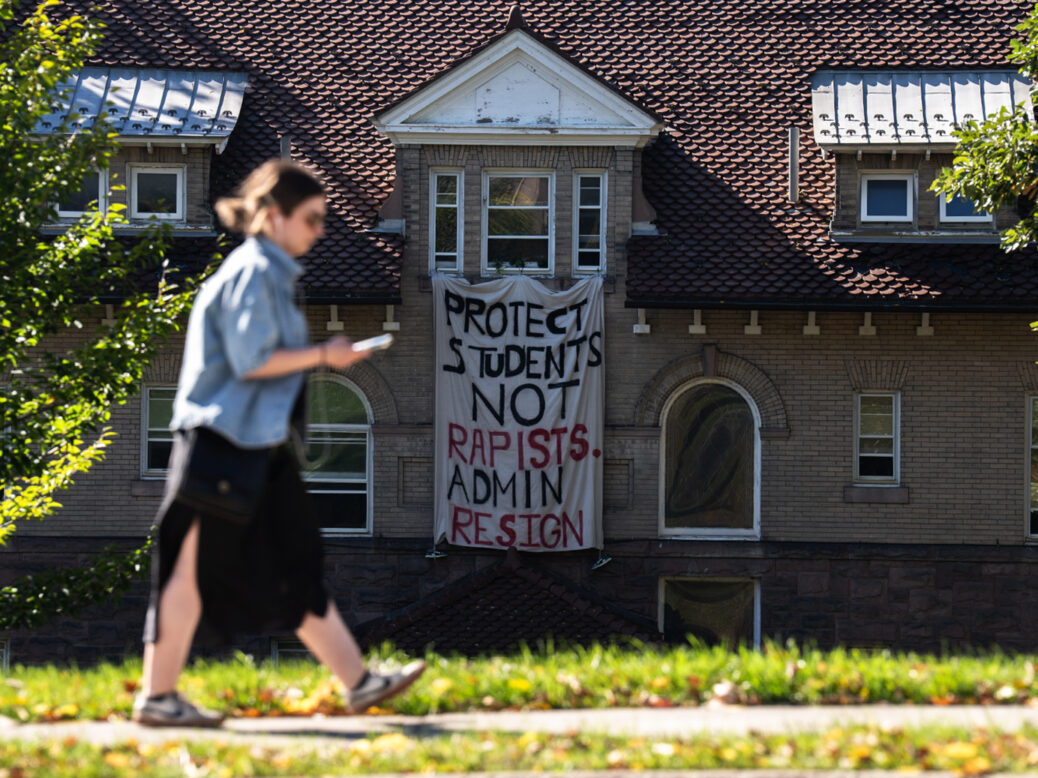
Before the Cornell student who would come to be known as Jane Doe began to see herself as a victim of gang rape, she had thought of herself as one thing first: a “whore”. For a substantial number of the people who have heard about the case since, that is all she will ever be.
It had been just over a week since the Chi Phi fraternity party on 19 October 2024. In the days that followed, a second-year student at Cornell University in upstate New York recounted the events of that night to her roommates and sent friendly messages to the men involved. She was worried about her reputation; people all over campus were talking about her. All she could do was sleep and cry. Her friends were concerned. “I don’t really remember her ever kind of saying that she had said yes to anything that occurred,” one recalled, describing the hours after Jane Doe returned home on the morning of 20 October.
While scrolling through an online messageboard centred on fraternity culture on her campus, Doe came across a disturbing post about that night. “Are Chi Phi brothers Crips or Bloods because I hear they have been doing hella Gang Banging?” it read. “They do drugs and gang r*ped a sophomore,” one user commented. “Report them.”
Now that night was being framed as something she had neither encouraged nor consented to. “That’s the first time I had ever heard the narrative change that I wasn’t a whore and that I was assaulted,” she would later tell investigators.

By 3 November, she had concluded that she had been raped. She alleges that, at the party, seven members of the fraternity sexually assaulted her. She had been drinking and she says the men also encouraged her to take ketamine, leaving her too impaired to consent. She alleges that the men took turns assaulting her over several hours, and encouraged others in a group chat to join in as the assault was taking place. One member allegedly posted that there was “free pussy” upstairs. Someone asked, “Shop still open?” – to which another member replied “Yea”.
She reported the alleged assault to Cornell University Police. “I was a sex doll for all intents and purposes,” she told them. In September 2026, Doe filed a civil lawsuit against the men and Cornell.
The case has been seized upon by the internet in the way that accusations of sexual assault often are: personal politics have coloured the scraps of narrative circulating online, blurring any complexities. To some, the men are violent rapists who took advantage of a woman who was unable to consent. To others, Jane Doe is a liar who regretted her actions and cried rape to salvage her reputation.
Our desire to impose moral certainty on the behaviour of those involved says as much about us as it does about them. Some are willing the men to be found guilty because the case gives form to the helplessness so many victims of sexual assault are left carrying – a chance, perhaps, to see accountability where they have so often found none. In the US, that powerlessness is sharpened by a growing sense that the machinery of justice itself is being eroded by a government that places ever more people beyond consequence. “Justice for Doe” is a proxy for the hope that American justice in general still exists.
That impulse is inverted by those who dismiss Doe’s claims. People have tried to identify her online, posting photographs of her and, in some cases, of women wrongly identified as her. Dasha Nekrasova, a reactionary cultural provocateur, went so far as to say that the woman in the photograph looked “exactly like how you’d think she would”. Meanwhile, #IamJaneDoe spread across social media as women share their own experiences and sought to protect her anonymity.
The early MeToo mantra of “Believe Women” has become something to mock or reject. The result is a perverse narrowing of what counts as credible rape: only the most extensively documented, violent cases – such as that of Gisèle Pelicot – command empathy. Jane Doe’s case, in which she initially participated in sexual activity, willingly drank alcohol, communicated with the accused afterwards and did not initially believe she had been raped, is easy for many to dismiss. Her behaviour becomes evidence against her, rather than part of the messy reality of sexual violence. If Pelicot has become the saint of sexual assault victims, Doe has been cast as their sinner.
And if Pelicot’s case became, for feminists, the ultimate proof that sexual assault remains a pervasive reality – its horror so unambiguous, its moral repugnancy so inarguable – the Cornell case risks becoming the inverse proof for anti-feminists: evidence that the problem has been exaggerated. It is also chaotic, easily ridiculed.
Due process for the accused is essential, but the insistence on it can leave little room for the contradictory, confusing behaviour of an alleged victim. We have reached a point where women are believed only when their accounts are supported by evidence so overwhelming that doubt itself becomes unreasonable. The starting point of “believing women” is now gauche. Ambiguity is an invitation to disbelief and ultimately, dismissal.
Whatever emerges from the litigation of this case, what will matter most to people is not what happened, but what the case – and the woman at its centre – came to be labelled as: a victim or a whore.
[Further reading: Joyce Carol Oates contradicts herself]
Content from our partners



Related


This article appears in the 07 Oct 2026 issue of the New Statesman, The Suspicious Relationship
Join the debate
Subscribe here to comment